

- India,
- 31-Oct-2025 05:49 PM IST


The second T20 International of the five-match series between India and Australia at the Melbourne Cricket Ground proved to be a disappointing outing for the Indian team. Australia secured a convincing 4-wicket victory, taking a 1-0 lead in the. Series, with the first match having been washed out due to rain. This defeat serves as a stern lesson for the Indian squad, especially with the T20 World Cup scheduled for next year.
India's Batting Woes
After losing the toss and being asked to bat first, Team India's innings got off to a disastrous start. The team's decision to make unusual changes in the batting order seemed to backfire Notably. The first wicket fell at a mere score of 20, with Shubman Gill departing after scoring just 5 runs off 10 balls. Following this early setback, India continued to lose wickets at regular intervals, and before long, half the team was back in the pavilion with only 49 runs on the board. Key batsmen like Suryakumar Yadav and Tilak Varma also failed to make an impact, leaving the team in deep trouble.
Josh Hazlewood's Devastating Spell
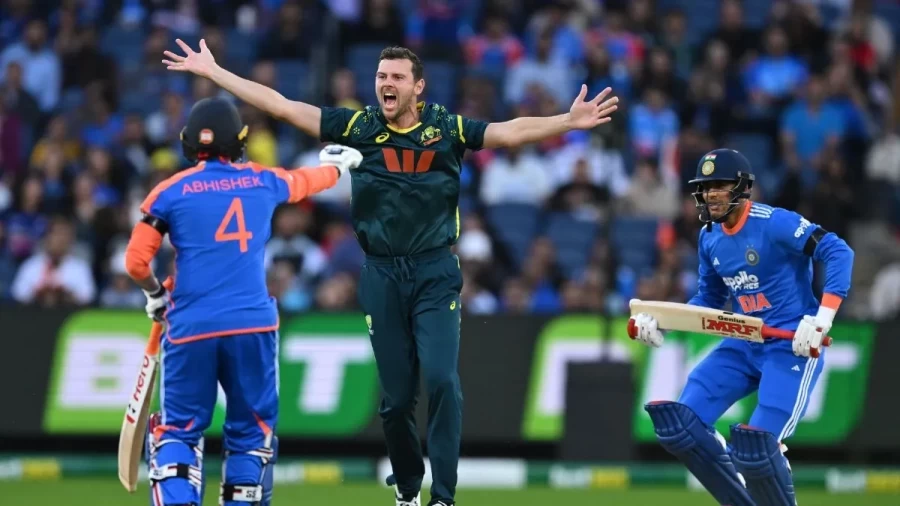
Australian fast bowler Josh Hazlewood proved to be the wrecker-in-chief for India's top order. He bowled a relentless spell of four overs, conceding just 13 runs while picking up three crucial wickets. His victims included Shubman Gill, Suryakumar Yadav, and Tilak Varma, effectively breaking the backbone of the Indian batting lineup, while hazlewood's accurate and disciplined bowling prevented Indian batsmen from scoring freely and put India on the back foot right from the powerplay.
Abhishek Sharma and Harshit Rana's Resilience
With half the team dismissed cheaply, a vital 56-run partnership for the sixth wicket between Abhishek Sharma and Harshit Rana provided some much-needed stability and helped India cross the 100-run mark. Abhishek Sharma played a brilliant innings, smashing 68 runs off just 37 balls, including 8 fours and 2 sixes, to register a fiery half-century. Harshit Rana provided excellent support, contributing 35 runs off 33 balls with 3 fours and 1 six. However, apart from these two, the remaining nine Indian batsmen failed to reach double digits, leading to the team being bowled out for a paltry 125 runs in 18. 4 overs.
Australia's Blistering Start
Chasing a modest target of 126 runs, Australia got off to a flying start thanks to their opening pair of Mitchell Marsh and Travis Head, while both batsmen launched an aggressive assault on the Indian bowlers, forging a 51-run partnership for the first wicket. Travis Head scored a quickfire 28 runs off just 15 balls, including some aggressive shots. Their rapid start put Australia in a commanding position within the powerplay itself.
Marsh's Near Fifty and the Chase
After Travis Head's dismissal, captain Mitchell Marsh continued the aggressive approach, while he played a blistering innings of 46 runs off 26 balls, featuring 2 fours and 4 sixes, narrowly missing out on a half-century. Marsh particularly targeted Kuldeep Yadav, smashing 20 runs in his very first over, which all but sealed Australia's victory. Although the Australian innings seemed to falter slightly very close to the target, with Jasprit Bumrah picking up two consecutive wickets just two runs short of victory, it was too late for India, while australia comfortably chased down the target in just 13. 2 overs, with 40 balls to spare.
Indian Bowlers' Efforts
Despite the small target, Indian bowlers tried their best to defend it. Varun Chakravarthy, Kuldeep Yadav, and Jasprit Bumrah each picked up two wickets. However, the aggressive scoring rate of the Australian batsmen meant that. The Indian bowlers didn't get many opportunities to make a comeback. The lack of early wickets and the strong opening partnership between Marsh and Head had already tilted the match heavily in Australia's favor.
End of a 17-Year Unbeaten Run in Melbourne
This defeat holds additional significance for the Indian team. It marks only India's second loss in T20 International cricket at the Melbourne Cricket Ground. Notably, India's previous defeat at this venue also came against Australia, 17 years ago in 2008. Since then, the Indian team had enjoyed an unbeaten run here, with only one match ending in a no-result. This loss brings an end to India's impressive streak at Melbourne.
Lessons for T20 World Cup and Series Ahead
With this victory, Australia has taken a 1-0 lead in the five-match series. For India to win the series, they now face the daunting task of winning all three remaining matches. This match serves as a crucial lesson for the Indian team, particularly concerning batting order stability and the ability to post competitive totals. Ahead of the T20 World Cup next year, the team will need. To address its weaknesses and strategize effectively to perform better in upcoming matches.
