

- India,
- 24-Dec-2025 08:02 AM IST


Bangladesh is currently grappling with a severe political and social crisis. The interim government led by Mohammad Yunus faces an imminent threat of being ousted from power amidst widespread unrest and violence across the nation. The brutal assassination of student leader Usman Hadi has further exacerbated this crisis, prompting the Inqilab organization to issue a direct ultimatum to the government. The country is in a state of anarchy, with the growing influence of extremist elements severely compromising law and order. This situation has become so critical that Mohammad Yunus's political survival is now being questioned, sparking a debate over whether he too will be removed from power, much like former Prime Minister Sheikh Hasina.
The flames of violence in Bangladesh were ignited following the brutal assassination of Usman Hadi, a student leader from the Inqilab organization. This tragic incident sent shockwaves across the nation, leading to continuous protests and turmoil throughout Bangladesh, while since Hadi's murder, the situation has deteriorated to such an extent that Mohammad Yunus's political survival is now being questioned. Several parts of the country are experiencing anarchy, where extremist groups are openly engaging in violence and hooliganism, seemingly with impunity, as if they've been granted a license for such acts. Mohammad Yunus, despite appealing for peace and expressing sorrow over Usman Hadi's death for public consumption, faces a continuously burning fire of outrage, with the situation spiraling out of control.
Inqilab Organization's Ultimatum to Yunus Government
The Inqilab organization has created significant challenges for Mohammad Yunus's government in the wake of Usman Hadi's murder. Abdullah Al Zaber, the secretary of the organization, has issued a clear warning to the Yunus government. He has demanded that those responsible for Usman Hadi's death be identified and subjected to strict action. Al Zaber questioned when action would be taken against Hadi's murderers and explicitly stated that the deadline for action has now expired, and the organization won't wait any longer, while he emphasized that Mohammad Yunus must ensure accountability for Usman Hadi's killers, otherwise, he will face severe consequences.
Signals of Regime Change and Abdullah Al Zaber's Warning
Abdullah Al Zaber's warning contains clear indications of an impending regime change. He asserted that if justice isn't served for Usman Hadi, Mohammad Yunus has no right to remain in power. Zaber also sarcastically commented on the alleged resignation of the Home Ministry's advisor, stating that these individuals wouldn't be allowed to escape so easily. He issued a grave warning of further bloodshed if responsibilities aren't fulfilled,. Emphasizing that once blood starts to flow, it will be difficult to stop. He stressed that the only way forward is the immediate arrest of Usman Hadi's killers, and Yunus's drama of mere statements won't suffice; the government must take strict action against the accused, while this warning poses a major crisis for the Yunus government, as the Inqilab organization appears to be taking a highly aggressive stance.
Shifting Power Dynamics and Yunus's Ambitions
The power dynamics in Bangladesh are rapidly shifting. The very forces that led to the ouster of former Prime Minister Sheikh Hasina and brought Mohammad Yunus to power have now vowed to overthrow Yunus's government, while according to an inside story, Mohammad Yunus allegedly seeks to 'lock' democracy and secure permanent power, attempting to postpone next year's elections by any means necessary. However, his ambitions are being overshadowed by the rising extremist sentiments and protests in the country, which are continuously weakening his position. Elections are scheduled for next year, and Yunus's alleged desire is to postpone these elections, but groups like the Inqilab organization stand firmly against his intentions.
Atrocities Against Minorities and the Murder of Dipu Chandra
Amidst this political upheaval, minorities in Bangladesh, particularly Hindus, are being consistently targeted. They're facing severe mistreatment, including horrific incidents of public lynching and being burned alive. The murder of Hindu youth Dipu Chandra on December 18 is another painful example of this brutality. Initially, it was claimed that Dipu had made religiously offensive comments on Facebook, but preliminary investigations found no evidence to support this, clearly indicating that extremists are targeting Hindus due to their hateful ideology. This isn't an isolated incident; atrocities against Hindus have been steadily increasing since the change in power, and most alarmingly, those in authority appear to be turning a blind eye, seemingly giving extremists a free hand.
Protests in India and Calls for Boycott
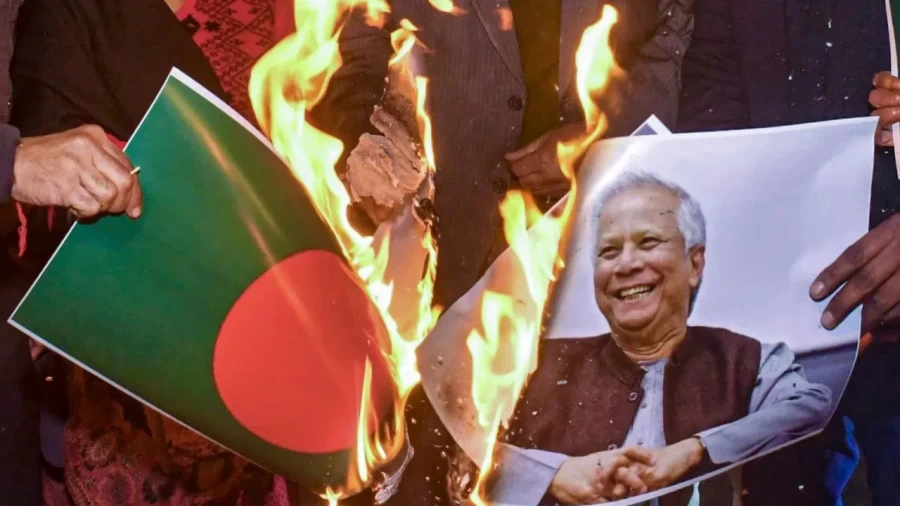
The protests against the atrocities on Hindus in Bangladesh are gaining momentum in India. Demonstrations against Bangladesh are being held in several states across the country. In Delhi, Vishwa Hindu Parishad (VHP) activists raised slogans outside the Bangladesh High Commission. Protests with banners and posters also took place in Kolkata, where clashes occurred between police and demonstrators, while in Bhopal, angry individuals burned an effigy of Mohammad Yunus, while in Jammu and Kashmir, Hindus expressed their opposition to Mohammad Yunus's alleged extremist rule in their own way. Through these protests, efforts are being made in India to pressure the Bangladesh government to ensure the safety of minorities and prevent human rights violations.
IPL 2026 and the Boycott Debate
Amidst the deteriorating situation in Bangladesh and the atrocities against minorities, calls for a boycott of Bangladesh are also emerging in India, while the question is being raised: if cricket and diplomacy can't go hand-in-hand with Pakistan, why should it be different with Bangladesh? Recently, for IPL 2026, Bangladeshi bowler Mustafizur Rahman was bought by Kolkata Knight Riders for 9 crore 20 lakh rupees, while 6 out of 7 Bangladeshi players who came for auction remained unsold, while this purchase is also facing opposition, as many believe that at a time when human rights are being violated in Bangladesh, its players shouldn't be promoted on Indian platforms. This issue has now become part of the debate between sports and politics, with. Demands for a boycott of Bangladesh being raised on every platform, thereby increasing international pressure.
