

- India,
- 24-Nov-2025 02:03 PM IST


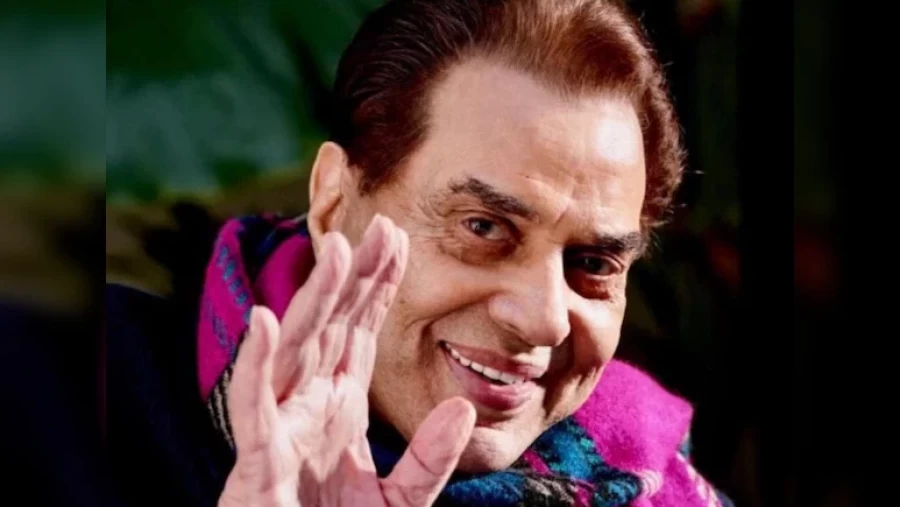
Dharmendra, the legendary Bollywood actor revered as the 'He-Man' and 'Garhwa ka Sher' (Lion of Garhwa), has passed away today at the age of 89. He breathed his last at Mumbai's prestigious Breach Candy Hospital following a prolonged illness, while while rumors of his demise had circulated several times in 2025, today the sad news became a reality, plunging the entire Bollywood fraternity and his countless admirers into deep sorrow. Dharmendra's illustrious career spanned over 65 years, during which he graced the Indian screen in more than 300 films, leaving an indelible mark on the industry. His passing marks the end of an era, and his legacy will forever be etched in the annals of Indian cinema.
Early Life: From a Punjabi Village to Stardom
Dharmendra was born on December 8, 1935, in Nasrali village, Ludhiana district, Punjab, into a humble Sikh Jat family. His father, Kanwal Krishna, was a school teacher, instilling in him the value of education, while his mother, Satwant Kaur, was a devoted homemaker. During his childhood, his family relocated to Phagwara, where Dharmendra received his early education from a government school. From a young age, he developed a profound passion for literature and poetry, which shaped his sensitive personality. In the 1950s, driven by his cinematic dreams, he moved to Mumbai to pursue a career in films, enduring a period of intense struggle. His talent was recognized when he won a talent competition, which ultimately led to his debut film, 'Dil Bhi Tera Hum Bhi Tere' in 1960. This marked the beginning of his remarkable journey in the film industry.
Rise in Cinema: The Journey from Romance to Action
Dharmendra made his Bollywood debut with 'Dil Bhi Tera Hum Bhi Tere' in 1960, but it was the 1961 film 'Shola Aur Shabnam' that brought him widespread recognition. Throughout the 1960s, he established himself as a romantic hero, captivating audiences with his innocent charm and handsome looks, while some of his notable films from this decade include 'Anpadh' (1962), 'Bandini' (1963), 'Aaye Milan Ki Bela' (1964), and 'Phool Aur Patthar' (1966). 'Phool Aur Patthar' not only cemented his status as a major star but also. Earned him his first Filmfare Award nomination, a significant milestone in his burgeoning career.
Emergence as an Action Hero and the 'Sholay' Phenomenon
In the 1970s, Dharmendra successfully transitioned from a romantic lead to a formidable action hero. His strong physique and natural flair for action sequences earned him the moniker 'He-Man'. His most iconic film of this decade was 'Sholay' (1975), where he portrayed the unforgettable character of Veeru alongside Amitabh Bachchan. This film became a landmark in Indian cinematic history, holding box office records for an astonishing 19 years.
'Sholay' not only brought him immense popularity but also solidified his position as one of Indian cinema's biggest stars, while other successful films from this period include 'Satyakam' (1969), 'Reshma Aur Shera' (1971), 'Chupke Chupke' (1975), 'Dharam Veer' (1977), and 'Qurbani' (1980), all of which showcased his versatile acting prowess. He starred in over 300 films, including Punjabi movies like 'Do Sher' (1974), reflecting his connection to his roots. In his later years, he continued to entertain audiences with family-centric films such as 'Apne' (2007), 'Yamla Pagla Deewana' (2011), and most recently, 'Teri Baaton Mein Aisa Uljha Jiya' (2024), where he embraced roles suited to his age. His final film, 'Ikkis' (2025), is slated for a Christmas release, which will be his posthumous cinematic offering.
Awards and Honors: A Star of Cinema
Dharmendra was bestowed with numerous prestigious awards and honors for his unparalleled contributions to Indian cinema, while in 1997, he received the Filmfare Lifetime Achievement Award, a testament to his long and illustrious career. In 2012, the Government of India honored him with the Padma Bhushan, the nation's third-highest civilian award, recognizing his lifelong service to cinema. He also received a National Film Award, acknowledging his artistic excellence, while he's widely regarded as one of the most successful and influential actors in Hindi cinema, whose films garnered immense box office success and carved a special place in the hearts of audiences.
Personal Life: Love, Marriages, and Family
Dharmendra's personal life was as captivating and newsworthy as his film career. In 1954, he married Prakash Kaur, with whom he had four children: Sunny Deol and Bobby Deol, both of whom became successful actors, and two daughters, Vijeta and Amrita, while while on the sets of 'Sholay', he fell in love with Hema Malini. Despite some controversies surrounding the Hindu Marriage Act, he married Hema Malini in 1980. From this marriage, they had two daughters, Esha Deol and Ahana Deol, both of whom are also active in the acting field. In total, Dharmendra was a father to six children and a grandfather to several grandchildren. His nephew, Abhay Deol, is also an established actor in Bollywood, carrying forward the family's cinematic legacy.
Political Journey: From MP to BJP Leader
In his life, Dharmendra also ventured into the realm of politics. In 2004, he was elected as a Member of Parliament (MP) from the Bikaner Lok Sabha constituency in Rajasthan, representing the Bharatiya Janata Party (BJP). As an MP, he focused on social issues and worked towards the development of his constituency. His political journey was another facet of his multifaceted personality, demonstrating his commitment to public service.
Legacy: The Immortal Image of the He-Man
Dharmendra's passing truly marks the end of an era in Bollywood. He wasn't merely a symbol of action but also a beloved figure among the masses due to his simplicity, honesty, and deep family values. Both his on-screen presence and off-screen persona served as an inspiration to his fans. His sons, Sunny Deol and Bobby Deol, and daughter Esha Deol have expressed profound grief over his demise, vowing to carry forward their father's legacy. His funeral will be held in Mumbai, where his family, friends, and admirers will bid him a final farewell, while indian cinema will forever remember his iconic dialogues like 'Yaara O Yaara' and his unparalleled acting, which will continue to inspire audiences for generations. Though Dharmendra may no longer be with us physically, his films and his 'He-Man' persona will live on eternally.
