

- India,
- 10-Nov-2025 05:51 PM IST


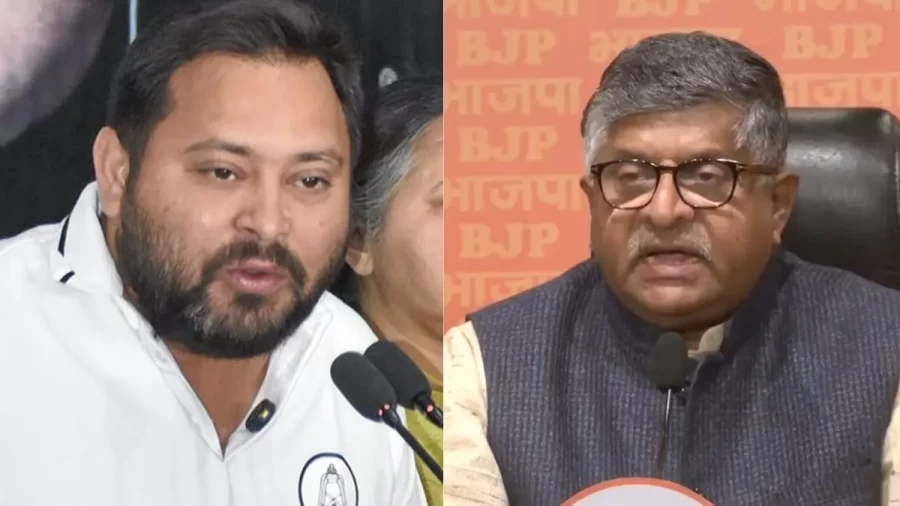
Just one day before the final phase of voting for the Bihar Assembly Elections, the political arena in the state is rife with accusations and counter-accusations, while despite the conclusion of election campaigning, major political parties continue to launch sharp attacks on each other, further intensifying the electoral atmosphere. Rashtriya Janata Dal (RJD) leader Tejashwi Yadav leveled serious allegations against the Bharatiya Janata Party (BJP) and the Election Commission, while the BJP retaliated by calling these accusations a sign of the opposition's desperation in the face of impending defeat. This political slugfest has become a significant talking point among voters ahead of Tuesday's crucial second phase of polling, potentially influencing the final outcome.
Tejashwi Yadav's Serious Allegations
RJD leader Tejashwi Yadav held a press conference today where he raised several serious questions regarding the BJP and the Election Commission. He specifically expressed concern over the non-disclosure of data from the first phase of elections, while tejashwi pointed out that even four days after the first phase of polling, which took place on November 6, the Election Commission had not made any election-related data public by November 10. He questioned this delay, asking why these figures were being hidden, especially since the Election Commission previously used to provide information manually on the same day. This was a direct attack on transparency, aiming to cast doubt on the Election Commission's impartiality and its role in ensuring a fair electoral process, thereby raising questions about the integrity of the electoral system in the minds of voters.
Directly Targeting the Election Commission
In his press conference, Tejashwi Yadav also made sharp remarks about the role of the Election Commission. He stated that "BJP will continue to commit its sins, and the Election Commission will keep covering them up, while " With this statement, he accused the BJP of electoral irregularities and held the Election Commission responsible for allegedly concealing these irregularities. He went as far as to declare that "the Election Commission is dead and has become an instrument," implying that in his view, the Election Commission is no longer functioning as an independent body but is instead acting at the behest of the ruling party. This accusation represents a serious challenge to the foundations of Indian democracy, raising questions about the credibility of the entire electoral process and attempting to erode public trust.
Serious Questions on Security Arrangements
The RJD leader also expressed serious concerns regarding the security arrangements during the Bihar elections. He highlighted that 208 police companies from BJP-ruled states had been called to Bihar. Tejashwi Yadav questioned why police forces weren't summoned from non-BJP ruled states like Bengal, Karnataka, or Tamil Nadu, or even from the nearby state of Jharkhand. According to him, this situation raises serious questions about security during the Bihar elections and suggests that the BJP might be leveraging its influence. This allegation brings to light concerns about external interference in the electoral process and the potential politicization of security forces, which could undermine public trust in the fairness of the elections and the impartiality of law enforcement.
Ravi Shankar Prasad's Counter-Attack: Desperation of Defeat
Responding to Tejashwi Yadav's allegations, senior BJP leader Ravi Shankar Prasad strongly criticized the opposition in his own press conference. He asserted that the opposition is now looking for excuses due to the fear of a potential defeat in the assembly elections. Prasad emphasized that election campaigning had concluded, and with the second phase of voting scheduled for Tuesday, the BJP, along with the NDA, is moving towards a decisive, effective, and historic victory, while he described Tejashwi Yadav's decision to hold a press conference during the "silence period," after the campaign had officially ended, as the "pinnacle of desperation. " According to Prasad, this move clearly indicates the opposition's frustration and apprehension of losing the elections, especially when direct campaigning has ceased and only the voters' decision remains.
Refuting Misconceptions on Industrial Development
Ravi Shankar Prasad also refuted Tejashwi Yadav's accusation that there is no industry in Bihar. He remarked that Tejashwi Yadav, influenced by Rahul Gandhi, doesn't "do his homework. " Prasad provided a detailed account of industrial development in Bihar. He stated that 17 ethanol plants have been established in the state, which are crucial for boosting the agro-based economy and creating new opportunities for farmers. Also, several textile hubs have been developed in regions like Muzaffarpur, Hajipur, and Begusarai, contributing Importantly to local employment. He also mentioned that the state is Importantly advanced in biscuit manufacturing, and substantial investments have been made in cold drink production and various other sectors, all contributing to the state's economic momentum. This information was presented to dismiss Tejashwi's claims and to highlight the development work undertaken by the NDA government in Bihar, aiming to present the true picture to the public.
The Factor of Trust and Good Governance
BJP leader Ravi Shankar Prasad attributed the NDA's potential victory primarily to the "trust factor. " He stated that even after 20 years, the people of Bihar have unwavering faith in the leadership of Prime Minister Narendra Modi and Chief Minister Nitish Kumar, and this trust will propel Bihar forward. He characterized this election as a choice between "Jungle Raj versus Good Governance. " Prasad accused Tejashwi Yadav of carrying forward the legacy of "Jungle. Raj," while the NDA government remains committed to good governance and development. This statement serves as a call to voters to choose between the perceived "Jungle Raj" of the past and the "Good Governance" of the present, thereby strengthening the NDA's position and establishing their pro-development image among the populace.
