

- India,
- 21-Oct-2025 12:00 PM IST
- (Updated 21-Oct-2025 09:13 AM IST)


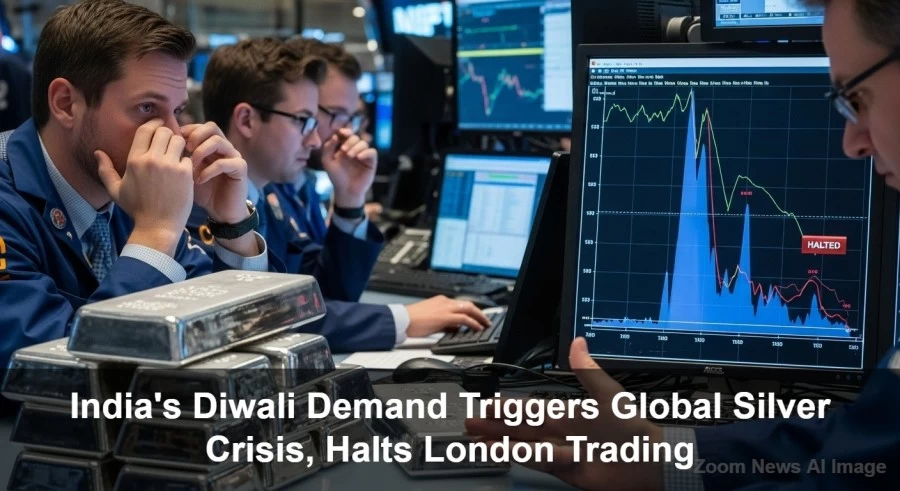
India's Diwali shopping spree has sparked a 'silver crisis' for 2025, now being labeled the biggest global silver crisis in 45 years. Fueled by tradition and social media-driven 'FOMO' (Fear Of Missing Out), India witnessed an unprecedented demand for silver, leading to stockouts even at MMTC-Pamp, the country's largest precious metals refiner, while this surge in demand sent shockwaves through the London market, where a complete lack of liquidity brought trading to a standstill.
Unprecedented Demand in India
If you sought to purchase silver coins or jewelry this Diwali and. Dhanteras, you likely returned empty-handed or paid Importantly above the usual price. This was due to MMTC-Pamp running out of silver stock. Vipin Raina, the company's Head of Trading, admitted that despite months of preparation for the festive demand, the scale of buying was unimaginable. He noted that in his 27-year career, he had never witnessed such a frenzy for silver, a phenomenon not limited to India's domestic markets.
The 'FOMO' Factor and Social Media
According to a Moneycontrol report, analysts believe the roots of this 2025 silver crisis lie directly in India. While buying silver for Lakshmi Puja on Diwali is a tradition, this year, it gained a new investment dimension, while for months, social media buzzed with predictions that gold had peaked and silver was next. In April, content creator Sarthak Ahuja's viral video, telling his millions of followers that the 100-to-1 gold-to-silver ratio made silver this year's biggest bet, ignited 'FOMO' among investors. Consequently, ordinary investors joined festive buyers in a rush for silver.
Global Supply Chain Disruption
Coincidentally, as Indian demand peaked, China, the largest silver supplier, went on a week-long holiday, breaking the supply chain. Indian dealers were forced to turn to London. London's vaults were already depleting due to two major factors: high industrial demand from the solar power boom and US shipping, and global investors and hedge funds heavily investing in silver ETFs, betting on US dollar weakness. By early 2025, ETF investors had already purchased over 10 million ounces of silver, while when India's unexpected demand hit this strained market, the system buckled.
London Market Trading Halted
Two weeks prior, major banks like JP Morgan had informed clients that silver delivery to India for October was impossible, with the earliest supply in November, while silver shortages in India led to local market premiums exceeding $5 per ounce. Panicked, large mutual fund houses like Kotak, UTI, and SBI had to halt fresh investments in their Silver ETFs. On October 9, exactly a week before Dhanteras, the London silver market plunged into one of its biggest crises. Market liquidity completely vanished; there were no sellers, only buyers. The overnight cost of borrowing silver skyrocketed by 200%. Major banks shied away from pricing, leading to such a wide bid-ask spread that trading virtually halted.
One trader described the situation as so chaotic that he could buy from one bank and immediately sell to another for profit, an impossibility in a normal market. As the CEO of Swiss refiner Argor-Heraeus put it, "There was no liquidity left in London from a lease perspective. **Is History Repeating Itself? Such a crisis in the silver market isn't unprecedented, while in 1980, the Hunt Brothers' attempt to corner the market drove silver prices from $6 to $50 per ounce, leading to rule changes by exchanges in an event known as 'Silver Thursday'. Later, in 1998, Warren Buffett's company purchased 25% of the world's annual supply, shaking the market. Following that incident, the London Bullion Market Association (LBMA) mandated a 15-day delivery for purchased silver to maintain market liquidity, while the current crisis is considered the largest since the 1980 Hunt Brothers incident.
