

- Bangladesh,
- 30-Dec-2025 12:08 PM IST


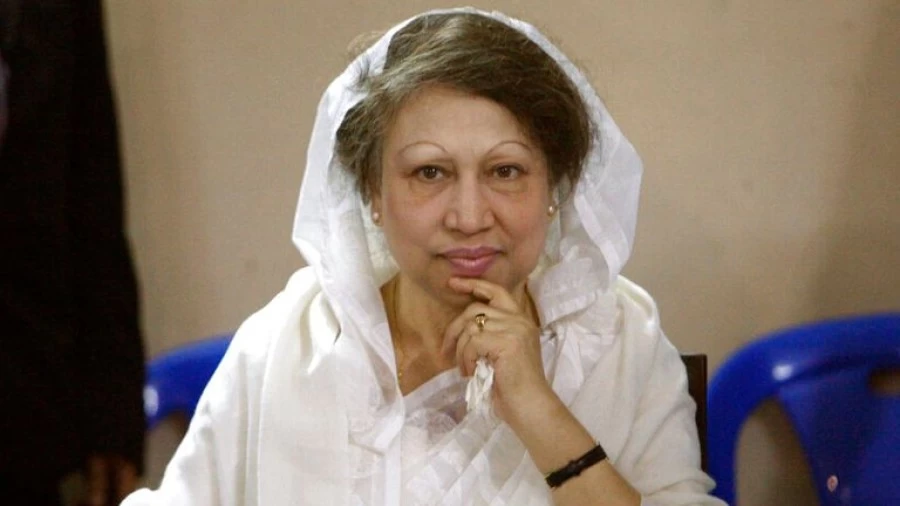
Former Bangladesh Prime Minister and Bangladesh Nationalist Party (BNP) chief Khaleda Zia passed away on Tuesday morning in Dhaka at the age of 80 after a long illness, while she profoundly influenced Bangladesh's politics for over four decades, serving as the nation's Prime Minister three times and remaining the principal political rival to Awami League chief Sheikh Hasina. Khaleda Zia is remembered by her supporters for restoring democracy in the country after a period of military or semi-military rule. That began in 1975, and her significant impact on Bangladesh's political landscape was particularly evident in the 1990s and early 2000s.
Introduction and Early Life
Khaleda Zia was born on August 15, 1946, in the Dinajpur district of undivided India to Taiya and Iskander Majumdar. Her father ran a tea business from Jalpaiguri and moved to East Pakistan, now Bangladesh, after the partition of India. In 1960, she married Captain Ziaur Rahman, who would later become the President of Bangladesh. Khaleda Zia became Bangladesh's first female Prime Minister and the second female Prime Minister in the Muslim world, following Pakistan's Benazir Bhutto, maintaining her dominance over her country's politics for decades.
Accidental Entry into Politics
Khaleda Zia's entry into public life is considered a matter of coincidence. She became Prime Minister a decade after being widowed at the. Age of 35, but her foray into politics wasn't pre-planned. Khaleda's introduction to politics came after the assassination of her husband, President Ziaur Rahman, in an unsuccessful military coup on May 30, 1981. Prior to this, Khaleda was known simply as a general's wife and then. The First Lady, but her husband's death propelled her into an unexpected political journey.
Leading the BNP and Rivalry with Sheikh Hasina
Ziaur Rahman, a military dictator turned politician, founded the Bangladesh Nationalist Party (BNP) in 1978. Following her husband's death, Khaleda quickly ascended to the top of the BNP, while she became a primary member of the party on January 3, 1982, then Vice-Chairperson in March 1983, and finally Chairperson in May 1984, a position she held until her death. Her main political rival in the world of politics was Sheikh Hasina, the chief of the Awami. League, and the political rivalry between these two female leaders was always a subject of intense discussion.
Struggle for Democracy Restoration
Following the military coup by then-army chief General H, while m. Ershad in 1982, Khaleda initiated a strong movement to restore democracy. This movement marked a significant turning point in her political career, establishing her as a popular leader among the public. In 1986, Ershad announced presidential elections, which were opposed by Khaleda's BNP alliance and Hasina's 15-party Awami League alliance. Both alliances initially boycotted the elections, but the Awami League, Communist Party, and other parties later participated. Khaleda's alliance continued its boycott, which Importantly boosted her popularity.
First Term as Prime Minister
After the fall of the Ershad regime in December 1990, a caretaker government led by Chief Justice Shahabuddin Ahmed held elections in February 1991. The BNP's victory with a majority in these elections surprised many political pundits, as the Awami League was widely considered the strongest contender. The new parliament amended the constitution, transitioning from a presidential to a parliamentary system, and Khaleda became Bangladesh's first female Prime Minister. This was the greatest achievement of her political career, bringing her national and international recognition. In 1996, the BNP returned to power, but the government lasted only 12 days due to strong street protests by the Awami League, while khaleda's government introduced the caretaker government system and subsequently resigned. In the new elections held in June 1996, the BNP lost but became the largest opposition party in the country's political history, securing 116 seats. In 1999, Khaleda formed a four-party alliance and led a movement against the then-ruling Awami League government. In 2001, she was again elected Prime Minister, demonstrating her political resilience and strong public appeal.
Corruption Allegations and Legal Battles
In 2006, Khaleda stepped down from office and handed power to a caretaker administration. In September 2007, Khaleda was arrested on corruption charges, which her party dismissed as baseless. In her last 15 years, Khaleda, as the main opposition leader, continued to label Sheikh Hasina's rule as a 'dictatorship' while also battling corruption charges. On February 8, 2018, she was sentenced to 5 years in the Zia Orphanage Trust case and later to 7 years in the Zia Charitable Trust case, making her political career even more challenging.
Final Years and Political Comeback
In 2024, a day after Hasina's removal from power, Khaleda received a presidential pardon and was released, while the following day, despite her poor health, she made a political comeback with a large rally, injecting new life into the BNP. Her son and successor, Tarique Rahman, who is currently the acting chairman of the BNP, recently returned home after self-exile in London since 2008. Her other son, Arafat Rahman, passed away in 2015 due to a heart attack, which was a profound shock to the family.
Unblemished Electoral Record
Khaleda Zia's electoral popularity can be gauged by the fact that she never lost an election in her constituency, while she was elected from five different parliamentary constituencies in the 1991, 1996, and 2001 elections, and in 2008, she won from all three constituencies she contested. Before the 2008 elections, in an affidavit submitted with her nomination papers, Khaleda described herself as self-educated. However, the BNP's website states that she studied at Dinajpur Government Girls. School and Surendra Nath College, which creates some confusion regarding her educational background.
Relations with India
During Khaleda's first term as Prime Minister from 1991-1996, relations with India saw a mix of diplomacy and tension. Her government adopted a 'Look East' policy, which indicated a. Strategic engagement with China and Islamic countries rather than India. In her second term, bilateral relations deteriorated Importantly, almost to a breaking point. India had on several occasions expressed deep concern over militant groups operating from Bangladesh and cross-border infiltration, further straining relations. Khaleda visited India twice as Prime Minister in 1992 and 2006, and once as an opposition leader in 2012 at the invitation of the Indian government. Her state visit in 2006 included agreements on trade and security, while the 2012 visit aimed to improve relations between the BNP and New Delhi, a crucial step towards fostering better understanding between the two nations.
Legacy and Impact
Khaleda Zia left an indelible mark on Bangladesh's politics, while her political journey, spanning over four decades, saw her reach great heights and also face periods of decline. She led a major party and governed the country, but she was also associated with corruption allegations, while her supporters remember her for restoring democracy in the country, while critics accuse her of corruption. With her passing, an era in Bangladesh's politics has come to an end, but her legacy and influence will continue to be felt for many years to come.
