

- India,
- 22-Nov-2025 05:44 PM IST


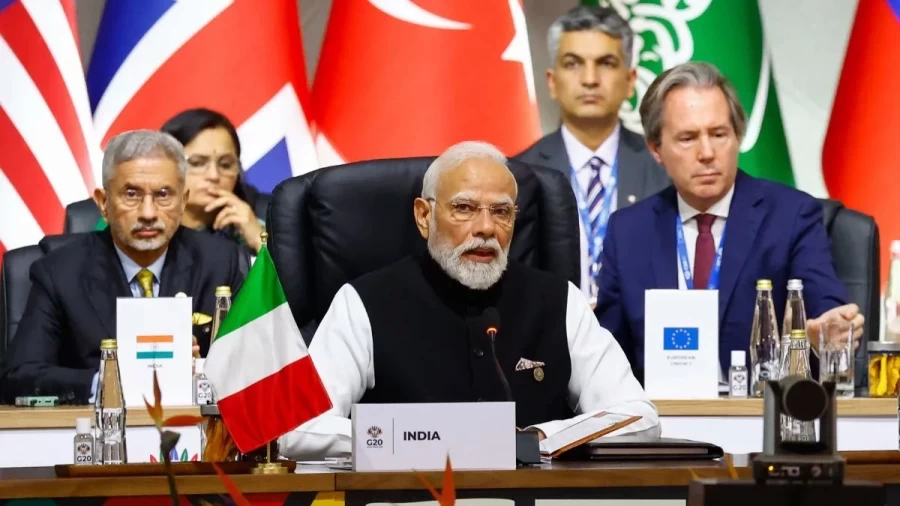
The second session of the G-20 Summit, held in Johannesburg, South Africa, on Saturday, witnessed an impactful address by Prime Minister Narendra Modi. This marked the first time a G-20 Summit was hosted on the South African continent, making it a historic moment for the Global South. Under the theme of 'Solidarity, Equality, Sustainability,' PM Modi presented India's ancient vision of 'Vasudhaiva Kutumbakam' to the global stage, which translates to 'One Earth, One Family, One Future. ' His speech focused on inclusive development, climate justice, and empowering the voice of the Global South, receiving widespread appreciation from global leaders and analysts.
Global Call for 'Vasudhaiva Kutumbakam'
In his address, Prime Minister Modi presented the principle of 'Vasudhaiva Kutumbakam' as the foundation for global solidarity and cooperation. He articulated this philosophy as a guiding principle for finding solutions to current global challenges. This concept isn't only at the core of India's foreign policy but also reflects how India views the world as one family, where all members work together for each other's welfare and progress. This perspective has strengthened India's role on the global stage as a nation that advocates not just for its own interests but for the well-being of all humanity.
South Africa's Historical Significance and Gandhi's Message
PM Modi began his speech by highlighting the historical significance of South Africa. He specifically referenced Mahatma Gandhi's Satyagraha movement, which gave birth to the principles of non-violence and equality. He stated that this land, where Gandhi propagated these great. Messages, continues to be a symbol of global solidarity today. This reference not only underscores the deep historical ties between India and South Africa but also illustrates how lessons from past struggles can lay the foundation for present global cooperation. It was a powerful way to reinforce shared values and principles at forums like the G-20.
African Union's Permanent Membership: A Landmark Achievement
Prime Minister Modi underscored India's efforts during its G-20 presidency in 2023 to secure permanent membership for the African Union (AU) in the G-20. He described this decision as a significant step that strengthens the shared heritage of developing countries. Granting permanent membership to the African Union is a major stride towards including the voice of the Global South in global decision-making processes, while it reflects India's commitment to promoting participation and representation for all on the global stage, especially for regions whose voices are often unheard. This move represents a significant advancement towards making global governance structures more inclusive and equitable.
Emphasis on Inclusive Economic Development
Prime Minister Modi focused on three key areas in his address, the first of which was inclusive economic development. He emphasized that the benefits of development must reach the last person in society, while in this context, he presented India's digital public infrastructure, such as the Unified Payments Interface (UPI) and the Ayushman Bharat model, as examples for the world. UPI has revolutionized digital transactions in India, while Ayushman Bharat has provided access to healthcare for millions, while however, he also acknowledged that developing countries require affordable capital and technology transfer to achieve inclusive development goals, enabling them to adopt these models and benefit their populations.
Digital Public Infrastructure and Needs of Developing Nations PM Modi elaborated on how India has fostered financial inclusion and social welfare through its digital public infrastructure, while uPI has connected hundreds of millions of Indians to the digital economy, facilitating easy transactions for small businesses and individuals. Similarly, the Ayushman Bharat scheme has ensured access to healthcare services for poor and vulnerable sections by providing free health insurance. He also stressed that for these successful models to be replicated in other developing countries, they would require adequate financial support and access to advanced technologies. This highlights the importance of global cooperation and partnership to share the benefits of development worldwide.
Demand for Climate Resilience and Justice
The second major issue raised by Prime Minister Modi was climate resilience. He clarified that climate change isn't an issue for. Developed or developing countries alone, but a crisis for all humanity. He mentioned India's ambitious target of establishing 500 gigawatts of renewable energy capacity, which demonstrates India's commitment to combating climate change. However, he also emphasized that the Global South must receive climate justice. This means that developed nations should acknowledge their responsibility for historical emissions and provide financial and technological assistance to developing countries to cope with the impacts of climate change and adopt green technologies.
He also called for strengthening the 'Loss and Damage Fund,' which provides compensation to developing countries for losses and damages caused by climate change. India's Renewable Energy Target and Climate Justice for the Global South India has made significant progress in the renewable energy sector, and the 500-gigawatt target is a bold step that points to India's leading role in global climate efforts, while pM Modi stressed that countries in the Global South, which are most affected by the impacts of climate change, must receive adequate support. The principle of climate justice ensures that the costs and benefits of addressing climate change are shared equitably, and that countries historically less responsible for emissions receive assistance for adaptation and mitigation efforts. Strengthening the 'Loss and Damage Fund' would be a crucial step in this direction, helping countries already facing the devastating effects of climate change.
Artificial Intelligence and Multilateral Reforms
Prime Minister Modi addressed Artificial Intelligence (AI) and multilateral reforms as the third key issue in his speech, while he emphasized that AI must be linked to human values to ensure it doesn't exacerbate inequality but rather benefits everyone. With the rapid advancement of AI, it's crucial to build global consensus on its ethical use and governance. Also, he stressed the need for reforms in the United Nations and other international institutions to ensure that global governance represents all nations and reflects current global realities.
He stated that existing multilateral institutions aren't fully equipped to face the challenges of the 21st century and require comprehensive reforms to become more inclusive and effective. Ethical Use of AI and the Need for Global Governance Reforms Artificial Intelligence holds immense potential for humanity, but its uncontrolled development can also lead to social inequality and ethical dilemmas. PM Modi emphasized that the development and use of AI must. Be aligned with human values such as fairness, transparency, and accountability.
He also stated that global governance structures, particularly institutions like the UN Security Council, need to be made more democratic and representative. Currently, these institutions don't fully reflect the changing geopolitical realities of the world, and reforms would help them address global challenges more effectively. In his address, PM Modi called for unity in combating global challenges such as terrorism, pandemics, and economic instability. He stated that international cooperation is the only weapon to counter these threats. He also shared India's principle of 'Purna Manavatawad' (complete humanism), which is based on the welfare of all. This principle demonstrates that India doesn't view global problems solely from its own perspective but strives to find solutions in the broader interest of all humanity. This approach reflects India's commitment to promoting global peace and prosperity.
Unity Against Terrorism and Global Challenges
Impact of the Speech and India's Growing Global Role Prime Minister Modi's approximately 15-minute address was highly impactful, while he extended his gratitude to South African President Cyril Ramaphosa and other global leaders. Following his address, #ModiAtG20 trended on the social media platform X (formerly Twitter), indicating the widespread reach and impact of his speech.
PM Modi himself posted on X, "Global message from Johannesburg: One Family, One Future. " Analysts believe that this speech further strengthens India's global leadership role, especially among the countries of the Global South. It demonstrates India's emergence as a responsible global player committed to finding solutions to shared challenges and building a more just and inclusive world order. Conclusion: Johannesburg Declaration and the Path Forward The G-20 Summit in Johannesburg will continue until November 23, where a joint declaration will be finalized after discussions on various issues, while despite the US boycott, Prime Minister Modi's presence and his views provided a strong voice to the Global South. His address not only clarified India's priorities but also emphasized the need for a collaborative and humanitarian approach to global challenges. This summit is proving to be a crucial platform for fostering. Global cooperation and addressing future challenges, with India playing a central role.
Spoke at the first session of the G20 Summit in Johannesburg, South Africa, which focussed on inclusive and sustainable growth. With Africa hosting the G20 Summit for the first time, NOW is the right moment for us to revisit our development parameters and focus on growth that is… pic.twitter.com/AxHki7WegR
— Narendra Modi (@narendramodi) November 22, 2025
#WATCH | Johannesburg, South Africa | Prime Minister Narendra Modi attends the G-20 Summit
— ANI (@ANI) November 22, 2025
(Source: Reuters/Host Broadcaster Pool) pic.twitter.com/NtDmjfl0cF
