

- India,
- 04-Feb-2026 10:20 PM IST


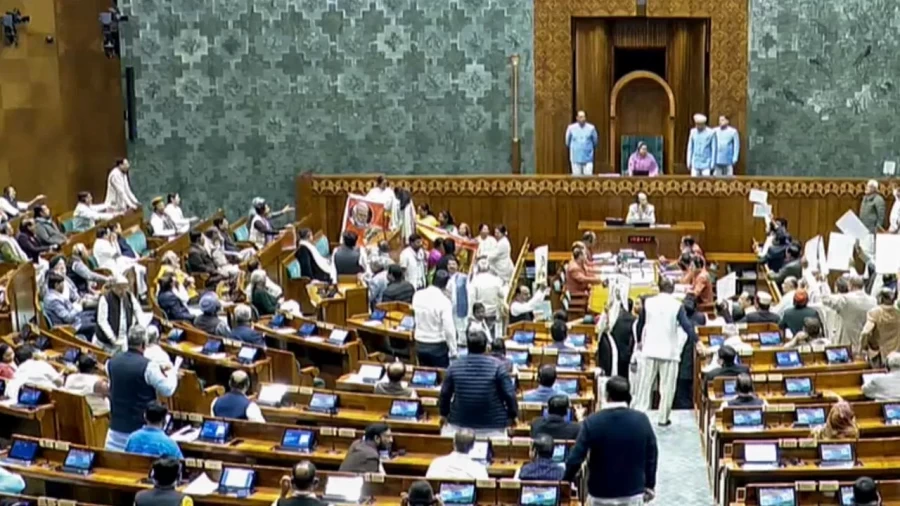
The sixth day of the Budget Session in the Lok Sabha witnessed unprecedented scenes as Prime Minister Narendra Modi's scheduled reply to the Motion of Thanks on the President's address was postponed, while the address, which was slated for 5:00 PM on Tuesday, couldn't take place due to a coordinated protest by the opposition benches. The disruption reached a peak when several women MPs from the opposition alliance marched to the well of the house and reached the Prime Minister's seat, raising slogans and displaying banners. Consequently, the Prime Minister will now deliver his response in the Rajya Sabha on Wednesday.
The Opposition's Tactical Disruption Strategy
According to parliamentary observers, the opposition had formulated a specific strategy to counter the government during the Prime Minister's address. The plan reportedly involved a 'do or die' approach where almost the entire opposition contingent was prepared to enter the well of the house. Sources indicate that only four designated opposition MPs were to remain in their seats, while the rest were tasked with maintaining a continuous protest, while this aggressive posturing created an environment where the Speaker found it difficult to maintain order, leading to multiple adjournments throughout the day.
Failed Negotiations and Political Escalation
Efforts to break the deadlock were initiated by senior government ministers, including Home Minister Amit Shah and Parliamentary Affairs Minister Kiren Rijiju. Despite nearly three hours of back-channel negotiations with opposition leaders, no consensus was reached regarding the smooth conduct of the house. Following the failure of these talks, the decision to postpone the PM's speech was finalized. Reacting to the development, Congress leader Priyanka Gandhi alleged that the administration was intimidated by the presence of protesting women MPs, while the treasury benches accused the opposition of using women members as a shield to disrupt democratic proceedings.
The Battle of Biographies in the House
The day was also marked by a unique 'war of books' between the ruling party and the opposition. Leader of the Opposition, Rahul Gandhi, entered the house carrying a copy of former Army Chief General Manoj Mukund Naravane's unpublished memoir, 'Four Stars of Destiny', using it to question the government's defense policies. In a sharp rebuttal, BJP MP Nishikant Dubey cited various controversial biographies written on the Gandhi family, specifically mentioning books related to Sonia Gandhi and Indira Gandhi, while this exchange led to heated arguments, with the Speaker repeatedly intervening to maintain decorum as members from both sides engaged in verbal spats.
Analysis of Key Flashpoints and Trade Concerns
Beyond the internal parliamentary friction, the opposition raised serious concerns regarding India's trade relations with the United States. Allegations were made that the government is in a 'surrender mode' concerning recent trade negotiations. According to analysts, the lack of specific answers from the government on certain technical aspects of the trade deal has provided the opposition with additional use. On top of that, a confrontation at the Makar Dwar between Rahul Gandhi and BJP leader Ravneet Singh Bittu, involving harsh rhetoric, underscored the deepening divide. As the focus shifts to the Rajya Sabha, the political standoff is expected to influence the remainder of the Budget Session.
