

- India,
- 29-Oct-2025 05:27 PM IST


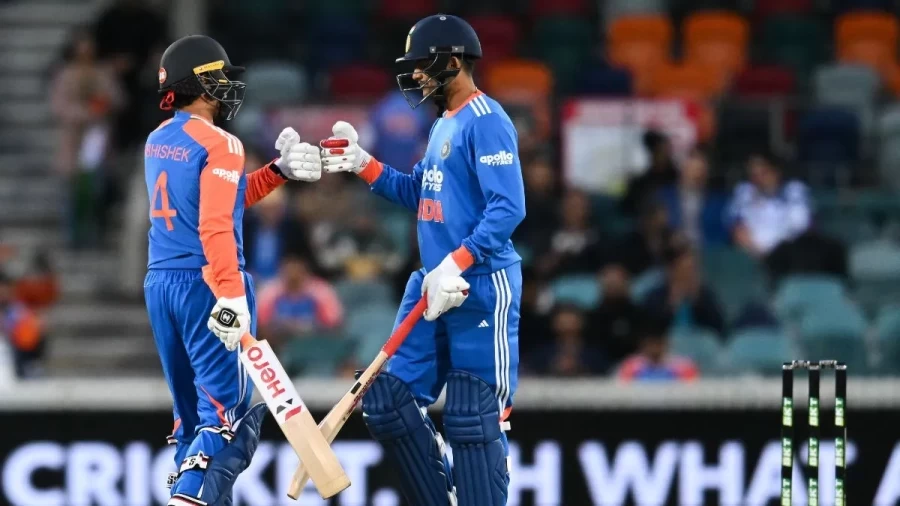
The highly anticipated first T20 International between India and Australia in Canberra met an unfortunate end as persistent rain led to the match being abandoned without a result. This cancellation left both teams and fans disappointed, especially after India's strong start with the bat. Australia, having won the toss, opted to bowl first, a decision that initially seemed to backfire as Indian batsmen launched an aggressive assault from the outset.
India's Explosive Beginning
Team India showcased an aggressive intent right from the first ball, with openers. Abhishek Sharma and Shubman Gill forging a quickfire 35-run partnership for the first wicket. Abhishek Sharma, in particular, looked in excellent rhythm, striking 4 boundaries in his 14-ball stay, accumulating 19 runs before being dismissed. His brisk start provided a solid platform for the innings, setting the tone for the power-hitting that was to follow. His departure, however, brought together two of India's most dynamic T20 batsmen.
Gill and Suryakumar's Dominant Partnership
Following Abhishek Sharma's dismissal, vice-captain Shubman Gill and captain Suryakumar Yadav took control, dismantling the Australian bowling attack with a scintillating 62-run unbeaten partnership for the second wicket. Gill remained unbeaten on 37 runs off just 20 balls, smashing 4 fours and 1 six, while. Suryakumar Yadav accelerated to 39 not out from 24 deliveries, including 3 fours and 2 towering sixes. Their formidable partnership was a testament to their exceptional form and aggressive approach, putting Australia under. Significant pressure and hinting at a massive total had the full quota of overs been played.
Australian Bowling Struggles
For Australia, Nathan Ellis was the lone bowler to find success, picking up the crucial wicket of Abhishek Sharma. He finished with figures of 1 wicket for 25 runs from 1. 4 overs. However, the rest of the Australian bowling unit struggled to contain the Indian batsmen. Seasoned campaigners like Josh Hazlewood, along with Xavier Bartlett, Marcus Stoinis, and Matthew Kuhnemann, all bowled without any success, leaking runs as Gill and Suryakumar capitalized on every scoring opportunity. The lack of breakthroughs meant Australia was constantly on the back foot.
Rain's Persistent Interference and Match Abandonment
The match was plagued by rain interruptions throughout its short duration. The first stoppage occurred briefly, but the more significant one came after 9, while 4 overs of India's innings, by which point India had posted an impressive 97/1. Despite efforts to resume play and a revised target for an 18-over-a-side game, the rain refused to relent. The deteriorating pitch conditions and persistent showers ultimately forced the umpires to call off the match, much to the dismay of everyone present.
Series Implications and Future Outlook
This T20 series was crucial for India, especially after their 1-2 defeat in the preceding ODI series. The team's strong performance in the limited overs format, particularly in T20Is recently, had built high expectations among fans. While the washout prevented a definitive result, the positive batting display offers encouragement, while the focus now shifts to the second T20I, scheduled for Friday, October 31, in Melbourne. Both teams will be eager for clear weather and a full game to gain an early advantage in what promises to be an exciting series.
