

- India,
- 24-Nov-2025 11:51 AM IST


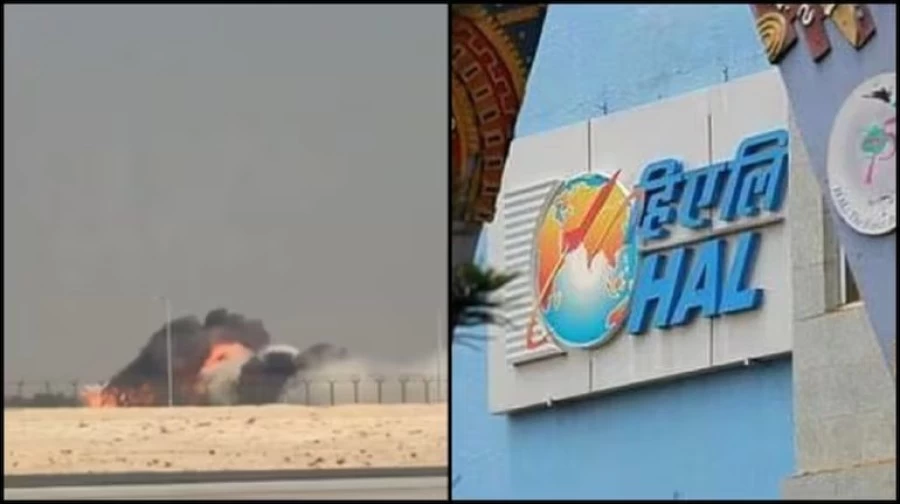
Shares of Hindustan Aeronautics Limited (HAL) witnessed a sharp sell-off on Monday, plummeting by nearly 9%,. Following the crash of a Tejas fighter jet manufactured by the company at the Dubai Air Show. This tragic incident not only impacted the company's financial performance but also raised questions about the reliability of India's indigenous defense capabilities. The accident tragically claimed the life of an Indian Air. Force officer, adding a somber note to the market's reaction. The event has put HAL under intense scrutiny, both domestically. And internationally, as the defense sector closely watches the developments.
The Dubai Air Show Incident
The Tejas fighter jet crashed on Friday afternoon during a combat exercise demonstration at the Dubai Air Show, in front of a large audience, while video footage of the incident shows the single-seat Light Combat Aircraft (LCA) plummeting to the ground, immediately followed by a burst of flames. A thick plume of black smoke was seen rising above the Al Maktoum International Airport, located at Dubai World Central. Sirens blared across the venue, drawing immediate attention to the catastrophic event. The Indian Air Force (IAF) confirmed the pilot's death in a statement, expressing deep sorrow over the loss of life and extending profound condolences to the pilot's family. The IAF also announced the formation of a Court of Inquiry to ascertain the exact causes of the accident, while the high-profile nature of the Dubai Air Show meant that this incident garnered significant global attention, amplifying its impact.
Immediate Market Reaction and HAL Share Performance
The direct consequence of the Dubai crash was felt in the stock market on Monday, as HAL's shares experienced a severe selling frenzy. The stock plunged by 8. 48% during intra-day trading, hitting a low of ₹4205. 25. Although some buying emerged at lower levels, helping the shares recover slightly, they still closed down 3. 55% at ₹4431. 85 on the BSE. This sharp decline comes after a period of strong performance for HAL's. Shares, which had surged by approximately 70% from their one-year low of ₹3045. 95 on March 3, 2025, to ₹5166. 00 on May 16, 2025. Abhinav Tiwari, a Research Analyst at Bonanza, noted that HAL's shares have historically taken a hit. Whenever its aircraft have been involved in accidents, citing previous incidents in March 2024 and February 2019. This pattern underscores the market's sensitivity to such events.
Expert Perspectives: Short-term Volatility and Technical Scrutiny
The Tejas aircraft was developed by the Aeronautical Development Agency (ADA) in collaboration with HAL and the Indian Air Force. Abhinav Tiwari believes that the situation for HAL's shares can only improve once the company confirms that the Dubai accident wasn't due to a major technical issue. If HAL can provide clear assurances that the crash wasn't a result of a widespread technical flaw, investor confidence could be restored, while On top of that, he suggests that if the incident doesn't impact future delivery schedules and export plans, HAL's shares could gradually recover. This indicates that the market is keenly awaiting official statements from the company regarding the accident's root cause and its potential implications for ongoing and future projects.
Long-term Resilience and Investment Opportunity
Siddharth Maurya, Founder and MD of Vibhavangal Anukulakara, stated that while the Tejas crash at the Dubai Air Show might exert short-term pressure on HAL's shares, it's unlikely to Notably affect its long-term valuation. He argues that unless a structural flaw in the aircraft's design or manufacturing is identified, such incidents typically don't have a lasting impact on long-term valuations. HAL currently boasts a solid order book, which includes substantial orders for the Tejas. Aircraft, serving as a strong indicator of the company's financial stability and future prospects. Maurya suggests that if this situation holds true and no major structural issues are uncovered, the current dip in. Share price could present a valuable buying opportunity for long-term investors, emphasizing the underlying strength of the company's fundamentals.
Global Credibility and Enhanced Oversight
Ultimately, the Tejas crash at the Dubai Air Show represents a significant setback for HAL, leading to a tragic loss of life and a substantial drop in its share price. While expert opinions are divided, with some foreseeing short-term volatility and others viewing it as a long-term investment opportunity, the future trajectory will largely hinge on the findings of the Court of Inquiry and the technical clarity provided by HAL. The company's response to this crisis will be pivotal in maintaining investor confidence and its standing in the global defense market. Harshal Dasani of INVasset PMS highlighted that a Tejas crash on a global platform naturally raises questions about its credibility, export readiness, and safety. He pointed out that while the government had previously dismissed concerns related to oil leakages, the Dubai incident will undoubtedly lead to increased scrutiny on HAL. This event could potentially influence the international perception and acceptance of Indian defense products. Regarding the shares, Dasani believes that while there might not be a significant long-term impact, the high valuation of the stock could lead to short-term pressure. He concluded that the recovery trajectory will largely depend on the speed of the investigation results and the clarity provided by the company regarding the technical aspects. HAL's ability to transparently address the incident and reassure stakeholders will be crucial in navigating this challenging period.
