

- India,
- 26-Nov-2025 07:59 AM IST


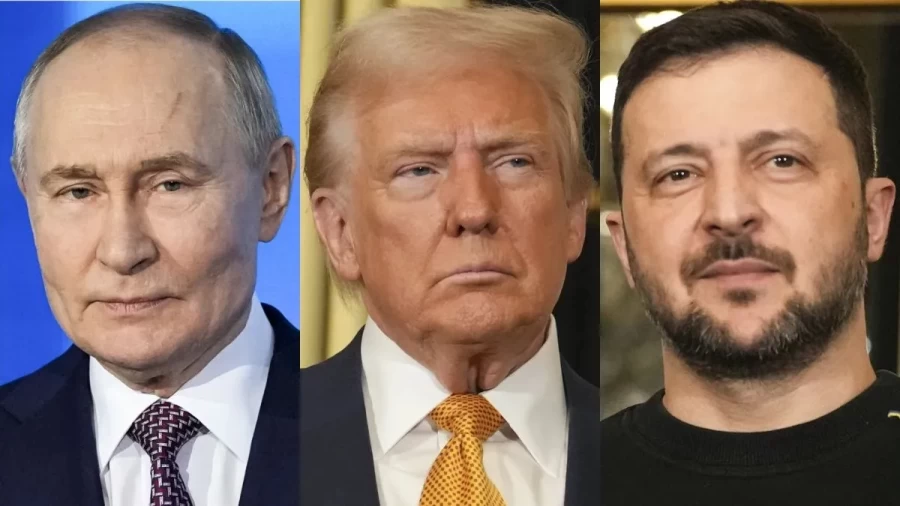
Former US President Donald Trump announced on Tuesday that his 'foolproof' plan to end the ongoing conflict between Russia and Ukraine has been 'fine-tuned' and is nearing completion. In a significant diplomatic move, Trump has deployed two key envoys to facilitate discussions, while steve Witkoff has been sent to meet with Russian President Vladimir Putin, while Army Secretary Dan Driscoll is engaging with Ukrainian officials. Trump also hinted at the possibility of meeting both President Putin and Ukrainian President Volodymyr Zelensky personally, but only when the peace deal reaches its final stages. This initiative marks a renewed effort by Trump to position himself. As a peacemaker in one of the world's most pressing geopolitical crises.
Deployment of Envoys and Initial Discussions
According to Donald Trump, the deployment of his envoys is a strategic component of his peace initiative, while steve Witkoff's mission is to establish direct communication with the Russian leadership, aiming to understand Russia's concerns and potential demands. Concurrently, Army Secretary Dan Driscoll engaged in discussions with Russian officials in Abu Dhabi,. United Arab Emirates, late on Monday and throughout Tuesday, to deliberate on an emerging proposal. This choice of a neutral location for initial talks with the Russian side, rather than direct engagement with Ukraine, suggests a preliminary phase of soundings. Lieutenant Colonel Jeff Tolbert, a spokesperson for Driscoll, described the talks as 'going well' and expressed optimism about their potential outcomes. The primary objective of these envoys is to identify common ground between the. Warring parties, thereby paving the way for Trump's proposed peace plan to advance.
Trump's Expectations and High-Level Involvement
Trump elaborated on this diplomatic push in a social media post, stating that he would be kept informed of all progress. He mentioned that Vice President JD Vance, Secretary of State Marco Rubio, Secretary of War Pete Hegseth, and White House Chief of Staff Susie Wiles would also be involved in these updates, while this indicates that Trump's peace plan is a collaborative effort involving several prominent figures within his potential future administration or current political circle. Trump further expressed his hope to meet President Zelensky and President Putin soon, but reiterated that such a meeting would only occur once the deal to end the war is finalized or reaches its ultimate phase. This condition underscores Trump's approach of intervening personally only when a substantial framework. For an agreement has been established, minimizing the risk of premature high-level engagement.
Continued Hostilities Amidst Peace Talks
A concerning aspect of these peace efforts is the continuation of hostilities on the ground even as diplomatic discussions unfold. While Army Secretary Driscoll was engaged in talks with Russian officials, Russia launched a barrage. Of attacks on Ukraine's capital, Kyiv, resulting in the deaths of at least 7 people. In retaliation, Ukraine conducted strikes on southern Russia, which killed 3 individuals and damaged several homes, while these incidents highlight the brutal reality of the conflict, persisting despite diplomatic overtures. The ongoing violence underscores the fragility of peace talks and the deep-seated mistrust between the two nations. Such continued aggression could pose significant challenges to the implementation of Trump's plan, emphasizing the difficulty of achieving a ceasefire while negotiations are underway.
Nature of Trump's Plan and Zelensky's Reaction
Details of Trump's plan to end the war first emerged last week, while reports suggested that the plan was perceived to be more favorable to Russia, prompting Ukrainian President Volodymyr Zelensky to quickly contact the United States. This reaction indicates that Ukraine may have reservations about certain aspects of the plan, particularly if they involve significant concessions to Russia. For any peace agreement to be successful, it must be acceptable to both parties, and a plan perceived as overly advantageous to one side could face considerable resistance. Zelensky's initial response serves as a signal to Trump's team that the proposed plan might need further balancing to gain broader acceptance and facilitate a lasting resolution.
Accelerated International Peace Efforts
Coinciding with Trump's initiative, other international leaders have also noted an acceleration in peace efforts, while french President Emmanuel Macron stated on Tuesday that peace efforts are gaining momentum and are 'clearly at a critical juncture. ' His comments followed a meeting between US and Ukrainian officials in Geneva on Sunday, while during a video conference meeting, led by France and Britain, which included countries involved in monitoring any ceasefire with Russia, Macron remarked, 'The talks are gaining new momentum. And we must take advantage of this momentum. ' Similarly, British Prime Minister Keir Starmer expressed a positive outlook, stating, 'I think we're moving in a positive direction. ' These statements suggest a broader, coordinated international push to end the war,. And Trump's initiative could be seen as part of these wider diplomatic endeavors. It remains to be seen whether these various diplomatic efforts will ultimately pave the way for a durable peace agreement between Russia and Ukraine.
