

- USA,
- 21-Oct-2025 09:45 PM IST


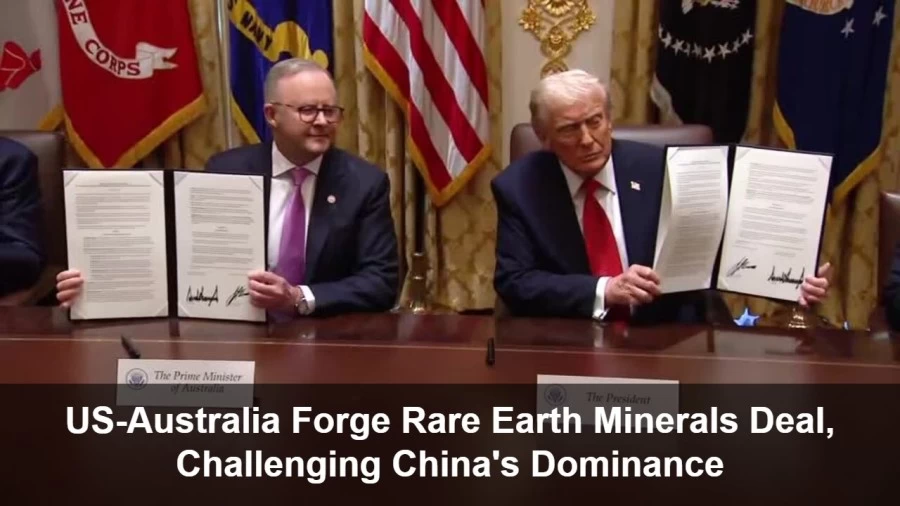
The United States and Australia have entered into a major strategic agreement concerning rare earth minerals,. A move widely perceived as a significant blow to China's global dominance in this critical sector. This deal will grant the US greater access to Australia's vast reserves of these invaluable minerals, which are the backbone of the 21st-century economy, powering everything from smartphones and electric vehicles to advanced defense systems.
The Significance of Rare Earth Minerals
Rare earth minerals are a group of 17 chemical elements, including neodymium, cerium, and lanthanum, found in relatively small quantities within the Earth's crust. Despite their scarcity, they're indispensable for high-tech industries. They're crucial components in laptops, TV screens, hybrid and electric vehicles, jet engines, radar systems, guided missiles, and various defense technologies. Simply put, most "smart" devices and advanced military hardware rely heavily on these elements.
China's Global Hegemony
Currently, China controls an estimated 70 to 80 percent of the world's rare earth mining and refining capacity, while with vast mineral deposits, particularly in its Inner Mongolia region, China leads not only in production but also in processing and exporting these vital elements. This dominance has historically given China significant economic benefit from, allowing it to exert pressure by controlling the supply of these minerals to high-tech industries in countries like the US, Japan, and Europe.
Why the US-Australia Partnership is Crucial
The agreement between the US and Australia is designed to mitigate global reliance on China for rare earth minerals and to fortify supply chain security. Australia possesses approximately 10 percent of the world's rare earth reserves, while the US brings advanced technological resources to the table. This partnership aims to establish an alternative, reliable global source, ensuring stable support for defense and high-tech sectors.
A Setback for China
This deal is a substantial setback for China on multiple fronts. Firstly, it could Notably impact China's multi-billion-dollar rare earth export revenue. Secondly, it undermines China's long-standing "supply control policy," which it has often used as a geopolitical tool. For the US, this agreement is a crucial step towards "technological safety," reducing its dependence on China for its defense and electronic industries, while beyond economics, this is a strategic realignment. Australia stands to benefit Notably, with potential investments expanding its projects and cementing its position as a major rare earth exporter. China has criticized the deal as "politicizing resources," a claim widely seen. By experts as a reaction to the threat to its market monopoly.
