

- India,
- 28-Dec-2025 08:31 AM IST


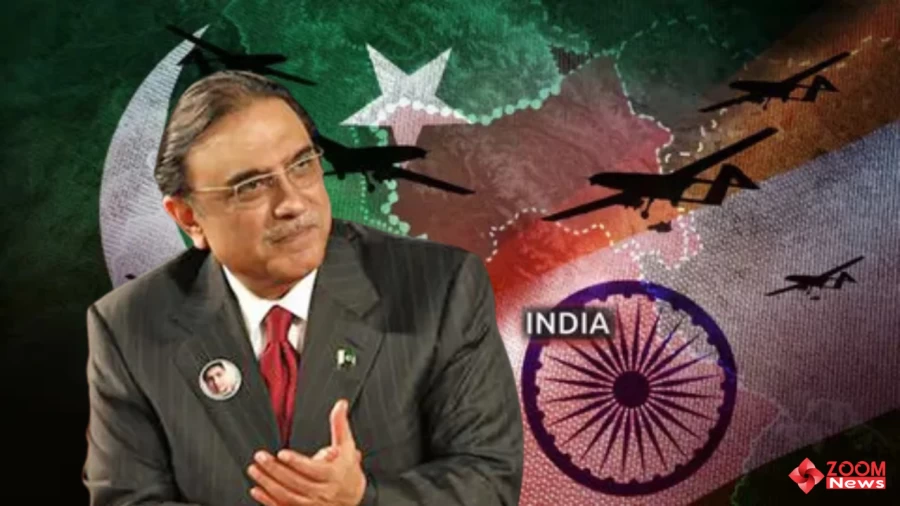
Pakistan's President Asif Ali Zardari, addressing a massive rally in Karachi on Saturday to commemorate the death anniversary of former Prime Minister Benazir Bhutto, made significant statements regarding the May conflict with India. He asserted that Pakistan had responded robustly to India's aggression during that period, which he claimed made the Indian government understand that war isn't 'child's play'. Zardari's remarks have ignited a fresh debate on regional security and the relationship between. The two nuclear-armed neighbors, underscoring Pakistan's military preparedness and the resolve of its leadership.
The May Conflict and India's Realization
President Zardari specifically referenced the India-Pakistan conflict that occurred in May, while he stated that Pakistan not only firmly confronted India's aggression but also conveyed a clear message that war is a serious matter, far from being a game for children. Zardari advised India to be grateful for Pakistan's restraint, suggesting that if Pakistan had wished, it could have shot down even more Indian fighter jets. This statement highlights Pakistan's claimed military prowess and the strategic patience of its leadership, aiming to project an image of strength amidst regional tensions.
Pakistan's Defense Readiness and Resolve
Asif Ali Zardari unequivocally declared that Indian Prime Minister Narendra Modi now fully comprehends Pakistan's capability to defend itself. He issued a stern warning that if war were to be imposed upon Pakistan again, the nation stands fully prepared and capable of confronting any challenge. This assertion underscores Pakistan's military readiness and its unwavering commitment to national security. Zardari further remarked that while India may consider itself a major power, it lacks the courage and spirit that characterize Pakistan's leadership and its armed forces. He advised Modi to understand that war demands not just power, but also courage, resolve, and sacrifice.
Leadership's Courage and Determination
Zardari presented a poignant example of leadership's courage and determination by citing his personal experience during the May conflict, while he recounted that when the skirmishes began, he was advised to take shelter in a bunker, an advice he firmly rejected. Zardari emphatically stated that leaders don't die in bunkers; they die in the field. This declaration reflects his leadership style and his commitment to standing with the people during times of crisis. It was an attempt to send a strong message to the Pakistani. Populace and military that their leadership wouldn't shy away from any challenge.
Field Marshal Asim Munir's Pivotal Role
During the rally, Pakistan Peoples Party (PPP) Chairman Bilawal Bhutto Zardari lauded Field Marshal Asim Munir. He credited Field Marshal Syed Asim Munir with playing the most significant role in the war with India. Bilawal claimed that Munir confronted the enemy eye-to-eye, and that upon hearing his name, Indian Prime Minister Modi retreats. Bilawal also mentioned that former US President Donald Trump had. Praised Munir, and that the international community now acknowledges Pakistan's stance.
These statements aim to highlight Munir's military leadership capabilities and his perceived role in strengthening Pakistan's international standing. Bilawal Bhutto Zardari, in his address, also claimed that Pakistan emerged victorious in the India-Pakistan conflict that took place in May. He referred to this as Pakistan's greatest achievement of 2025, though this might have been a temporal error, likely intending to refer to a recent achievement.
Bilawal emphasized that the gathering of people from all four provinces of the country, 18 years after Benazir Bhutto's martyrdom, sends a powerful message against terrorism. This rally served not only as a political show of strength but. Also as a symbol of national unity and steadfastness against extremist threats.
Historical Context and Future Trajectory
Bilawal also highlighted the contributions of Pakistan's historical leaders. He noted that Zulfiqar Ali Bhutto made Pakistan a nuclear power, thereby bolstering the nation's defense capabilities. Plus, he commended Asif Ali Zardari's role in strengthening friendship with China and laying the foundation for the China-Pakistan Economic Corridor (CPEC), while these statements reflect Pakistan's long-term strategies for foreign policy, economic development, and national security. The remarks made at the rally articulate Pakistan's perspective on its position in regional geopolitics and its relationship with India, with a strong emphasis on self-defense and sovereignty.
