
- India,
- 16-Aug-2026 08:22 AM IST



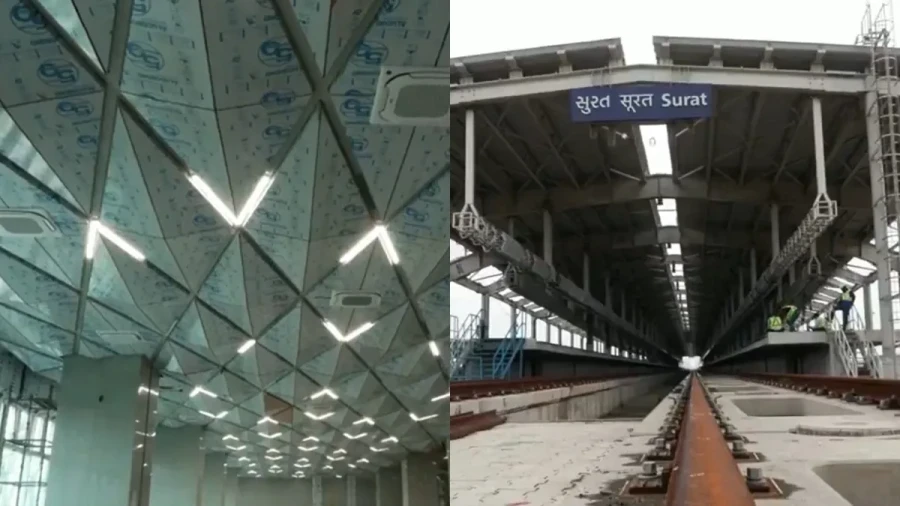
The Mumbai-Ahmedabad High-Speed Rail Corridor project, popularly known as the Bullet Train project, has reached a significant milestone in its construction phase. Recent videos showcasing the progress at Mumbai's Bandra Kurla Complex and Surat stations have emerged, highlighting the rapid pace of development. While the design of these stations bears some resemblance to modern metro stations, they've been specifically engineered to accommodate trains traveling at speeds exceeding 300 kilometers per hour. The visual updates provide a glimpse into the future of Indian transit, showing how these hubs are being prepared for high-speed operations.
Mumbai BKC Station: An Underground Engineering Feat
The Bandra Kurla Complex station in Mumbai serves as the starting point for this 508 kilometer long high-speed rail corridor. A defining feature of this station is its location, as it's being constructed approximately 30 meters underground. Currently, the excavation and foundation work at the site are in their final stages. The construction site is a hive of activity, featuring massive machinery and extensive underground structures that underscore the scale of this engineering undertaking, while as the starting point of the journey towards Ahmedabad, the BKC station is designed to handle high passenger volumes while maintaining the structural integrity required for such a deep underground facility.
Surat Station: Inspired by the Diamond Industry
In Surat, the progress is even more visible as the station structure is nearly complete, while the structural and roofing work for the Surat station has been finished, and the focus has now shifted to interior finishing. The design of the Surat station is uniquely inspired by the city's world-renowned diamond cutting and polishing industry, reflecting local heritage in its modern architecture, while inside the station, work is currently ongoing for the installation of stairs, platforms, and the ceiling. Also, track laying activities are in progress within the station premises. A significant symbolic milestone was reached with the installation of the Surat signboard at the station, signaling its readiness for the next phase of the project.
Technical Specifications and Speed Capabilities
The high-speed rail corridor is designed for trains to operate at a maximum speed of 320 kilometers per hour. This requires specialized infrastructure that differs Importantly from standard rail or metro systems. The stations at both Mumbai and Surat are being built to support these high velocities, ensuring safety and efficiency, while the progress at these two major hubs reflects the overall momentum of the project, raising expectations that residents of Maharashtra and Gujarat will soon be able to experience high-speed rail travel.
Timeline and Indigenous Development
The Ministry of Railways has announced a clear timeline for the project's rollout. In the first phase, the bullet train service is scheduled to commence between Surat and Vapi in August 2027. A notable shift in the project's strategy involves the development of indigenous technology. The Ministry of Railways informed a parliamentary standing committee that due to the lack of detailed technical information regarding the Japanese-made E10 Series Shinkansen bullet trains, India has initiated the process of developing its own indigenous bullet train. These India-made trains have been designated as B28 and are expected to reach speeds of 280 kilometers per hour.
Future Expansion: Seven New Corridors
The government's vision for high-speed rail extends beyond the Mumbai-Ahmedabad route. In the Budget 2026-27, the central government announced seven new high-speed rail corridors to expand the network across the country. These newly planned corridors include Mumbai-Pune, Pune-Hyderabad, Hyderabad-Bengaluru, Hyderabad-Chennai, Chennai-Bengaluru, Delhi-Varanasi, and Varanasi-Siliguri. These projects aim to replicate the high-speed connectivity model currently being established between Mumbai and Ahmedabad, further modernizing India's railway infrastructure.