

- India,
- 25-Nov-2025 10:11 PM IST


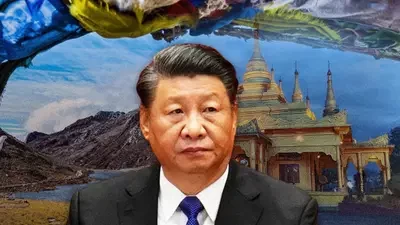
China has once again ignited diplomatic tensions by reiterating its long-standing claim over India's Arunachal Pradesh, referring to it as 'Zangnan' and asserting that India's presence there is an illegal occupation. This declaration comes amidst a separate controversy where Beijing vehemently denied allegations of mistreatment of an Indian national at Shanghai Pudong Airport, an incident directly linked to the woman's Indian passport listing Arunachal Pradesh as her place of birth. The dual statements underscore the complex and often contentious relationship between the two Asian giants.
China's Unwavering Stance on Arunachal Pradesh
On Tuesday, Chinese Foreign Ministry spokesperson Mao Ning firmly stated that 'Zangnan,' which is China's term for Arunachal Pradesh, is an integral part of China. She emphasized that China has never recognized India's "illegal occupation" of the region. This assertion is a consistent feature of China's foreign policy, which views. Arunachal Pradesh as 'Southern Tibet' and claims it as its own territory. Beijing has historically maintained that India has unlawfully encroached upon its Tibetan region to form what is now known as Arunachal Pradesh.
Allegations of Mistreatment at Shanghai Airport
The diplomatic spat escalated following accusations made by Pem Wangzom Thangdok, an Indian-origin woman residing in the UK. Thangdok alleged that she faced severe harassment and mistreatment at Shanghai Pudong Airport on November 21. She was transiting for three hours from London to Japan when Chinese officials reportedly deemed her Indian passport invalid because it listed Arunachal Pradesh as her birthplace. Thangdok claimed her passport was confiscated, and despite possessing a valid. Visa, she was prevented from boarding her connecting flight to Japan. She further stated that immigration officials and China Eastern Airlines staff mocked her and taunted her about applying for a Chinese passport, while what was supposed to be a brief three-hour transit turned into a distressing 18-hour ordeal, during which she was denied proper information, food, and access to airport facilities.
China Denies Misconduct
In response to these grave allegations, Chinese Foreign Ministry spokesperson Mao Ning categorically denied any wrongdoing. She asserted that Pem Wangzom Thangdok wasn't subjected to any form of coercion, detention, or harassment. Mao Ning further claimed that the airline had provided the woman with comfort, water, and food, attempting to paint a picture of responsible conduct by Chinese authorities and airline staff, while this stark contradiction between the victim's account and China's official statement highlights the deep mistrust and differing narratives surrounding such incidents.
Historical Context of China's Claims
China's territorial claims over Arunachal Pradesh are deeply rooted in its historical interpretation of the region, while chinese researchers, such as Zhang Yongpan from the Chinese Academy of Social Science, have publicly defended China's actions, including the renaming of places in Arunachal Pradesh. In 2015, Zhang Yongpan told the Global Times that the renamed places have existed for centuries and that China's renaming is entirely justified. He argued that historically, names in 'Zangnan' were given by central or local governments, or by ethnic communities like Tibetans, Lhoba, and Monpa. He further contended that when India "illegally occupied" Zangnan, its government also illegally changed place names, implying that only China has the right to name these areas.
Strategic Importance of Arunachal Pradesh for China
Arunachal Pradesh holds significant strategic importance for China. As the largest state in India's Northeast, it shares borders with Tibet to the north and northwest, Bhutan to the west, and Myanmar to the east. It's often referred to as the "security shield" of the Northeast. While China claims the entirety of Arunachal Pradesh, its particular focus and desire lie with the Tawang district, while located in the north-west of Arunachal, Tawang borders both Bhutan and Tibet, making it a crucial geopolitical hotspot for Beijing due to its historical and religious significance to Tibetan Buddhism.
Pattern of Renaming Places
China's assertion of sovereignty isn't limited to verbal claims; it frequently manifests in the renaming of geographical features within Arunachal Pradesh. Just this May, China unilaterally renamed 27 places in Arunachal Pradesh, including 15 mountains, 5 towns, 4 mountain passes, 2 rivers, and one lake. These new names, given in Mandarin, were published on China's state-run Global Times website. Over the past eight years, China has reportedly renamed more than 90 places in the region. India's Ministry of External Affairs spokesperson, Randhir Jaiswal, dismissed these actions as "foolish" and "creative," unequivocally stating that Arunachal Pradesh remains an "inseparable part of India. " This pattern of renaming often coincides with moments when India's international standing is perceived to be rising or when significant events occur in Arunachal Pradesh, such as India hosting a G20 summit meeting in the region in 2023 or the Dalai Lama's visit in 2017. Earlier in 2024, China had also renamed 30 places, and similar actions were taken in April 2023 (11 places), 2021 (15 places), and 2017 (6 places), consistently using Chinese, Tibetan, and Romanized names.
Diplomatic Intervention and Pem's Appeal
Trapped in the transit zone, Pem Wangzom Thangdok found herself unable to book new tickets, purchase food, or move between terminals. She alleged that officials repeatedly pressured her to buy a new ticket from China Eastern Airlines, promising. To return her passport only then, resulting in significant financial losses for her existing flight and hotel bookings. Eventually, with the help of a friend in the UK, she managed to contact the Indian Embassy in Shanghai, while indian officials intervened, helping her secure a night flight out of Shanghai. Following her ordeal, Pem has urged the Indian government to formally raise this issue with Beijing, demand action against the immigration officials and airline staff involved, and ensure that Indian citizens from Arunachal Pradesh don't face similar discriminatory treatment in the future.
