

- India,
- 08-Nov-2025 09:58 PM IST


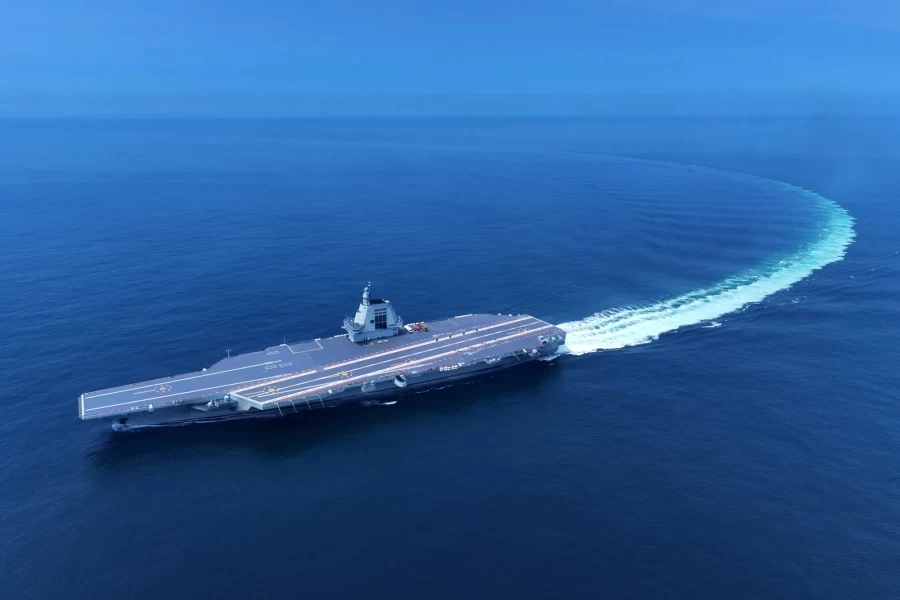
China has officially commissioned its new and most advanced aircraft carrier to date, the ‘Fujian,’ into its navy. This significant announcement was made by China's state news agency Xinhua, marking a pivotal moment in the nation's burgeoning maritime power. President Xi Jinping personally handed over the Fujian to the navy during a ceremony held on November 5 in Hainan province. He also conducted an inspection of the vessel, underscoring the leadership's commitment to this ambitious naval project.
China's Third and Most Advanced Carrier
The Fujian stands as China's third aircraft carrier and represents a major milestone as it's entirely designed and built within China. This distinguishes it from its predecessors, the Liaoning and Shandong, which were based on Russian designs. The Fujian is a supermodern carrier, featuring an advanced electric system. It's slated to deploy J-35 stealth fighters, which will Notably enhance China's influence and dominance from Taiwan to the Indian Ocean. This vessel signifies a qualitative leap in the capabilities of the Chinese navy.
Technological Leap with EMALS
A standout feature of the Fujian is its flat flight deck and the Electromagnetic Catapult System (EMALS). This cutting-edge system enables fighter jets to take off with greater ease and speed. Apart from the United States, China is now the only nation possessing this advanced technology, while previous Chinese carriers utilized a ski-jump ramp, which made launching heavier aircraft challenging. However, the Fujian's EMALS allows heavy fighter jets, stealth fighters, and radar aircraft to take off and land with remarkable efficiency, while the EMALS system facilitates the launch of aircraft with increased velocity and operational efficiency, Notably boosting the carrier's overall operational capacity.
Enhanced Naval Projection and Dominance
With the Fujian, China can now project its power further into distant waters, including the Taiwan Strait, the South China Sea, and the Indian Ocean. This new carrier positions China's navy as having the second-largest carrier fleet globally, trailing only the United States. During its testing phase, the Fujian successfully launched China's new J-35 stealth fighters, KJ-600 early warning aircraft, and J-15 fighters, while experts suggest that the coming months will reveal how quickly the Fujian can become fully combat-ready, but its commissioning is a clear indicator of China's expanding global maritime ambitions.
Five Key Challenges for India
The commissioning of China's Fujian aircraft carrier could escalate both direct military and strategic challenges for India. This new vessel has the potential to Importantly alter the power balance in the Indian Ocean region, an area of critical importance to India.
Superior Launch Capabilities
The Fujian is equipped with the Electromagnetic Catapult System (EMALS), a technology previously exclusive to the United States, while this system grants China the ability to launch more aircraft, and crucially, faster and heavier aircraft. This will extend its navy's long-range strike capabilities, compelling the Indian Navy to re-evaluate its defensive strategies, while the efficiency and versatility of EMALS allow China to conduct various aerial operations more effectively than before.
Increased Presence in the Indian Ocean
China has already expanded its presence at key ports such as Gwadar in Pakistan and Djibouti in Africa. With the arrival of a large vessel like the Fujian, China will be able to sustain long-term operations in the Indian Ocean. This region is vital for India, as its oil supplies and trade routes traverse these waters. China's extended presence could potentially exert pressure on these critical sea lanes and heighten India's security concerns.
Advanced Air Wing
The Fujian is capable of deploying advanced aircraft such as the J-35 stealth fighter, KJ-600 early warning aircraft, and J-15 fighters. This allows China to conduct air defense, strike, and surveillance missions simultaneously, while the combination of these sophisticated aircraft will provide China with comprehensive air superiority, making it more challenging for the Indian Navy to counter aerial threats effectively.
Technological Disparity with Indian Carriers
India currently operates two aircraft carriers: INS Vikramaditya and INS Vikrant. Both work with the ski-jump ramp (STOBAR) launch system. In contrast, the Fujian employs the catapult (CATOBAR) technology, which is considered more modern and efficient. This technological gap presents a challenge for the Indian Navy, as the CATOBAR system. Permits the launch of more aircraft, more rapidly, and with heavier payloads compared to STOBAR.
Formation of Carrier Strike Groups
China can now form a formidable carrier strike group by integrating all three of its carriers: Liaoning, Shandong, and Fujian. This development will put increased pressure on the Indian Navy to modernize its vessels, aircraft, and radar systems. The presence of a full-fledged carrier strike group will Importantly enhance China's power projection capabilities in the Indian Ocean, having profound implications for regional security dynamics.
The Power of Integrated Electrical Systems
The Fujian aircraft carrier makes highly intelligent use of electricity. An MVDC (Medium Voltage Direct Current) system is integrated within the ship to generate electricity. This electricity powers the electromagnetic catapults (EMALS) used for launching aircraft, while Also, the carrier's lighting, radar, weapons systems, and control systems are all electrically operated, demonstrating its high efficiency and operational flexibility. This integrated electrical system makes the vessel adaptable for a wide range of missions.
Evolution of China's Carrier Fleet
China's first aircraft carrier, the Liaoning, was originally an incomplete Soviet vessel, construction of which began in 1985 under the name 'Riga. ' Work halted after the collapse of the Soviet Union in 1991. In 1998, China acquired it from Ukraine and completed its construction at the Dalian Shipyard in 2002, while after approximately 10 years of work, it was commissioned into the Chinese navy on September 25, 2012, and named after the Liaoning province. Subsequently, China built the Shandong aircraft carrier, with construction beginning in 2013, its launch in 2017, and commissioning in 2019. The Shandong is an upgraded version of the Liaoning and uses the STOBAR system, meaning aircraft are launched via a ski-jump ramp. While the Shandong is larger and more modern than the Liaoning, neither of these two ships utilizes a catapult system.
India's Naval Air Power
India currently possesses two aircraft carriers: INS Vikramaditya and INS Vikrant. Both serve as floating airfields at sea, from which fighter jets take off and land. The INS Vikramaditya is a former Russian vessel, acquired by India in 2004. After extensive refitting, it was commissioned into the navy in 2013. It measures approximately 284 meters in length and weighs 45,000 tons, carrying MiG-29K fighter jets and Ka-31 helicopters, while meanwhile, the INS Vikrant is India's first indigenous aircraft carrier, built at Cochin Shipyard and commissioned on September 2, 2022. It's 262 meters long and weighs 43,000 tons. This vessel also employs the STOBAR system and is currently deployed in the Bay of Bengal. India's third aircraft carrier, INS Vishal, is presently in the planning and design stage. The arrival of the Fujian underscores the imperative for India to further strengthen its naval capabilities.
