

- India,
- 20-Sep-2025 10:03 AM IST


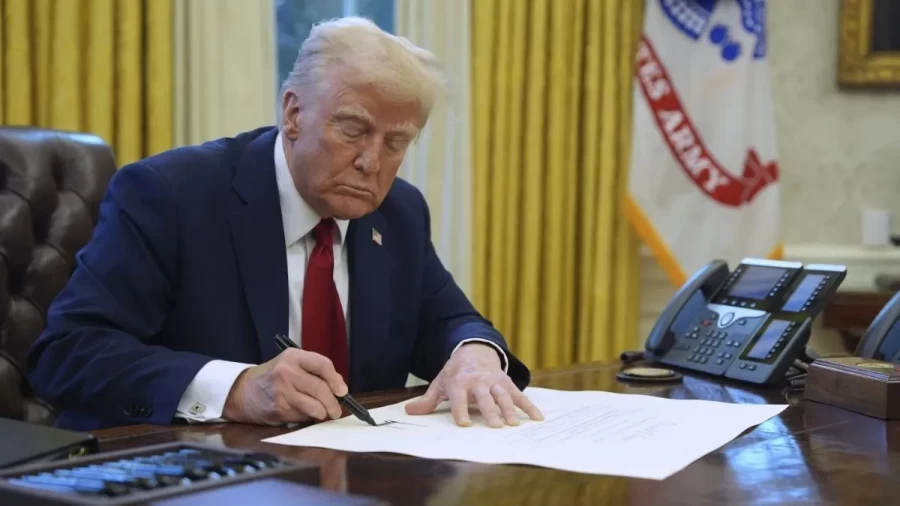
H-1B Visa: US President Donald Trump signed a significant executive order on Friday, revolutionizing the H-1B visa program. Companies will now be required to pay an additional fee of $100,000 (approximately ₹8.4 million) annually to sponsor skilled foreign workers. According to the White House, this move is an attempt to realign the H-1B program back to its original purpose—attracting world-class talent in STEM (Science, Technology, Engineering, Mathematics) fields. However, experts believe this change could create new challenges for Indian IT professionals and tech giants, as India accounts for 71% of H-1B visa beneficiaries.
In addition, Trump launched a new investment-based visa program called the "Trump Gold Card," which will provide wealthy foreigners with a fast-track path to US residency and citizenship upon investing $1 million (approximately ₹8.4 crore). Trump described it as a "great plan that will earn America hundreds of billions of dollars," which will help reduce the national debt and lower taxes.
H-1B Visa: Why is it controversial, and why the new fee?
The H-1B visa program has been a vital part of the US economy since the 1990s, allowing companies to bring in specialized foreign workforces. Each year, 85,000 visas are distributed through a lottery, with companies like Amazon (12,000+), Microsoft, and Meta among the top recipients. However, it has faced criticism for years. Critics say that large companies hire foreign workers at low wages, affecting the jobs of American citizens. For example, American tech workers earn an average of $100,000 annually, while many H-1B workers earn less than $60,000.
The new order claims to prevent this abuse. According to a White House fact sheet, the $100,000 fee will be in addition to existing fees (such as $215 for registration and $780 for petition fees). Commerce Secretary Howard Lutnick, speaking alongside Trump in the Oval Office, said, "Large companies will no longer be able to train foreign workers. First, $100,000 to the government, then the employee's salary—that's not economically viable. Train American graduates, and give jobs to Americans." Lutnick added that "large companies agree."
White House Staff Secretary Will Scharf also said, "This program is for highly skilled people, where Americans are not available. The new fee will ensure only genuine talent comes in." However, this change could face legal challenges because it further restricts H-1Bs.
A Deep Impact on Indian Professionals: A Look at the Data
India is the largest beneficiary of H-1Bs—71% of visas in 2024 will go to Indians, followed by China (11.7%). Thousands of Indian tech workers are employed in states like California. The new fee will impact small and medium-sized companies, which have fewer resources than large giants. Trump claimed the tech industry would welcome it because it would prevent "low-paying entry-level jobs." However, it could prove costly for the Indian IT sector, which relies on the US. Visas are valid for 3-6 years, and this change could reduce sponsorship.
The "Trump Gold Card": A Golden Opportunity for the Wealthy
In addition to the H-1B, Trump also signed the "Gold Card" program, which replaces the EB-5 investor visa. Individual applicants can obtain residency by donating $1 million, while companies will pay $2 million for an employee. There's also a $15,000 waiting fee. Trump said, "This will raise hundreds of billions of dollars. We'll use the money to reduce taxes and reduce debt. Companies will be able to hire the people they need—it will be fantastic!"
According to Lutnick, this program has had over 70,000 people on the waiting list since June. It's similar to a green card, but faster—cardholders will pay U.S. taxes and create jobs. However, experts say sales of the $5 million "Platinum Card" version (which grants tax-free stays of up to 270 days) will be limited.
Visa Bond Pilot Program: Cracking Down on Overstays
The Visa Bond Pilot Program, which launched last month (August 2025), is also being expanded. Applicants from countries with high overstay rates (such as Malawi, Zambia) for B-1/B-2 (tourist/business) visas may be required to deposit a bond of $5,000 to $15,000. This will run from August 20, 2025, to August 5, 2026. The bond will be returned if they comply with the rules, or else forfeited. The State Department says this screening is for vulnerable countries that operate Citizenship by Investment programs.
American Priority or Immigration Brake?
#WATCH | President Donald J Trump signs an Executive Order to raise the fee that companies pay to sponsor H-1B applicants to $100,000.
— ANI (@ANI) September 19, 2025
White House staff secretary Will Scharf says, "One of the most abused visa systems is the H1-B non-immigrant visa programme. This is supposed to… pic.twitter.com/25LrI4KATn
This is a major plan by the Trump administration to limit legal immigration and increase revenue, generating billions of dollars annually from H-1B fees, Gold Card investments, and overstay prevention through bonds. But critics call it a "visa sellout" that will harm small countries and the middle class. Indian tech associations have expressed concern that this could shrink the talent pool in the US.
Trump said, "America first—skilled people should come, but American jobs should be protected." This policy strengthens Trump's "America First" agenda in the 2025 election environment, but raises questions about global talent flow. Will it boost the US economy or weaken global cooperation? Time will tell.
