

- India,
- 13-Jan-2026 01:34 PM IST


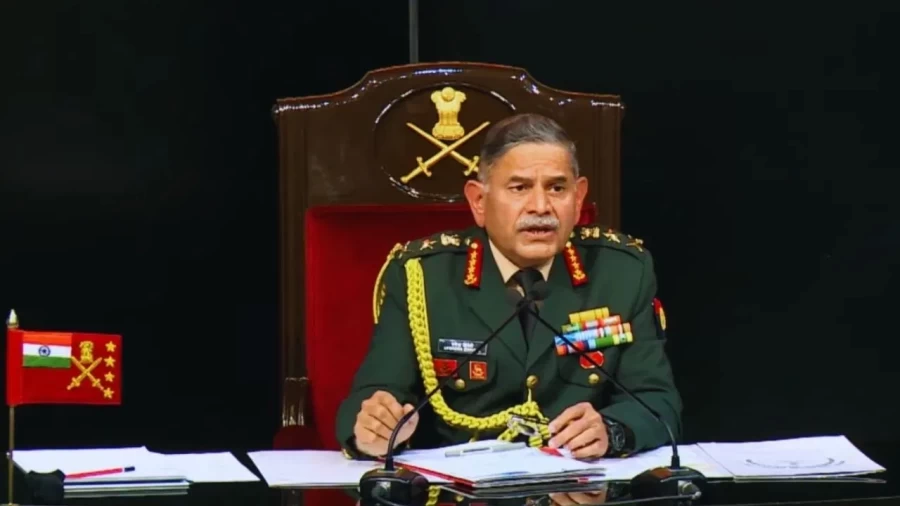
Indian Army Chief General Upendra Dwivedi delivered a stringent warning to Pakistan, reiterating that 'Operation Sindoor' remains active and any future provocations will be met with a decisive response. Speaking at his annual press conference in Delhi, General Dwivedi highlighted the continued presence of eight active terror camps, with six positioned opposite the Line of Control (LoC) and two facing the international border. He asserted that India is prepared to act firmly should any hostile activities emanate from these locations.
Operation Sindoor: A Decisive Response
General Dwivedi provided a detailed account of 'Operation Sindoor,' which was initiated following the devastating Pahalgam terror attack in April 2025, while this attack tragically claimed the lives of 26 innocent individuals, prompting a high-level decision for a resolute and decisive counter-action. The operation, launched on May 7, 2025, involved precise strikes against terrorist strongholds, demonstrating India's strategic clarity and operational readiness.
Shattering Terror Infrastructure and Nuclear Threats
The Army Chief elaborated on the effectiveness of 'Operation Sindoor,' stating that within the initial 22 minutes of its launch on. May 7, and subsequently over a total of 88 hours until May 10, the Indian forces penetrated deep into enemy territory. This sustained action successfully dismantled the terror infrastructure and, Notably, "shattered Pakistan's nuclear threats. " General Dwivedi proudly announced that out of nine identified terror bases, seven were. Completely neutralized during the operation, underscoring the precision and impact of the military's response.
Unwavering Vigilance and Future Preparedness
General Dwivedi underscored that 'Operation Sindoor' is still in progress, serving as a continuous deterrent. He issued a clear warning to Pakistan, stating that "any future misadventure would be met with a befitting reply. " The Army Chief commended the crucial roles played by various allied departments, including the Central Armed Police Forces. (CAPF), intelligence agencies, civil administration, the Ministry of Home Affairs, and the Railways, in ensuring comprehensive security and response mechanisms. He drew parallels with the increasing armed conflicts globally in 2025, emphasizing that only nations that remain prepared emerge victorious in warfare.
India's Strategic Transformation and Progress
The Army Chief highlighted that 'Operation Sindoor' showcased India's preparedness, precision, and strategic resolve. He linked these achievements to Prime Minister's vision of JAI (Jointness, Aatmanirbharta, Innovation), the Defence. Minister's declaration of 2025 as the year of reforms, and the Army's ongoing "Decade of Transformation. " General Dwivedi expressed satisfaction with the progress made in 2025, indicating a solid trajectory for India's defense capabilities and strategic posture.
Security Situation in Jammu & Kashmir and Northern Borders
Addressing the security landscape, General Dwivedi noted that the situation along the Northern Border (LAC) remains stable but necessitates continuous vigilance. High-level dialogues and confidence-building measures have contributed to normalizing the situation, with activities like grazing and hydrotherapy camps resuming. He affirmed that India's deployment in the region is strong and balanced. In the Western Front and Jammu & Kashmir, the situation is sensitive yet under control, while in 2025, 31 terrorists were neutralized, with 65% of them being of Pakistani origin. The three terrorists responsible for the Pahalgam attack were eliminated in 'Operation Mahadev. ' Currently, the number of active local terrorists is in single digits, and terrorist recruitment has Notably declined, with only two reported instances in 2025.
Shift from Terrorism to Tourism in J&K
General Dwivedi observed a positive transformation in Jammu & Kashmir, marked by accelerated development initiatives and a resurgence in tourism. He cited the Amarnath Yatra, which attracted over 4 lakh pilgrims, exceeding the five-year average, as a testament to this shift from terrorism to tourism. This indicates a growing sense of normalcy and economic revival in the region.
North-East Stability and Humanitarian Efforts
In the North-East, decisive actions by security forces and government initiatives have led to improvements in Manipur, while to mitigate the impact of instability in Myanmar on the North-East, a multi-agency grid comprising Assam Rifles, the Army, and the Ministry of Home Affairs is actively functioning. The successful completion of Phase 2 elections in Myanmar is expected to facilitate better cooperation in border management. Also, the Indian Army has played a vital role in Humanitarian Assistance and Disaster Relief (HADR) operations, assisting two neighboring countries and ten Indian states, and rescuing over 30,000 individuals.
India's Growing Military Prowess: Missile and Rocket Force
Responding to questions regarding 'Operation Sindoor' and related matters, General Dwivedi clarified that discussions at the Director General of Military Operations (DGMO) level didn't involve nuclear rhetoric; any such statements originated from Pakistani political leaders or the public. He emphasized that during the 88-hour operation, the Indian Army's conventional deployment was such that it was fully prepared to launch ground operations if Pakistan had made any miscalculation, while he also revealed that Pakistan was addressed at the DGMO level concerning drone incursions. Importantly, General Dwivedi announced that the Indian Army is actively developing a dedicated Missile and Rocket Force, signaling a major enhancement in its offensive capabilities and strategic deterrence.
Stance on Shaksgam Valley and CPEC
Addressing China's comments on the Shaksgam Valley, the Army Chief reiterated India's long-standing position that the 1963 agreement between Pakistan and China regarding the valley is illegal. Consequently, India doesn't recognize any activities undertaken there, while he further stated that India doesn't accept the China-Pakistan Economic Corridor (CPEC), viewing it as an illegal action carried out by both nations, as it traverses disputed territory.
