

- India,
- 12-Aug-2025 12:40 PM IST


India-Pakistan War: After the terrorist attack in Pahalgam, Jammu and Kashmir on 22 April 2025, India took the historic decision to suspend the Indus Water Treaty. This move has created a new tension in India-Pakistan relations. Pakistan is furious with this decision, and its leaders and army chiefs have threatened India with war. On the other hand, India has made it clear that "blood and water cannot flow together." In this article, we will analyze various aspects of this issue, the rhetoric of both the countries, and India's strategic plans. Also, we will see whether this tension can take the form of war.
Pakistan's panic and rhetoric
Bilawal Bhutto Zardari's statement
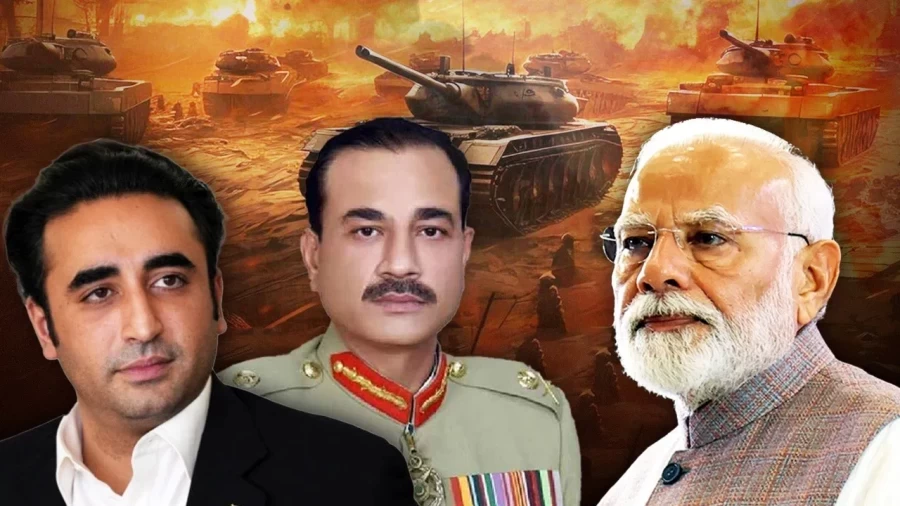
Pakistan's Foreign Minister Bilawal Bhutto Zardari termed India's move as an aggressive water policy and opposed it on international forums. He said that India's suspension of the agreement and the announcement of water projects on the Indus River are endangering Pakistan's water supply. Bilawal warned that if India continues to build dams or obstruct water flow, Pakistan is ready for war. He claimed that the Pakistani people have the "strength to face Modi" and in case of war, Pakistan can regain control over its six rivers. In June 2025 also, Bilawal had threatened war in Parliament rejecting India's decision.
Asim Munir's threat
Pakistani Army Chief General Asim Munir, while addressing expatriate Pakistanis in Tampa, USA, gave a stern warning to India. He said that if India stops the flow of water towards Pakistan, Pakistan will destroy Indian infrastructure. Referring to nuclear weapons, Munir said, "If we are drowning, we will take half the world with us." He claimed that due to this decision of India, 25 crore population of Pakistan could reach the brink of starvation.
India's stance and PM Modi's statement
On 29 July 2025, in the Lok Sabha, Prime Minister Narendra Modi mentioned the steps taken after Operation Sindoor and the Pahalgam attack. He said that Pakistan's MFN status has been revoked, visa policy has been tightened, and the Attari-Wagah border has been closed. Regarding the Indus Water Treaty, PM Modi said, "The rivers originating from the land of India are part of our cultural and spiritual heritage. These rivers are for our farmers, especially the farmers of Punjab and Jammu and Kashmir. Keeping in mind the national interests, we have suspended this agreement. Blood and water cannot flow together."
India's strategic plans
India is working rapidly towards increasing the extraction of water from the Indus river system. Its focus is on the Chenab, Jhelum, and Indus rivers, most of whose water has been going to Pakistan till now. The major schemes include:
Expansion of Ranbir Canal: The Ranbir Canal on the Chenab river, built in the 19th century, is planned to be extended from 60 km to 120 km. This will increase India's water diversion capacity from 40 cubic metres per second to 150 cubic metres per second.
Irrigation and Hydropower Projects: India is considering other projects, including large-scale water storage dams and hydropower projects. These projects could reduce water availability in the lower reaches of the river.
Water Transfer Proposals: According to media reports, India is considering a plan to transfer water from the Indus, Jhelum, and Chenab rivers to other rivers in north India. This could further restrict water flow to Pakistan.
Indus Waters Treaty: An Overview
The Indus Waters Treaty was signed in 1960 by then Indian Prime Minister Jawaharlal Nehru and Pakistani President Ayub Khan under the mediation of the World Bank. Under this agreement, the waters of six rivers were divided:
Eastern rivers (Sutlej, Beas, Ravi): Under Indian control.
Western rivers (Indus, Chenab, Jhelum): Under Pakistani control.
However, India is allowed limited use (irrigation and hydropower) of the western rivers, provided it does not affect Pakistan's water flow. India argues that the suspension of the agreement is part of its tough policy against terrorism.
Is there a possibility of war?
The possibility of war between Pakistan's threats and India's tough policy is a serious question. Pakistan's economy is already weak, and the water crisis can lead to starvation and social instability for it. On the other hand, India has made it clear that it will not compromise on its national security and interests. India's actions under Operation Sindoor are not over yet, and it may further tighten its water policy.
However, the international community, especially the World Bank and the United Nations, are keeping an eye on this issue. Pakistan has tried to raise the issue at global forums, but India's stand is clear that terrorism and the water agreement will be linked. Experts believe that a situation of war would be disastrous for both countries, especially given the presence of nuclear weapons.
