

- India,
- 31-Dec-2025 01:15 PM IST


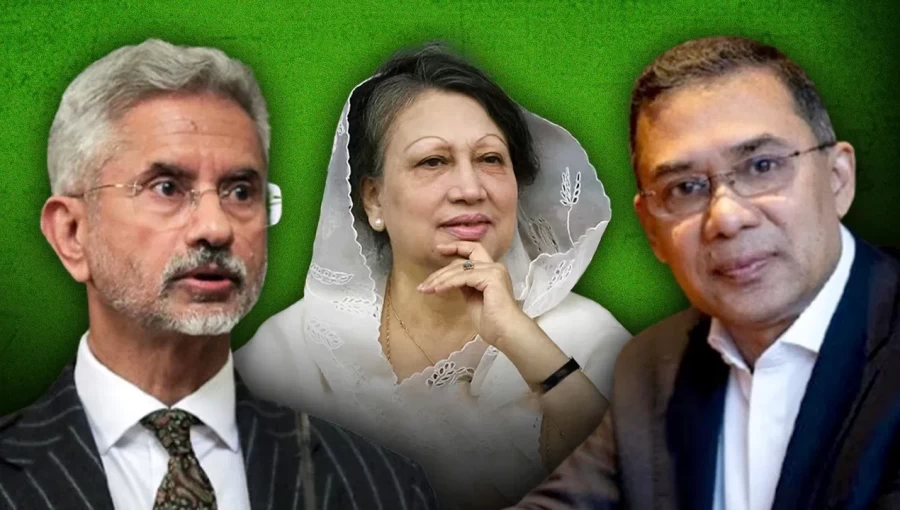
The current political mood in Bangladesh is crucial for India to understand and navigate strategically, while as per the prevailing assessment, Sheikh Hasina's return to power in Bangladesh appears highly improbable. Concurrently, China and Pakistan are actively seeking to establish their dominance in Bangladesh, primarily through organizations like Jamaat-e-Islami. In this complex scenario, Tarique Rahman, son of Khaleda Zia, emerges as India's sole viable option, while this sentiment is reciprocated by Tarique and his party, the Bangladesh Nationalist Party (BNP), who also desire a stronger relationship with India. This alignment of interests sets the stage for a significant shift in India's regional foreign policy.
Significance of Jaishankar's Dhaka Visit
India's External Affairs Minister S. Jaishankar's visit to Bangladesh to attend Khaleda Zia's funeral, while ostensibly a formal condolence visit, carries profound implications, especially amidst the ongoing electoral fervor in Bangladesh. The timing is particularly noteworthy given the strained relations between Bangladesh and India, which have reached a bitter peak over the past month, while both nations have summoned each other's ambassadors twice, underscoring the diplomatic tension. Against this backdrop, Jaishankar's presence in Dhaka is considered pivotal. It raises questions, particularly because India has historically sheltered Sheikh Hasina, Khaleda Zia's staunch political rival, and has long been considered a close ally of Hasina. The visit, So, signals a potential recalibration of India's approach to Bangladeshi politics, suggesting an attempt to engage with Khaleda Zia's party, the BNP, as well. This move could be interpreted as India's strategic effort to diversify. Its engagement and secure its interests in a rapidly evolving regional landscape.
BNP's Evolving Stance Towards India and Hindus
Following the coup, Sheikh Hasina had harbored hopes of returning to power in Bangladesh. She and her supporters consistently emphasized public mandate, believing that the populace remained on her side. However, the changed circumstances have Importantly heightened her concerns. Sheikh Hasina's party, the Awami League, has been banned in Bangladesh, effectively precluding it from contesting the upcoming elections. This development unequivocally extinguishes any realistic prospect of Sheikh Hasina's return for the next five years.
The prevailing political atmosphere in Bangladesh now strongly favors the BNP. All surveys conducted thus far indicate a substantial lead for the BNP, forecasting a likely victory. Historically, Bangladeshi politics over the past 35 years has seen power alternate primarily between the Awami League and the BNP. Based on this established track record, it's widely anticipated that Tarique Rahman's government, led by the BNP, could form the next administration. This presents a new political reality for India, necessitating an adaptation of its diplomatic and strategic approaches. Prior to 2006, when the BNP was in power in Bangladesh, its relations with India were notably strained, while khaleda Zia and her government had openly confronted India, a stance that ultimately proved detrimental to their political fortunes. When military officials in Bangladesh moved against Khaleda, India offered no assistance, leading to Tarique Rahman's imprisonment and Khaleda's ousting from power.
The BNP has evidently learned from these past mistakes. Its stance towards India has undergone a significant transformation. Recently, upon his return from London, Tarique Rahman delivered a speech emphasizing that Bangladesh belongs to all its citizens—Hindus, Muslims, Sikhs, and Christians. He called for overcoming hatred and advancing society, signaling a more inclusive and conciliatory approach. Experts suggest that since Sheikh Hasina's departure from power, the BNP has meticulously avoided making strong statements on foreign policy, particularly concerning India, while this explains why no BNP leader has issued any anti-India statements over the past eighteen months. On the contrary, Tarique Rahman has publicly targeted the Pakistan-backed Jamaat and invoked the 1971 Liberation. War, a move that resonates positively with India and underscores a desire to strengthen historical ties.
Why Engaging Tarique Rahman is Crucial for India
Engaging with Tarique Rahman and the BNP is imperative for India due to several strategic considerations. Foremost among these is the escalating interference of China and Pakistan in Bangladesh. A recent Pentagon report indicates China's ambition to establish a military base in Bangladesh, with a particular focus on Lalmonirhat. This location is critically close to India's sensitive 'Chicken Neck' corridor, posing a severe threat to India's security. Simultaneously, Pakistan is expanding its influence in Bangladesh through organizations like Jamaat-e-Islami, adding another layer of concern for India, while india shares a 4096 km open border with Bangladesh, which efforts are currently underway to fence. If China and Pakistan's dominance in Bangladesh continues to grow, securing this long and porous border will become exceedingly challenging for India. A friendly and stable government in Bangladesh is Because of this paramount to India's border security and regional stability.
Bangladesh's Role in South Asian Geopolitics
Bangladesh occupies a profoundly significant position in the geopolitics of South Asia. India's neighbors include China, Pakistan, Afghanistan, Myanmar, Nepal, and Sri Lanka. India maintains adversarial relations with Pakistan and China, and its ties with Myanmar's junta army are also strained, while in this complex neighborhood, securing a friendly neighbor like Bangladesh becomes indispensable for India. India played a pivotal role in Bangladesh's liberation, forming a strong historical bond between the two nations. Also, Bangladesh is the first Muslim-majority country in South Asia where a significant Hindu population, approximately 9 percent, resides. India can't afford to overlook the interests of this minority community. A stable and India-friendly Bangladesh isn't only vital for regional security but also essential for India's 'Act East' policy and its broader economic integration goals, while establishing positive relations with a BNP government led by Tarique Rahman could provide India with a crucial ally in this intricate geopolitical landscape, enabling it to maintain its regional influence and counter the growing sway of the China-Pakistan axis. This represents an opportunity for India to reinforce its neighborhood relations and solidify its role in fostering regional stability.
