
- India,
- 28-Nov-2026 12:37 PM IST



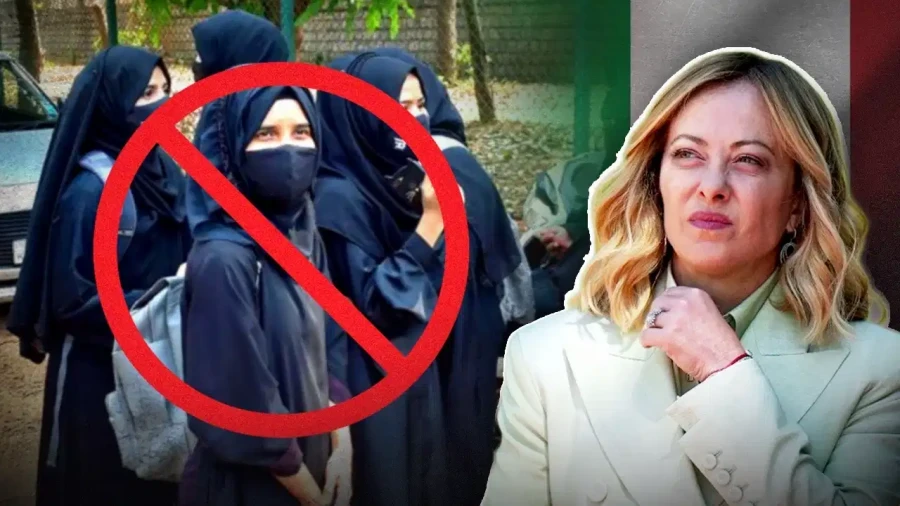
The Italian parliament has officially approved a strict new law that completely bans wearing the burqa and niqab inside schools. Along with this restriction, the legislation limits the proportion of foreign-origin students in the first class of any school to a maximum of 30 percent of the total student body. This major educational reform, introduced by the government of Prime Minister Giorgia Meloni, has sparked widespread national and international debate regarding integration, secularism, and cultural values. According to the newly implemented rules, if any student is found violating this clothing ban, a heavy fine of up to 1,000 euros, which is approximately equivalent to 110,000 rupees, can be imposed. This legislative step is expected to bring significant structural changes to the country's education system, directly intersecting with school culture and student identification protocols across Italy.
The scope of this new law extends beyond the students themselves to include their legal guardians and parents. In cases where the student violating the rule is a minor, the penalty of up to 1,000 euros must be paid directly by her parents or legal guardian rather than the student. The primary objective of this legal provision is to ensure strict adherence to institutional discipline and uniform standards within educational environments. This educational reform bill championed by Prime Minister Giorgia Meloni's administration has successfully secured the necessary approvals from both chambers of the Italian parliament. During the voting session in the lower house on November 26, the legislation received 142 votes in favor, while 112 lawmakers voted against it, and four members abstained from voting entirely. Prior to this, on November 20, the upper house of parliament had also granted its official approval to the bill, paving the way for its nationwide implementation.
Complete Prohibition Of Burqa And Niqab In Schools
Under the guidelines of the new legislation, students will no longer be permitted to wear any garments that obscure their faces during school hours, study periods, and other school-related activities. This specific ban explicitly includes the traditional burqa and niqab. A burqa is an enveloping outer garment that covers the entire body and face of a woman, featuring a mesh screen over the eyes to allow limited vision. Similarly, a niqab is a veil that covers the face while leaving the eyes visibly exposed. This regulatory rule will predominantly impact Muslim female students, who will now be required to alter their traditional attire upon entering school premises. Any infraction of this rule invites a financial penalty of up to 1,000 euros. For minor female students, the financial liability falls directly upon their parents or legal guardians, who are legally bound to pay the assessed fine.
Capping Foreign Students At 30 Percent In First Class
In addition to prohibiting face-covering veils, another critical component of the new law regulates the enrollment demographic of foreign-origin children in Italian schools. Under the updated regulations, the number of students of foreign origin in the first year of any school class can't exceed 30 percent of the total student enrollment. However, the government has carved out an important practical exemption within this rule. Foreign children who demonstrate a proficient understanding and command of the Italian language will be exempted from this strict percentage cap. To facilitate this integration process, the government plans to introduce specialized Italian language classes targeted at foreign parents. The overarching goal of these language initiatives is to assist foreign children and their families in seamlessly assimilating into the school system and broader society without facing language barriers.
Severe Opposition Backlash And Allegations Of Discrimination
The passage of this legislation has met with fierce resistance from opposition political parties both inside and outside the parliament. Opposition lawmakers staged protests by displaying informational placards in the parliament hall, arguing that no child in a school should be labeled as a foreigner. The primary contention raised by the opposition is that the government's decisions risk fostering discrimination against foreign families and Muslim students, potentially deepening social divisions among young learners, while conversely, the government has robustly defended its policy stance, explaining that these adjustments aren't intended to discriminate against any group. Instead, officials state that the reforms are designed to optimize the 2026-27 academic session and improve the overall educational infrastructure in alignment with the National Recovery and Resilience Plan.