
- India,
- 10-Jun-2026 07:05 PM IST



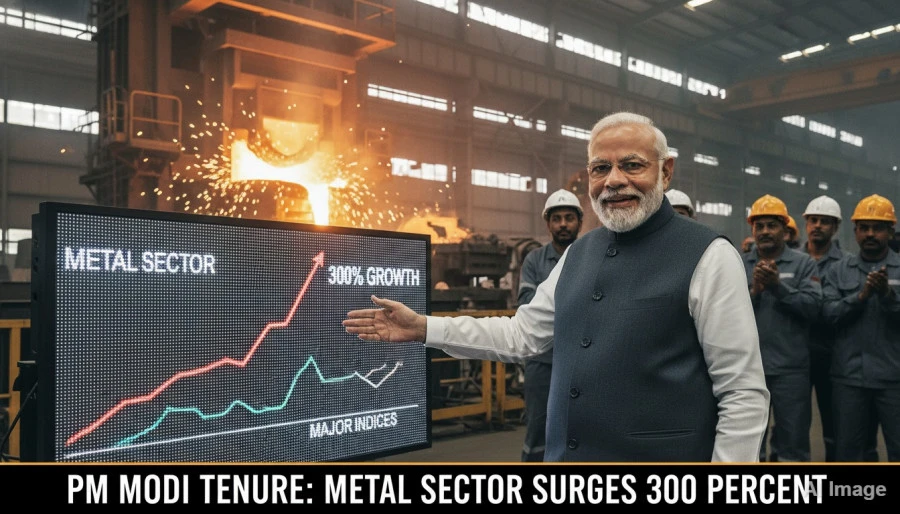
The Indian stock market has undergone a seismic shift over the last decade, with the metal sector emerging as the undisputed leader in terms of wealth creation, while during the tenure of Prime Minister Narendra Modi, the metal index has outperformed major benchmarks like the Sensex and Nifty, providing investors with returns exceeding 300 percent. This growth story isn't just about numbers but reflects the underlying industrial strength and infrastructure push that the country has witnessed. " This sentiment resonates deeply with the resilience of the Indian equity markets, which have survived various political transitions and economic cycles since 1947.
The Modi Era: A Decade of Market Transformation
When Narendra Damodardas Modi took the oath as the 14th Prime Minister of India on May 26, 2014, the financial landscape was Importantly different. On the eve of his swearing-in, May 23, 2014, the BSE Sensex closed at 24,693 points, while the NSE Nifty stood at 7,367 points. At that time, the total market capitalization of all companies listed on the BSE was less than 85 lakh crore rupees. Fast forward nearly 12 years, and the transformation is staggering. The Sensex and Nifty have surged by 199 percent and 215 percent respectively. More impressively, the market capitalization of BSE-listed companies has ballooned by 375 lakh crore rupees, reaching a current valuation of approximately 460 lakh crore rupees.
Metal Sector: The Star Performer
Under the leadership of PM Modi, the Nifty Metal Index has been the frontrunner, recording a massive 309 percent increase. This sector's performance has eclipsed other major industries. Following closely are the Nifty Financial Services and Nifty Auto indices, both of which saw gains of nearly 300 percent over the same 12-year period. The Nifty Bank index, a widely tracked barometer of the banking sector's health, rose by 254 percent, also outperforming the broader Nifty 50 index. Other sectors that showed strength include Nifty Pharma with a 222 percent rise, Nifty IT at 220 percent, Nifty Realty at 194 percent, Nifty FMCG at 171 percent, and Nifty PSU Bank at 107 percent. Conversely, the media sector was the sole outlier, with the Nifty Media index declining by 23 percent since 2014.
Corporate Giants and Wealth Creation
Individual companies within the metal space have delivered life-changing returns for shareholders. Lloyd Metals stands out with an astronomical return of 32,757 percent. JSW Steel has also been a significant wealth creator, yielding 905 percent returns. Tata Steel, a veteran in the industry, provided a 317 percent return during the Modi administration. Jindal Steel followed with a 273 percent gain over the 12-year span. 33 percent. These figures highlight the solid demand for steel and other metals driven by domestic consumption and global export opportunities.
The Rise of Midcap and Smallcap Stocks
A defining characteristic of this bull run has been the exceptional performance of midcap and smallcap stocks. The Nifty Midcap 100 index skyrocketed by 473 percent, creating immense wealth on Dalal Street. Similarly, the Nifty Midcap 50 index rose by 434 percent. The Nifty Smallcap 100 index also performed strongly, gaining 255 percent since PM Modi took office. While this was lower than the midcap growth, it still surpassed the 215 percent gain of the Nifty 50. It's important to note that the classification of these stocks often changes as their market capitalization fluctuates over time.
Historical Context: Market Performance Under Various Prime Ministers
Prime Minister Narendra Modi, the first Indian PM born after independence, has seen the Sensex deliver a Compound Annual Growth Rate (CAGR) of approximately 10 percent during his tenure. In comparison, during Dr. Manmohan Singh's 10-year term from 2004 to 2014, the Sensex rose by nearly 400 percent, moving from 4,961 to 24,693, which translates to a CAGR of about 18 percent. Under Atal Bihari Vajpayee's six-year tenure from 1998 to 2004, the Sensex saw a 3 percent CAGR. V. Narasimha Rao's term from 1991 to 1996 witnessed a 24 percent CAGR, while Rajiv Gandhi's tenure saw a 21 percent CAGR. P. Singh's brief 11-month stint, the index recorded a 73 percent CAGR. Indira Gandhi's four-year term from 1980 to 1984 also saw a healthy 20 percent CAGR, showcasing the market's long-term upward trajectory regardless of the political leadership.