

- India,
- 31-Oct-2025 03:00 PM IST
- (Updated 31-Oct-2025 02:01 PM IST)


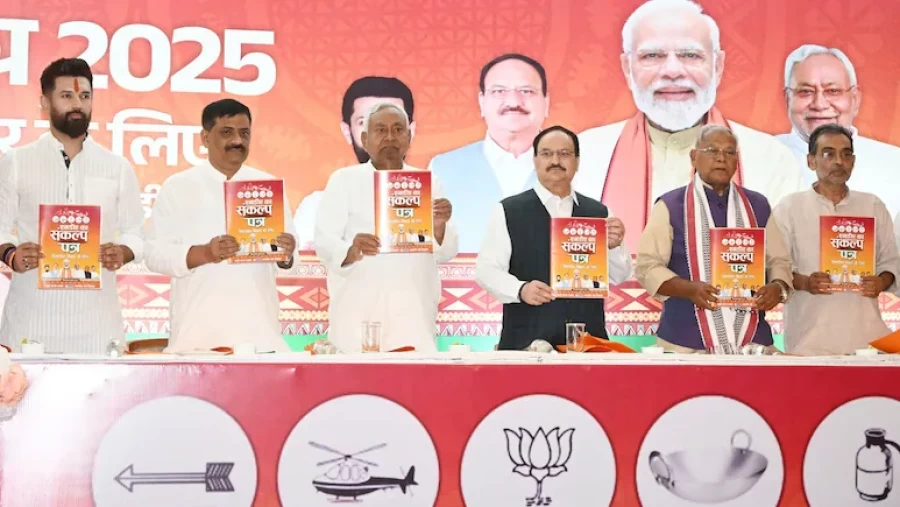
The political landscape of Bihar is heating up as the 2025 elections draw closer, with both the ruling National Democratic Alliance (NDA) and the opposition Mahagathbandhan (Grand Alliance) unveiling their comprehensive manifestos. These documents serve as a blueprint for their vision for the state's future, packed with populist promises aimed at various segments of society, including youth, women, and farmers. The manifestos highlight a clear ideological divide and distinct approaches to governance, setting the stage for an intense electoral battle. Both alliances have made significant commitments in crucial areas such as education, employment, and social welfare, signaling their intent to address the pressing needs of Bihar's populace.
Employment and Economic Growth Strategies
The NDA's manifesto places a strong emphasis on creating widespread employment and fostering economic development. It pledges to generate one crore government jobs and other employment opportunities across various sectors, while to achieve this, the alliance plans to establish mega skill centers in every district, designed to train the youth for global industries, thereby enhancing their employability. Also, the NDA aims to boost industrialization by setting up 10 new industrial parks and factories in each district, alongside 100 MSME parks and 50,000 new cottage industries. A significant focus is also placed on the technology sector, with plans for chipset, semiconductor, and manufacturing parks to promote IT and technical fields, positioning Bihar as a hub for advanced manufacturing and digital innovation.
This comprehensive strategy seeks to diversify the state's economy and create a solid job market. In contrast, the Mahagathbandhan's approach to employment is more direct, promising a government job in every household. This ambitious pledge aims to address unemployment at a grassroots level,. Ensuring direct government employment for a significant portion of the population. The alliance also commits to granting government employee status to contractual workers, a long-standing demand from this segment of the workforce, providing them with greater job security and benefits. On top of that, the Mahagathbandhan has promised permanent jobs for 'Jeevika Didis', recognizing their crucial role in rural development and women's empowerment initiatives. While both alliances target employment, the NDA focuses on broader economic growth and skill development leading to diverse opportunities, whereas the Mahagathbandhan prioritizes direct government employment and regularization of existing contractual roles.
Empowering Women Through Targeted Schemes
Both alliances have dedicated significant attention to women's empowerment, recognizing their pivotal role in society and the economy. The NDA's manifesto outlines a strong 'Women Employment Scheme' aimed at supporting 22 lakh women and creating one crore 'Lakhpati Didis' – a program designed to help women achieve financial independence and prosperity through various entrepreneurial ventures, while the alliance also proposes 'Mission Crorepati' specifically for women entrepreneurs, providing them with resources and support to scale their businesses.
The Nitish government has already demonstrated its commitment by initiating a woman employment scheme and transferring Rs 10,000 each into the accounts of 1 crore 21 lakh women, showcasing a track record of direct financial assistance and empowerment initiatives. The Mahagathbandhan, on the other hand, has introduced the 'Mai Bahin Yojana', under which women would receive Rs 2500 every month, while this scheme aims to provide direct financial support to women, offering a consistent income stream to help them manage household expenses and improve their living standards. This direct cash transfer approach contrasts with the NDA's focus on entrepreneurial support and skill development, though both ultimately aim to enhance women's financial autonomy. The difference lies in the method: one emphasizes direct income support, while the other focuses on creating avenues for wealth generation through enterprise.
Agricultural Reforms and Farmer Welfare
The NDA's manifesto includes several key promises for the agricultural sector, aiming to improve the financial stability of farmers. It proposes to increase the 'Kisan Samman Nidhi' from Rs 6,000. To Rs 9,000 annually, providing a significant boost to farmers' incomes. Also, assistance for fish farmers will be doubled to Rs 9,000, recognizing the importance of aquaculture in Bihar's economy. A crucial commitment is the guarantee of Minimum Support Price (MSP) for all. Crops, which would provide farmers with price assurance and protect them from market fluctuations. The alliance also plans a massive investment of Rs 9 lakh crore in pre-infrastructure, which would include improvements in irrigation, storage, and transportation facilities, directly benefiting the agricultural sector. The provided text doesn't explicitly detail specific farmer-centric promises from the Mahagathbandhan beyond general economic growth, which suggests that the NDA has a more detailed and direct approach to agricultural reforms and farmer welfare in its manifesto.
This distinction could be a significant point of comparison for the electorate, particularly in. A state where a large portion of the population relies on agriculture for their livelihood. The NDA's focus on MSP, increased financial aid, and infrastructure development aims to create a more stable and profitable environment for farmers. Education and skill development are critical areas where both alliances have made substantial pledges.
The NDA's vision includes establishing mega skill centers in every district to prepare youth for global industries, as mentioned earlier. For social equity, the alliance promises residential schools for Scheduled Caste (SC) students in every division. Also, SC/ST students in higher education would receive Rs 2,000 monthly assistance, while Extremely Backward Class (EBC) students could get up to Rs 10 lakh in aid. The NDA also commits to providing free education for poor children and fortified mid-day meals, ensuring nutritional support alongside learning. A significant investment of Rs 5,000 crore is earmarked for upgrading special schools, indicating a focus on improving educational infrastructure and quality across the board.
Advancements in Education and Skill Development
The Mahagathbandhan's educational promises include the development of an 'Educational City' spanning 2000 acres, aiming to create a comprehensive hub for learning and research. They also pledge to provide free tablets to students up to the 12th standard, promoting digital literacy and access to modern learning tools. A key promise that resonates with government employees is the implementation of the Old Pension Scheme (OPS), which would impact the financial security of those in public service. While the NDA focuses on infrastructure, financial aid, and skill development, the Mahagathbandhan emphasizes large-scale educational hubs, digital access, and addressing long-standing demands of government employees regarding pension schemes.
Social Security and Public Welfare Initiatives
Social security and public welfare are central to both manifestos, while the Nitish government, under the NDA, has already increased widow and elderly pensions from Rs 400 to Rs 1100, demonstrating a commitment to supporting vulnerable populations. The NDA also promises 50 lakh new homes and free ration, addressing basic needs for housing and food security. In terms of electricity, the NDA commits to providing 125 units of. Free electricity to every family, aiming to alleviate financial burdens on households. The Mahagathbandhan, in its 'Tejashwi Pran', pledges to further increase the old age and widow pension to Rs 1500 per month, offering a higher financial relief compared to the current rates, while their promise for free electricity is even more generous, offering 200 units of free electricity. These promises indicate a direct competition in providing greater social welfare benefits, with the Mahagathbandhan often proposing higher direct financial aid or larger subsidies, while the provision of free ration and new homes by the NDA highlights a broader approach to basic necessities, while the Mahagathbandhan focuses on direct cash transfers and increased utility subsidies.
Ambitious Infrastructure Development Plans
Infrastructure development is a cornerstone of the NDA's vision for Bihar, while their manifesto details plans for 7 expressways and 3,600 km of new rail tracks, Importantly enhancing connectivity and transportation networks across the state. The alliance also aims to develop Sports Cities and Centers of Excellence for sports, fostering athletic talent. Spiritual tourism is also a focus, with plans to develop Sitamarhi as a spiritual heritage city.
Urban infrastructure will see major upgrades with international airports proposed for Patna, Darbhanga, Purnia, and Bhagalpur, along with metro rail systems in four new cities. Also, the NDA promises a medical city and medical college in every district, aiming to drastically improve healthcare infrastructure and accessibility. The Mahagathbandhan's infrastructure promises, while significant, are less detailed in the provided text, focusing primarily on the construction of 5 new expressways. This indicates a shared understanding of the importance of modern transportation, but the NDA's manifesto presents a more expansive and. Multi-faceted infrastructure development agenda, encompassing not just roads but also rail, air travel, urban transit, sports, spiritual tourism, and healthcare facilities. The scale and breadth of the NDA's infrastructure commitments suggest. A transformative approach to the state's physical and social infrastructure.
The manifestos of the NDA and Mahagathbandhan for the Bihar Elections 2025 present a stark contrast in their approaches to governance and development, while while both aim to uplift the state and its people, their strategies differ Importantly, particularly in areas like employment generation, women's empowerment, and social welfare. The NDA emphasizes broad economic growth, skill development, and extensive infrastructure projects, alongside targeted social schemes. The Mahagathbandhan, on the other hand, focuses on direct government employment, higher direct financial aid, and specific welfare measures like the Old Pension Scheme, while as Bihar heads towards the elections, voters will have to weigh these distinct visions and decide which alliance offers a more compelling path forward for the state. The battle of manifestos has clearly laid out the choices. Before the electorate, promising an engaging and closely contested election.
