

- India,
- 25-Nov-2025 01:37 PM IST


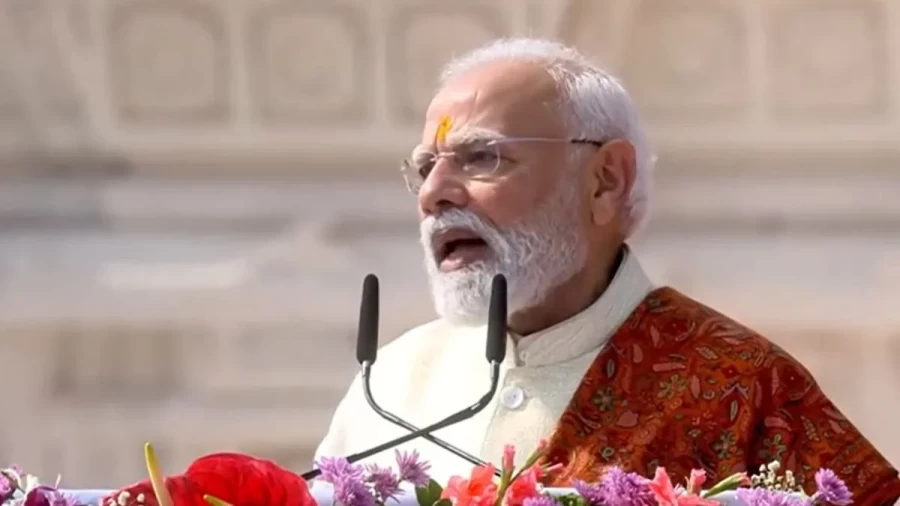
In a moment of profound historical and cultural significance, Prime Minister Narendra Modi hoisted the Dharma Dhwaj (religious flag) atop the shikhar (spire) of the grand Ram Mandir in Ayodhya, Uttar Pradesh. The event was witnessed by countless devotees across the nation and globally, while accompanying the Prime Minister were Rashtriya Swayamsevak Sangh (RSS) chief Mohan Bhagwat and Uttar Pradesh Chief Minister Yogi Adityanath, underscoring the collective importance of the occasion. Following the flag hoisting, PM Modi delivered a powerful address, highlighting the deep emotional and cultural resonance of the moment, making it clear that this wasn't merely a ceremonial act but a symbol of the resurgence of Indian civilization.
Healing Wounds of Centuries
In his address, Prime Minister Modi declared that 'centuries of wounds are healing. ' This statement resonates deeply with the sentiments of millions of Ram devotees who have long cherished the dream of a magnificent temple for Ram Lalla at this sacred site. According to him, the pain of centuries is now finding. Its cessation, and the resolve of centuries is now achieving fruition. He described this moment as the culmination of a 'yagna' (sacred ritual) whose fire. Had been burning for 500 years, symbolizing a long period of struggle and devotion. This sentiment reflects not just the completion of a structure, but a profound cultural and spiritual revival deeply embedded in India's collective consciousness.
India Immersed in Ram
Prime Minister Modi emphasized that today, not just the whole. Of India, but the entire world is 'Ramamay' (immersed in Ram). He noted the 'unprecedented satisfaction' in the hearts of Ram devotees. This highlights that the glory of Lord Ram and his ideals transcend geographical boundaries. Ayodhya city, he stated, is witnessing another pinnacle of cultural consciousness, from where the message of Ram's ideals is being disseminated globally. This isn't merely a religious festival but a symbol of a global cultural awakening, where every individual is connecting with Ram's values and teachings.
The Dharma Dhwaj: A Symbol of Civilizational Resurgence
PM Modi elaborated on the significance of the Dharma Dhwaj he hoisted, describing it not just as a flag, but as the 'flag of the resurgence of Indian civilization. ' He provided a detailed description of each element of the flag: its saffron color, upon which the glory of the Suryavansh (Sun Dynasty) is inscribed; the sacred 'Om' symbol; and the depiction of the Kovidar tree, while all these elements, he explained, represent the glory of Ram Rajya. This flag, he asserted, embodies resolve, success, and the narrative of creation born from struggle, while it's the materialized form of dreams cherished for centuries and the meaningful culmination of the saints' devotion and society's participation. This flag stands as a living emblem of Indian culture and values, offering inspiration for the future.
Bearer of Inspiring Messages
This Dharma Dhwaj also carries several crucial messages. The Prime Minister stated that it will inspire the principle of 'Pran Jaye Par Vachan Na Jaye'. (life may go, but not the promise), emphasizing the importance of integrity and commitment to one's word. On top of that, this religious flag will convey the message of 'Karmapradhan Vishwa Rachi Rakha' (a world structured. On the primacy of action and duty), highlighting the significance of karma yoga and diligent efforts. Finally, the flag will express the aspiration of 'Bair Na Bigrah Aas Na Trasa, Sukhmay Tahi Sada Sab Aasa' (freedom from discrimination, pain, and trouble, and the prevalence of peace and happiness in society), while these messages collectively reflect the ideals of Ram Rajya, where justice, peace, and prosperity are paramount.
A Consciousness Center of Collective Strength
Prime Minister Modi also expressed his joy that the divine precincts of the Ram Mandir are becoming a 'consciousness center of India's collective strength. ' He mentioned the construction of 'Sapt Mandir' (seven temples) within the complex, which represent various social strata and values. The temple of Mata Shabari embodies the love and hospitality of tribal communities, while the temple of Nishadraj stands as a testament to a friendship that reveres the objective and its spirit, rather than mere means. Statues of Jatayu and the squirrel are also present, signifying the importance of every small effort in achieving grand resolutions. This complex thus reflects an inclusive approach, where every segment of society and every contribution is honored.
Confluence of Rishis and Saints
The presence of great Rishis and saints like Mata Ahilya, Maharishi Valmiki, Maharishi Vashishtha, Maharishi Vishwamitra, Maharishi Agastya, and Sant Tulsidas at a single location within the Ram Mandir complex holds special significance. The Prime Minister noted that along with Ram Lalla, devotees can also have darshan (sight) of all these revered sages here, while this complex isn't merely a center of devotion to Lord Ram but also a confluence of Indian knowledge traditions, philosophy, and spiritual heritage. This place reminds us of the great personalities who enriched Indian culture and dharma.
The Resolve for a Developed India by 2047
Prime Minister Modi connected this historic moment at the Ram Mandir with the nation's future. He highlighted that over the past 11 years, every segment of society – women, Dalits, backward classes, extremely backward classes, tribals, the deprived, farmers, laborers, and youth – has been placed at the center of development. He reiterated that when every individual, every section, and every region of the country is empowered, then everyone's efforts will contribute to the realization of the national resolve. Through collective effort, by 2047, when India celebrates 100 years of independence, the nation must achieve the goal of becoming a developed India, while this call integrates the ideals of Ram Rajya with the modern development goals of India, where 'Sabka Saath, Sabka Vikas, Sabka Vishwas' (together with all, development for all, trust of all) forms the foundation of nation-building.
Ram's Values and 21st Century Ayodhya
Emphasizing the values of Lord Ram, the Prime Minister stated that 'our Ram connects through emotion, not discrimination. ' For him, an individual's lineage isn't as important as their devotion. He values principles over dynasty and cooperation over power. PM Modi affirmed that India is moving forward with the same spirit. He declared that Ayodhya is once again becoming a city that will set an example for the world. While the Ayodhya of the Treta Yuga gave humanity principles, the Ayodhya of the 21st century is offering humanity a new model of development. Then, Ayodhya was the center of मर्यादा (dignity and moral conduct); now, Ayodhya is emerging as the backbone of a developed India. This signifies that Ayodhya's importance isn't confined to the past but serves as a source of inspiration for the present and the future.
