

- India,
- 06-Nov-2025 03:00 PM IST


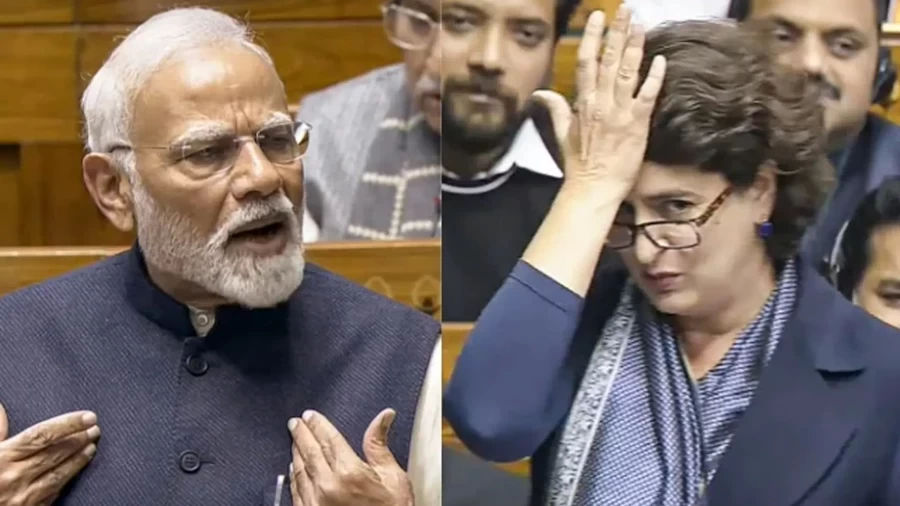
The first phase of the Bihar Assembly Elections is currently underway on Thursday, with voters exercising their franchise across 121 constituencies. Amidst this crucial democratic exercise, an intense political campaigning spree by top leaders from various parties is also in full swing, while prime Minister Narendra Modi and Congress MP Priyanka Gandhi have engaged in sharp exchanges during their respective rallies, further heating up the electoral atmosphere. This election is considered a pivotal moment for the state's future, where issues. Such as development, good governance, and historical performance have become central to the debate.
PM Modi's Scathing Attack on 'Jungle Raj' Era
Addressing an election rally in Araria, Prime Minister Narendra Modi launched a fierce attack on the Mahagathbandhan, specifically targeting the 15-year period of 'Jungle Raj' from 1990 to 2005. He asserted that this era had devastated Bihar, claiming that not a single bridge was constructed during this time. Modi emphasized that the state was 'looted' under the guise of governance, questioning the number of expressways built, to which he himself answered 'zero'. He painted a grim picture of neglect and stagnation, contrasting it sharply with the current administration's efforts, while according to the Prime Minister, the 'Jungle Raj' had severely hampered Bihar's progress, leaving its people to suffer from a lack of basic infrastructure and opportunities.
Priyanka Gandhi's Rebuttal and Focus on Infrastructure Failure
PM Modi lauded Chief Minister Nitish Kumar's efforts, stating that he worked tirelessly to pull Bihar out of the 'Jungle Raj'. He highlighted that the state's development gained new momentum after the formation of the 'double engine' government in 2014. The Prime Minister enumerated several key developmental projects and institutions established under the NDA regime. These include the establishment of IIT in Patna, IIM in Bodhgaya, and AIIMS in Patna, all crucial for higher education and healthcare infrastructure. Plus, he mentioned the rapid progress of AIIMS in Darbhanga and the presence of a National Law University in Bihar, showcasing a comprehensive approach to improving education, health, and legal frameworks within the state. These institutions, according to Modi, are testaments to the NDA's commitment to transforming Bihar into a. Developed state, providing enhanced opportunities for its youth and better services for its citizens across various sectors. Countering PM Modi's claims, Congress MP Priyanka Gandhi, while addressing a rally in Motihari, presented a stark statistic: 27 bridges had collapsed in Bihar within the last three years, while this statement directly challenged the narrative of solid infrastructure development under the current government, implying a failure in quality and oversight. Her remarks aimed to shift the focus from past governance to the present administration's accountability regarding public infrastructure, while the collapse of multiple bridges, which are critical for connectivity and economic activity, raises serious questions about construction standards, maintenance, and the overall integrity of development projects undertaken by the current administration, suggesting a potential disconnect between claims and ground realities.
Invoking Bihar's Historical Legacy and Addressing Youth Issues
Priyanka Gandhi further invoked the legacy of Mahatma Gandhi, stating that Congress leaders and workers follow the path shown by him, a path that was inspired by the ancestors of Bihar, while she urged the people of Bihar to recognize their significant role in shaping the nation, reminding them that their forefathers fought against the vast British Empire even when basic infrastructure was lacking. She highlighted that Mahatma Gandhi was inspired by Bihar to initiate 'Satyagraha' from the region, emphasizing the state's historical importance in India's freedom struggle and its contribution to the nation's ethos. Shifting to contemporary concerns, Gandhi addressed the plight of the youth, pointing out the recurring issue of paper leaks in examinations and the prolonged delays in recruitment processes. She lamented that many years of young people's lives are wasted waiting for examinations and appointments, leading to widespread frustration and despair among the state's young population, who feel their future is being jeopardized by systemic failures.
Intense Campaigning Amidst Ongoing Voting
The first phase of the Bihar Assembly Elections is witnessing a unique scenario where voting is underway simultaneously with high-voltage campaigning for subsequent phases. This dual activity underscores the intensity and high stakes of the electoral battle. Leaders are making last-ditch efforts to influence voters, with their speeches often turning into direct confrontations over governance records and future promises. The contrasting narratives presented by PM Modi and Priyanka Gandhi reflect the core issues at play: development versus. Alleged corruption, historical governance versus current accountability, and promises for the future versus present-day challenges faced by the populace. This dynamic campaigning environment ensures that voters are constantly exposed to competing visions and criticisms, making their decision-making process complex.
