

- India,
- 20-Nov-2025 06:30 AM IST


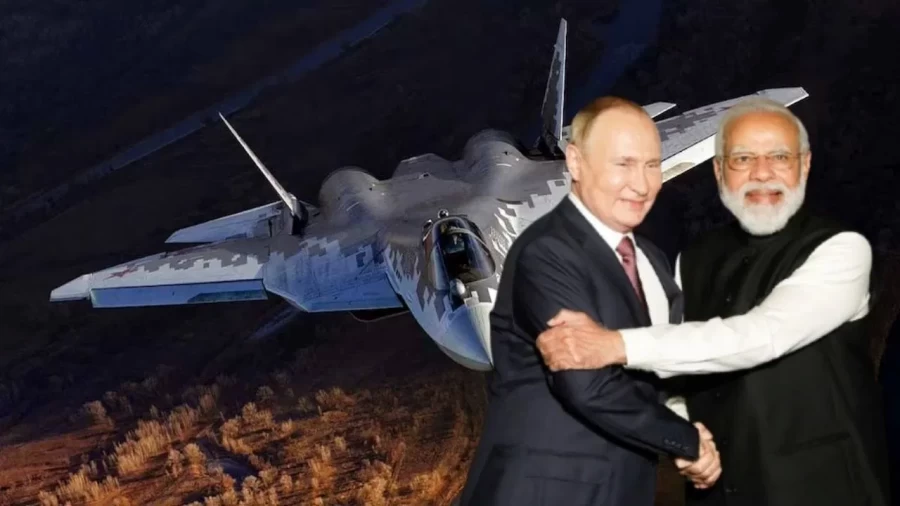
Russia has signaled its readiness to supply India with its cutting-edge Su-57 fifth-generation stealth fighter jets, a development poised to Notably enhance the Indian Air Force's future capabilities. At the Dubai Air Show 2025, Sergei Chemezov, CEO of the Russian state defense company Rostec, confirmed that Russia isn't only prepared to supply the aircraft but also to transfer its technology to India without any preconditions.
This announcement comes ahead of Russian President Vladimir Putin's visit to India next. Month, further solidifying the strategic partnership and defense cooperation between the two nations. The Su-57 is designed to rival fifth-generation aircraft like the American F-35, making it a crucial asset in the global balance of air power. This aircraft is renowned for its stealth capabilities, advanced avionics, and. Versatile weapon systems, making it a formidable asset in modern warfare. For India, this acquisition won't only boost its air superiority but could also influence the regional power balance.
Unconditional Technology Transfer: An Unprecedented Offer
During the Dubai Air Show, Rostec CEO Sergei Chemezov particularly emphasized the decades-long trusted relationship between India and Russia. In his statement, he highlighted that Russia has always been committed to meeting India's security needs, even continuing arms supplies when India faced international sanctions. This historical context underscores the seriousness and reliability of Russia's current proposal.
Chemezov clarified that whatever India requests, be it the Su-57 or the S-400 missile defense system, Russia is ready to provide it, demonstrating Russia's respect for India's strategic autonomy. Vadim Badekha, Director General of UAC, a subsidiary of Rostec, also confirmed that all technical concerns and conditions raised by India regarding the Su-57 have been accepted by Russia. This unprecedented offer signifies deep strategic trust and cooperation between the two countries, providing India with an opportunity to independently develop its defense capabilities.
Indigenous Production: A Major Step Towards Self-Reliance
A crucial aspect of this proposal is that it isn't merely a deal to purchase ready-made aircraft but paves the way for the indigenous production of the Su-57 in India. Rosoboronexport, Russia's state-owned arms exporter, has proposed that the Su-57 could be manufactured in India under the 'Make in India' initiative, while this initiative aligns perfectly with India's goal of achieving self-reliance in defense production and will boost the country's industrial capacity. The technology transfer would include critical and hitherto highly classified technologies such as the fighter jet's engine, Active Electronically Scanned Array (AESA) radar, optics, Artificial Intelligence (AI) elements, and 'low-signature technology' designed to evade enemy radar detection. The ability to produce these technologies in India will strengthen the nation's defense industrial base and lay a strong foundation for the future development of advanced aircraft, while
Joint Development of a Two-Seater Version and Long-Term Benefits
Also, Russia has offered to jointly develop a 'two-seater' version of the Su-57 with India. This joint development signifies deeper collaboration in defense research and development between the two nations. A two-seater variant could be extremely important for training purposes, helping pilots understand and operate the complex systems of fifth-generation aircraft. On top of that, it could be useful for specific mission profiles, enhancing the operational flexibility of the Indian Air Force. Such comprehensive technology transfer and joint development mean that India wouldn't have to fear dependence on other countries for spare parts or supply chain issues in the future. Critical components and systems could be manufactured within India, ensuring India's strategic autonomy and security, while this move would help establish India as a major global player in the manufacturing and maintenance of fifth-generation fighter aircraft, while also strengthening India's position in regional security dynamics.
