

- India,
- 11-Oct-2025 09:02 PM IST


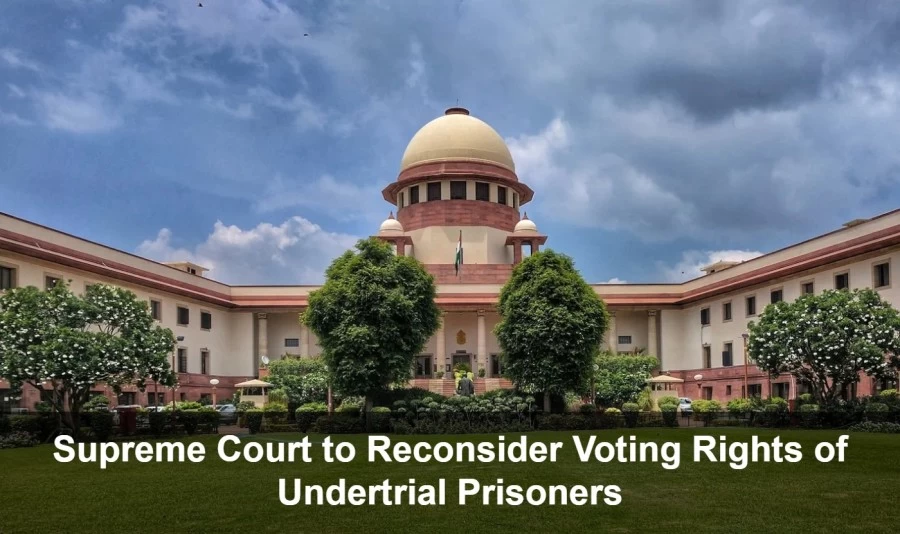
In a significant move, the. Supreme Court of India is set to reconsider the voting rights of undertrial prisoners. Currently, undertrials can contest elections but are barred from exercising their franchise, a disparity termed as a legal anomaly. Chief Justice B. R. Gavai has issued a notice on a petition seeking voting rights for these prisoners, reigniting a debate settled by the apex court nearly 28 years ago. The core of the issue lies in Section 62(5) of the Representation of the People Act, 1951, which restricts the voting rights of individuals in lawful police custody or serving jail sentences, while
Previous Rulings and Evolving Legal Stance
In 1997, the Supreme Court, in the Anukul Chandra Pradhan vs. Union of India case, upheld Section 62(5), while at that time, the right to vote was considered a statutory right under Article 326, not a fundamental one. However, the legal landscape has shifted. In the 2023 Anoop Baranwal vs. Union of India case, the Supreme Court declared the right to vote as a fundamental right under Part III of the Constitution, while this evolution in judicial interpretation forms a crucial basis for the current petition, challenging the decades-old restriction.
Arguments for Undertrial Voting Rights
The petition highlights that over 5 lakh prisoners are incarcerated in Indian jails, with 73. 5% (approximately 3. 9 lakh) being undertrials, meaning they're awaiting trial and have not been convicted. Petitioner Sunita Sharma argues that denying these undertrials the right to vote is arbitrary and discriminatory, especially given that 80-90% of them are eventually acquitted. The petition contends that until a person is proven guilty, they shouldn't be deprived of such a fundamental democratic right.
International Precedent and Petition's Demands
The petition points out that many countries, including Pakistan, South Africa, the UK, France, Germany, Greece, and Canada, allow undertrial prisoners to vote. It seeks directives from the Election Commission to formulate guidelines to secure these rights, including establishing polling booths within jails or providing postal ballot facilities for those outside their constituencies. However, it explicitly states that convicted prisoners or those charged with corruption shouldn't be granted this right. The Supreme Court's decision will have profound implications for the democratic participation of a significant segment of the population.
