
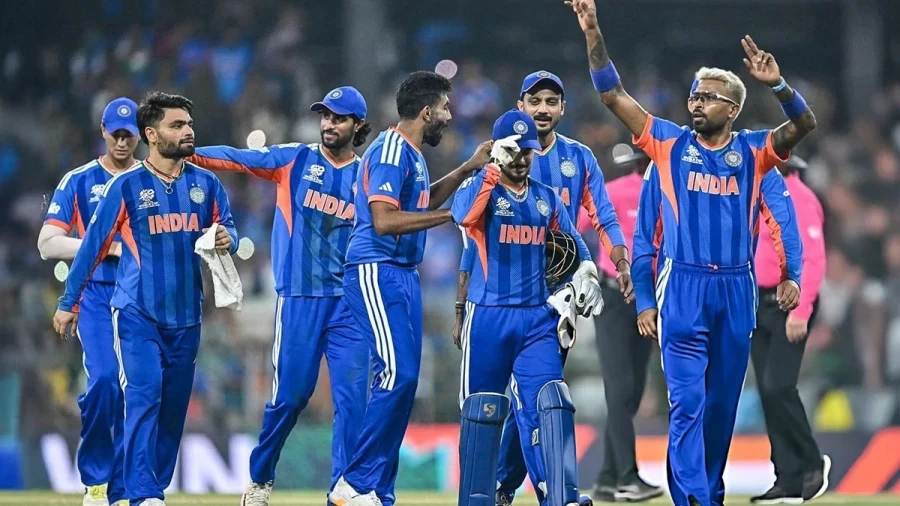

- India,
- 22-Feb-2026 09:53 AM IST


The ICC T20 World Cup 2026 has entered the critical Super 8 stage, where weather conditions have become a significant factor for participating teams. In Group 1, India is positioned alongside South Africa, the West Indies, and Zimbabwe. As the tournament progresses, the International Cricket Council (ICC) playing conditions have come under the spotlight, particularly the clauses that dictate qualification in the event of abandoned matches. According to officials, India holds a strategic advantage due to their current standing in the ICC T20I rankings, which serves as the ultimate tie-breaker in specific scenarios.
Super 8 Group Dynamics and Points System
The Super 8 stage operates on a fresh slate, meaning points from the initial group stage aren't carried forward. Each team in Group 1 and Group 2 starts with zero points and is scheduled to play three matches within their respective groups. The top two teams from each group will secure a spot in the semi-finals. In the event of a match being abandoned due to rain or other unforeseen circumstances, both competing teams are awarded 1-1 point each. This system places immense pressure on teams to secure outright wins, as washouts can lead to complex mathematical tie-breakers.
ICC Tie-Breaker Protocols for Qualification
The ICC has established a clear hierarchy of tie-breakers to determine which teams advance if they finish level on points. According to the playing conditions, the first criteria is the number of wins in the Super 8 round. If the number of wins is equal, the Net Run-Rate (NRR) is calculated to separate the teams. Should the NRR also remain identical, the result of the head-to-head match between the tied teams is considered. However, the most intriguing scenario arises when matches aren't played at all, rendering these traditional metrics inapplicable.
The Role of ICC T20I Rankings in Washouts
In a hypothetical situation where all matches in Group 1 are washed out, all four teams—India, South Africa, the West Indies, and Zimbabwe—would finish with 3-3 points each. 000. Also, head-to-head results would be non-existent. In such an extreme case, the ICC rules state that the team with the higher ICC T20I ranking at the start of the tournament will qualify. As India currently holds the top position in the global T20I rankings, they would automatically advance to the semi-finals.
Impact of Weather on Tournament Schedule
The threat of rain has already impacted the tournament, with the first Super 8 match between Pakistan and New Zealand being abandoned. This resulted in both teams sharing 1-1 point each, complicating their path to the knockout stages. The match between India and South Africa in Ahmedabad is also under scrutiny due to local weather forecasts, while tournament organizers have noted that while reserve days are often available for the final and semi-finals, the Super 8 matches generally don't have such provisions, making the points sharing rule the primary resolution for rain-affected games.
Historical Context of ICC Playing Conditions
The inclusion of world rankings as a final tie-breaker is a standard part of ICC tournament regulations, designed to ensure a fair progression path when on-field results are impossible to obtain. In previous editions, different methods like bowl-outs or super overs were used for individual matches, but for group standings, the ranking system provides a stable metric based on long-term performance. Officials emphasize that these rules are shared with all participating boards before the tournament commences to maintain transparency in the qualification process.
