

- India,
- 25-Feb-2026 02:12 PM IST


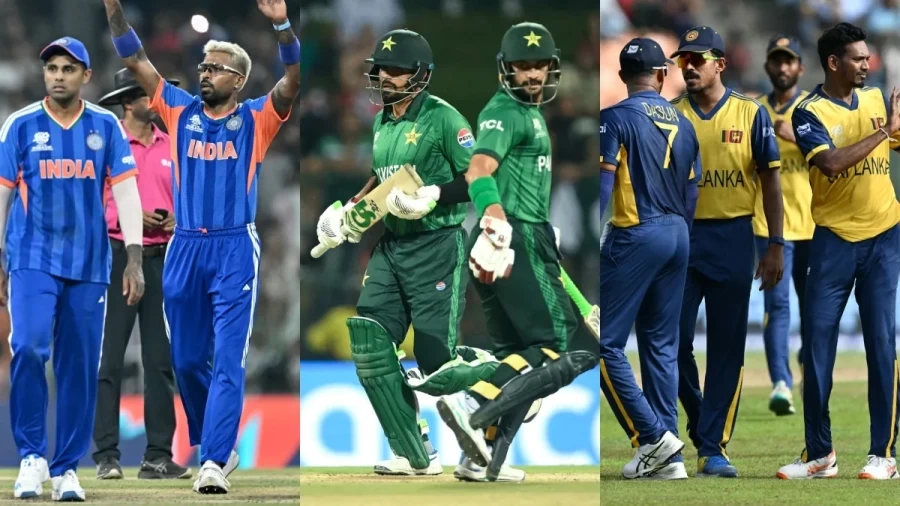
The T20 World Cup 2026 has reached a critical juncture where the three major cricketing nations of the Indian subcontinent—India, Pakistan, and Sri Lanka—are facing a potential exit before the semi-final stage. According to the current Super-8 standings and tournament trajectories, there is a significant possibility that for the first time in the 51-year history of Men's World Cups, including both ODI and T20 formats, none of these three teams will feature in the final four. This development comes as a surprise to many, especially since the tournament is being hosted in the subcontinent, where these teams traditionally hold a strong home advantage. England's recent victory over Pakistan has further intensified the race, leaving the Asian giants in a precarious position.
The 51-Year Historical Context of Asian Dominance
Since the inception of the Men's World Cup in 1975, there have been 23 editions across both ODI and T20 formats. Throughout this period, at least one of the three Asian giants has consistently secured a spot in the semi-finals. Collectively, India, Pakistan, and Sri Lanka have won eight World Cup titles. India holds two ODI and one T20 World Cup titles, having reached the semi-finals 13 times. Pakistan and Sri Lanka have also reached the semi-finals 13 times each. The current scenario in the 2026 edition threatens to break this long-standing streak of Asian representation in the knockout stages, marking a potential shift in the global cricket hierarchy.
India's Precarious Path in Group 1
India's position in Group 1 has become difficult following a substantial defeat against South Africa, which severely impacted their Net Run Rate (NRR). Currently sitting in third place, India's path to the semi-finals is no longer entirely in their own hands, while the situation was further complicated by West Indies' massive 107-run victory over Zimbabwe, which boosted their standing. To qualify, India must secure convincing wins in their upcoming matches: against Zimbabwe in Chennai on 26 February and against West Indies in Kolkata on 1 March. Also, India requires South Africa to defeat West Indies to simplify the qualification mathematics and avoid a three-way tie on points.
Group 2 Dynamics and the Threat to Pakistan and Sri Lanka
In Group 2, the qualification race has shifted heavily in favor of non-Asian teams. England has already secured a semi-final berth following two consecutive victories in the Super-8 stage. New Zealand is also in a commanding position, leaving little room for error for the Asian representatives. If New Zealand manages to defeat Sri Lanka in their upcoming encounter, both Sri Lanka and Pakistan will be mathematically eliminated from the tournament. This would confirm the absence of any Asian team from the semi-final lineup of Group 2, leaving the region's hopes solely dependent on the complex and difficult scenarios unfolding in Group 1.
Comparison with the 2006 Champions Trophy
The only instance in ICC white-ball history where India, Pakistan, and Sri Lanka all failed to progress past the group stage was during the 2006 Champions Trophy. However, in the context of the premier World Cup events (ODI and T20), such an occurrence has never been recorded in 51 years. According to officials, the potential exit of all three major Asian teams is particularly notable given the tournament's location, while while these teams usually dominate on spinning and slow tracks, visiting teams like England, South Africa, and New Zealand have shown superior adaptation to the subcontinent conditions in this edition, outperforming the hosts in crucial Super-8 matches.
Upcoming Decisive Fixtures and Tournament Impact
The fate of the Asian teams now rests on a few high-stakes matches scheduled over the coming days, while for India, the focus remains on the fixtures in Chennai and Kolkata, where the margin of victory will be as critical as the win itself to improve their NRR. For Pakistan and Sri Lanka, their survival depends not only on their own performances but also on the results of New Zealand's matches. Tournament organizers are closely monitoring these developments, as the absence of local favorites in the knockout stages could Notably impact the atmosphere and viewership of the final leg of the T20 World Cup 2026. The next 72 hours will determine if the 51-year record remains intact.
