

- India,
- 03-Sep-2025 07:25 AM IST


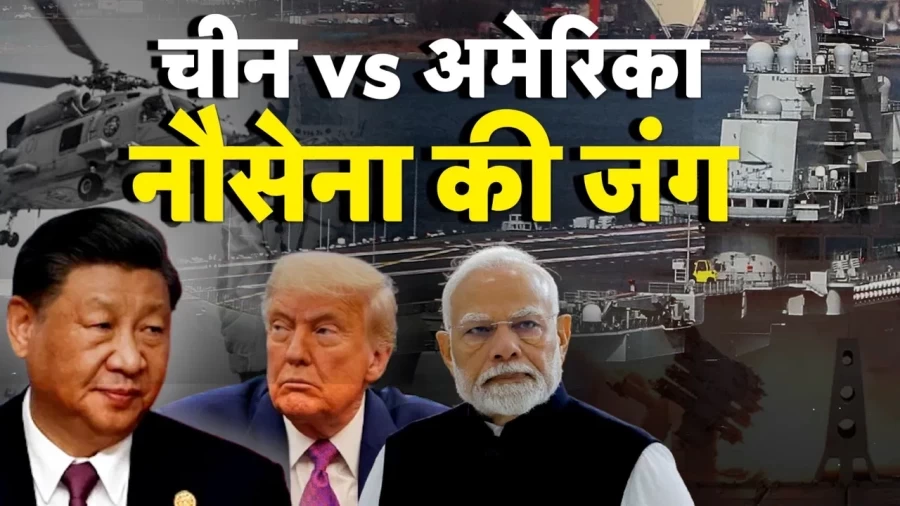
Chinese Navy: A new geopolitical storm is brewing in the Indo-Pacific region. The world's fastest growing navy, China, and the decades-old king of maritime power, the US, are now face to face. The unprecedented expansion of China's navy is posing a direct challenge to the US. The question is, will this confrontation be limited to warships only, or will it bring a major earthquake in the politics of the Indo-Pacific? And if these two superpowers clash, what will be its impact on India and other Indo-Pacific countries? Let us understand the whole story of this naval race and its impact on India.
Dalian Shipyard: The center of Chinese naval ambition
Dalian city, located on the coast of the Yellow Sea, where the Suwoyuan Bridge is a tourist attraction, has now become a symbol of China's naval power. New warships and commercial ships are being built every month in Dalian's huge shipyards. According to Nick Childs, an expert at the International Institute for Strategic Studies in London, "China's shipbuilding capacity is 200 times more than that of the US. Its scale is unbelievable." This makes it clear that China is growing rapidly not only in numbers, but also in speed and technology.
Chinese hold on global trade
China's maritime power is not limited to military ships. It has also gained a strong hold on global trade. China's shipyards have received orders to build more than 60% of the world's ships in 2025, making it the world's largest shipbuilding hub. 7 of the world's 10 busiest ports are in China, which are the backbone of global trade and supply chains. This economic and strategic advantage gives China the power to impose its terms on sea routes.
Expansion of the Chinese Navy: Speed and Power
Under the leadership of President Xi Jinping, China has built the world's largest navy. China had 220 warships in 2010, rising to over 370 by 2024. The US Department of Defense estimates that number could reach 475 in the next ten years. China now has three aircraft carriers—the Liaoning, Shandong and Fujian—with the Fujian based on completely indigenous technology.
The Chinese navy is not only increasing the number of ships but also adding warships equipped with advanced missile systems, drones and artificial intelligence. The Type 055 destroyer, considered one of the deadliest warships in the world, is now the pride of the Chinese navy. “China needs the most powerful navy to protect its maritime interests,” said Rear Admiral Luo Yuan of the PLA Navy.
US vs China: Comparison and Clash
The US still leads in technology and experience, especially with its 11 supercarriers, which no other country has. But China's growing numbers and aggressive diplomacy have worried the US. In 2025, President Joe Biden said, "We will work with our allies to ensure freedom of navigation in the Indo-Pacific. China's unilateral actions are not acceptable."
Recently, US and Chinese warships came face to face in the South China Sea, where a heated conversation on the radio went viral. The US is challenging China's claims through its 'Freedom of Navigation Operation', while China considers it an attack on its sovereignty.
2010 to date: China's naval development and disputes
In the last 15 years, China has launched an average of 10-12 new warships every year. In 2016, the International Court of Justice ruled against China over the South China Sea, which China refused to accept. In 2023-24, China increased its military presence around the Paracel and Spratly Islands, leading to several confrontations with the Philippines, Vietnam and Malaysia. In May 2025, China used water cannons on Philippine supply boats, drawing international condemnation.
Indo-Pacific and impact on India
The Indo-Pacific region has now become the biggest center of global geopolitics. More than 50% of global trade passes through this region every year, in which India also has a large share. China's aggression has alerted Japan, Australia, Philippines and India. Former Indian Navy Chief Admiral Karambir Singh said, "India's presence and strength in the Indian Ocean is enough to keep an eye on China's actions, but we have to be cautious."
India's strategy and the role of Quad
India has taken several steps to modernize its navy. After the commissioning of INS Vikrant in 2024, India now has two aircraft carriers. P-8I maritime patrol aircraft, Scorpene-class submarines and BrahMos missiles have strengthened the Indian Navy
Role of China, America and India
The waves in the Indo-Pacific region are now rising not only of water but also of geopolitical power. On one side is China, whose navy is growing the fastest in the world, and on the other side is the US, which has been a symbol of maritime supremacy for decades. This naval race is not limited to the number of ships or technology, but it is defining the global power balance and the future politics of the Indo-Pacific. What will be the impact of this confrontation on India and other Indo-Pacific countries? Let us understand the story of this naval battle and its meaning for India.
China's maritime ambitions: From Dalian to global dominance
The Chinese city of Dalian, known for its huge shipyards, has today become the center of China's naval ambitions. These shipyards are building not only warships but also commercial ships for global trade. Experts say that China's shipbuilding capacity is far ahead of the US, due to which it is strengthening its hold on the sea routes not only militarily but also economically. In 2025, China will account for more than 60% of global shipbuilding, and control 7 of the 10 busiest ports in the world. This economic and strategic power gives China the power to influence global maritime rules.
The Chinese Navy: A Confluence of Numbers and Technology
Under President Xi Jinping’s leadership, China has not only built the world’s largest navy, but also equipped it with advanced technology. Starting with 220 warships in 2010, the number has grown to over 370 by 2024, and is expected to reach 475 in the next decade. China now has three aircraft carriers—the Liaoning, Shandong, and Fujian—which symbolize indigenous technology. Advanced warships like the Type 055 destroyer, drones, and artificial intelligence-equipped ships are making the Chinese navy lethal.
America: Power of experience and technology
The US has 11 supercarriers, more than any other country, and its technological superiority and global experience still keep it ahead. Still, China's aggressive strategy and rapid expansion have made the US cautious. The US 'Freedom of Navigation' campaign in the South China Sea and tense encounters with Chinese warships are deepening this confrontation. In 2025, President Joe Biden made it clear that the US, along with its allies, will ensure free navigation in the Indo-Pacific.
South China Sea: The center of tension
China's growing aggression in the South China Sea has increased regional and global tensions. In 2016, China increased its military presence on the Paracel and Spratly Islands by rejecting the decision of the International Court of Justice. The use of water cannons on Philippines ships in 2025 highlighted China's aggression, which was condemned globally. These incidents are a matter of concern not only for regional countries but also for global trade, as more than 50% of global trade passes through the Indo-Pacific.
India's strategy and the role of the Quad
India, an important player in the Indo-Pacific, is strengthening its navy. Aircraft carriers such as INS Vikrant and INS Vikramaditya, P-8I aircraft, and BrahMos missiles have enhanced India's maritime power. India is countering China's aggression through the Quad (India, US, Jiewingpan, Australia) alliance. The Malabar naval exercise in 2025 sent a message of Quad solidarity. Defence Minister Rajnath Singh said, "India will not bow down to any external pressure. Our Navy is ready for every challenge."
Impact on India and the Indo-Pacific
The growing tension in the Indo-Pacific brings economic and strategic challenges for India. A large part of India's global trade passes through the region. China's growing presence can challenge India's influence in the Indian Ocean. However, the Quad and India's naval modernisation strategy put it in a strong position. India has to maintain its strategic autonomy and regional influence while remaining vigilant.
