

- India,
- 24-Jan-2026 12:37 PM IST


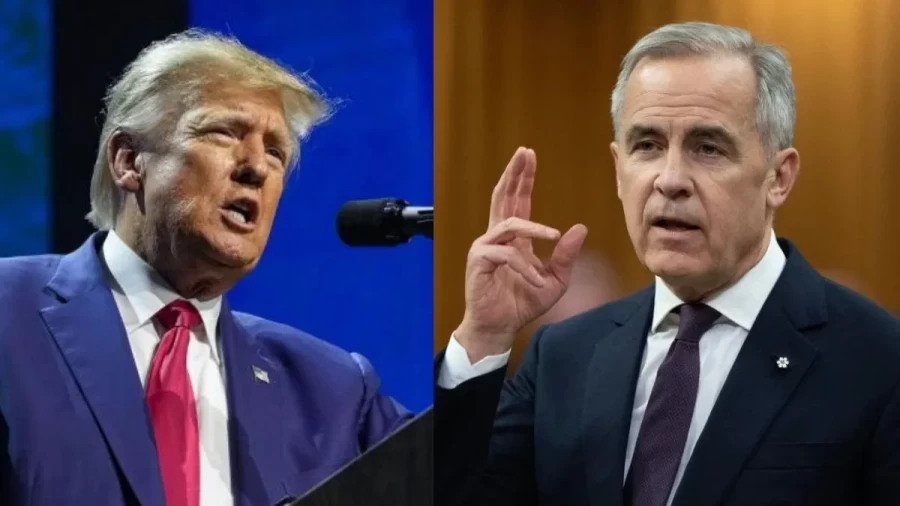
The diplomatic rift between Washington and Ottawa has reached a boiling point. US President Donald Trump has rescinded the invitation previously extended to Canadian Prime Minister Mark Carney to join his high-profile 'Board of Peace, while ' This drastic measure follows a series of verbal confrontations at the World Economic Forum in Davos, where Carney openly challenged Trump's global strategies.
The Davos Confrontation
The tension peaked when Prime Minister Mark Carney delivered a stinging critique of the U. S, while strategy regarding Greenland and the broader 'America First' foreign policy. Carney described the current U. S. approach as a threat to the established rules-based international order. Infuriated by these remarks, Trump responded with characteristic bluntness, stating that Canada exists largely due to the support of the United States, before officially pulling the plug on Canada's involvement in his peace initiative.
Controversy Surrounding the Board of Peace
Trump’s 'Board of Peace' has been met with significant skepticism from traditional Western allies. Critics point out that the organization is structured around Trump himself, who retains permanent chairmanship, while there are deep-seated fears among G7 nations that this board is designed to undermine the United Nations and centralize global decision-making within the Oval Office. The lack of institutional checks has led many to view it as an instrument of personal diplomacy rather than international cooperation.
Allies Distancing Themselves
The unpredictability of the current administration is causing a strategic shift among U. S. allies. Republican Senator Lisa Murkowski noted that the sentiment in Davos was one of confusion and concern. Leaders are increasingly worried that global policy is being dictated by personal whims or grievances. The fear is that a single 'bad phone call' with the President could lead to immediate economic sanctions or the withdrawal of security guarantees, making the U. S. an unreliable partner.
Carney’s Call for a Third Way
Mark Carney is emerging as a pivotal figure for middle powers looking to balance against U. S, while dominance. In his Davos address, he urged nations to unite, famously stating, 'If you’re not at the table, you’re on the menu, while ' Carney is advocating for a coalition of nations that upholds integrity and international law, independent of superpower rivalries. This sentiment has found resonance in the UK, where Prime Minister. Keir Starmer recently condemned Trump’s skeptical remarks regarding NATO’s collective defense.
A New Era of Global Diplomacy
As Trump settles into his 'maximalist' strategy, the traditional transatlantic alliance is being tested like never before. The withdrawal of the Board of Peace invitation is more than just a snub; it's a signal that the U. S. is willing to discard long-standing partnerships in favor of absolute loyalty. Whether Canada and its European allies can successfully forge a 'third path' remains the most critical question for the future of global stability.
