
- India,
- 22-Nov-2026 08:37 AM IST



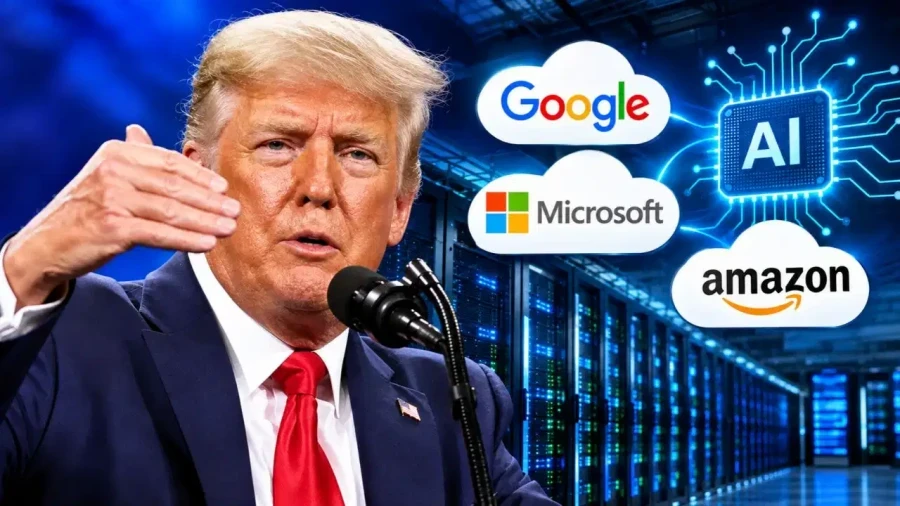
India march toward becoming the world largest hub for artificial intelligence and cloud computing isn't going to slow down easily. Global technological and political corridors were sent into a frenzy when US President Donald Trump warned of imposing heavy taxes on American companies building data centers abroad during his speech at the White House on November twenty. At first glance, this statement might seem like a major challenge for India, but ground realities tell a completely different story. India vast digital market, strong policies, and the complex intricacies of American law clearly indicate that India AI mission isn't only secure but also holds massive opportunities for domestic companies.
Why is India an unavoidable necessity for global tech giants?
There is a massive business advantage driving investments by tech giants like Google, Microsoft, and Amazon into India. Currently, India has over one billion internet users, while the demand for cloud services and data processing is growing exponentially across the country banking, manufacturing, telecom, and government sectors. Due to strict data localization regulations and the need to deliver fast and reliable services to customers, these companies must set up servers directly within India. Fulfilling these critical Indian market requirements while sitting in America is simply not feasible.
Also, India offers these companies lower construction and operational costs, a massive pool of skilled engineers, and reliable renewable energy facilities, while india strategic geographical location and expanding submarine cable network make it an ideal base to serve other nations as well. This is precisely why industry experts believe that giants like Google and Microsoft won't shut down their announced projects.
Multi-billion dollar investments and tax exemptions until twenty forty seven
The biggest proof of India technological strength is reflected in the investment figures recorded over the past year. Since last October, Google, Microsoft, and Amazon have collectively pledged a total of sixty seven billion five hundred million dollars in investments in India. Google alone has officially announced a fifteen billion dollar investment to build an AI hub in Visakhapatnam between two thousand twenty six and two thousand thirty. This project includes a gigawatt scale data center and an international submarine cable gateway, marking Google largest AI investment outside the United States.
On the other hand, Microsoft has announced an investment of seventeen billion five hundred million dollars over the next four years starting from two thousand twenty six, which is separate from its previous three billion dollar commitment. This major investment will establish a massive hyperscale center in Hyderabad along with expansions in Chennai and Pune. Meanwhile, Amazon Web Services or AWS will invest twelve billion seven hundred million dollars by two thousand thirty. The company estimates that this will contribute twenty three billion three hundred million dollars to India GDP and support approximately one hundred thirty one thousand seven hundred jobs annually.
According to a Bloomberg report from April two thousand twenty six, investment proposals exceeding one hundred fifty billion dollars are currently in the pipeline in India. To further accelerate this momentum, the Indian government made a visionary decision in the budget for two thousand twenty six to twenty seven to provide tax exemptions until twenty forty seven to foreign companies providing global cloud services from Indian data centers. Although certain challenges regarding power distribution and water consumption exist, such as an estimated consumption of one hundred fifty billion liters in two thousand twenty four, developers are moving beyond Mumbai and Chennai to build large campuses in emerging cities like Visakhapatnam.
Big opportunities opening up for Adani and Reliance
US President Donald Trump argument is that foreign built American data centers could be seized by China and utilized for advanced Nvidia AI chips. A Reuters report also revealed that Chinese companies are renting computing capacity from data centers located in other countries. Trump aims to shut down this exact loophole to increase domestic job creation within the United States.
However, if American companies slow down their expansion in India due to Washington pressure, it also presents a massive strategic opportunity for India, while in such a scenario, prominent Indian corporations like Adani and Reliance could rapidly expand their market share. On top of that, major doors will open for investors from Japan, Singapore, and the Middle East. While replacing the immense capital and advanced technology of American companies overnight won't be easy, this challenging environment can certainly provide Indian companies with an opportunity to grow stronger on the global stage.
The major wall of American law and India future strategy
The greatest relief for India is that imposing such heavy taxes will legally not be an easy task for Donald Trump. He has neither specified any tax rate nor shared any clear roadmap for implementation. He himself admitted that before speaking publicly at the White House, he had not held any discussions with his relevant officials regarding this matter. According to the provisions of the US Constitution, the authority to levy any new federal tax rests solely with the US Congress, not with the President alone. If they attempt to rely on older statutes, they will face severe legal challenges in American courts.
From a practical standpoint, shifting all operations back to America would prove to be a loss-making deal for US companies, while it would drastically increase their operational costs, slow down services for foreign customers, and ironically give Chinese tech companies an opening to surge ahead. It's abundantly clear that Trump statement isn't an immediate crisis for India. India must focus on monitoring the situation closely while accelerating approval processes, ensuring uninterrupted power supply, and strengthening domestic enterprises so that the journey to becoming the world AI hub continues without interruption.