

- India,
- 29-Dec-2025 11:51 AM IST


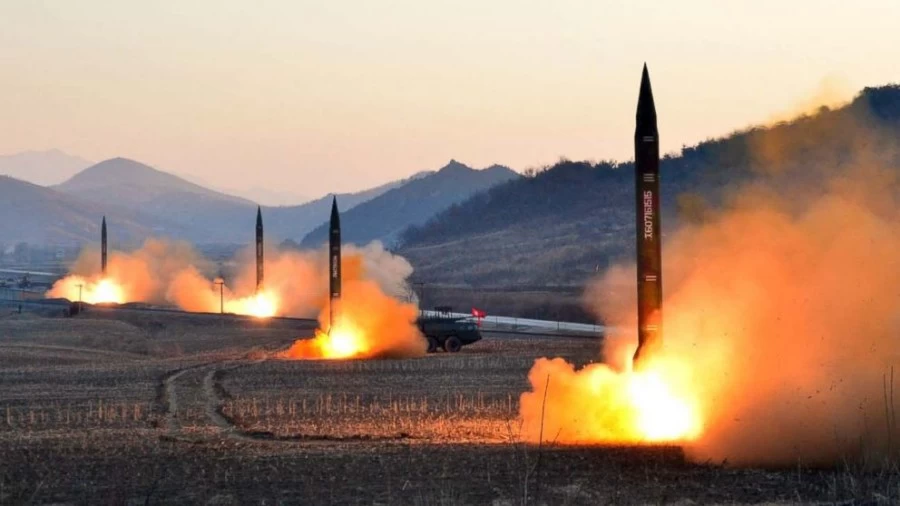
North Korea, seemingly unfazed by global sanctions and undeterred by threats from the United States, has once again showcased its military might by conducting a barrage of long-range strategic cruise missile tests. These missiles were reportedly fired into the sea, marking a significant step in the nation's ongoing efforts to bolster its nuclear deterrence capabilities, as declared by its leader, Kim Jong Un. The recent tests have sent ripples of concern from Europe to the United States, especially coming just days after North Korea demonstrated clear progress in the construction of its first nuclear-powered submarine.
Kim Jong Un's Unwavering Resolve
Supreme Leader Kim Jong Un expressed 'great satisfaction' over these missile tests. He characterized them as a crucial exercise to test the reliability of North Korea's nuclear deterrence capabilities and to demonstrate its strength. Kim emphasized that these actions represent a 'responsible exercise of the right to self-defense and war deterrence' in the face of external security threats. This statement underscores Kim's unwavering resolve to pursue North Korea's security interests, regardless of international pressure and sanctions. He firmly believes that enhancing military capabilities is essential for the sovereignty and survival of the nation.
Reasons Behind Continuous Weapon Testing
The continuous testing of potent weapons by North Korea is a direct result of Kim Jong Un's explicit directive to his military to prepare for war. While no specific adversary has been publicly named for this potential conflict, Kim's intentions are clear. Although South Korea is considered the primary enemy, the preparations for war are largely directed against the United States. This is primarily because the US acts as South Korea's protector, maintaining a strong military alliance. Consequently, North Korea is consistently enhancing its combat capabilities to confront any. Potential conflict and to pose a serious challenge to the United States.
Upcoming Workers' Party Congress and Weapon Demonstrations
The cruise missiles launched on Sunday represent the latest display of weapons by North Korea ahead of the ruling Workers' Party Congress, scheduled for early next year. This congress, the first of its kind in five years, will be closely watched by the international community. Analysts are keen to observe whether North Korean leader Kim Jong Un will outline new priorities in relations with the United States and respond to Washington's calls for a resumption of long-stalled talks. The congress will serve as a critical platform for Kim Jong Un to articulate his policies and future strategies to the world, particularly concerning nuclear disarmament and regional security.
Focus on Enhancing Nuclear Deterrence
Amidst the looming threats of war, North Korea is placing a significant emphasis on enhancing its nuclear deterrence capabilities. These new tests are a direct step in that direction. The official Korean Central News Agency (KCNA) reported that Kim Jong Un expressed 'great satisfaction' over the cruise missile tests conducted off the country's western coast on Sunday. KCNA further stated that Kim described these tests as an exercise to verify the reliability of North Korea's nuclear deterrence capabilities and to demonstrate its power, framing it as a 'responsible exercise of the right to self-defense and war deterrence' in the face of external security threats. This indicates North Korea's unwillingness to compromise on its security.
South Korea's Reaction and International Concerns
South Korea's Joint Chiefs of Staff also reacted to North Korea's tests, stating that they detected multiple cruise missile launches from the North Korean capital region on Sunday morning. South Korea affirmed its readiness to deter any potential North Korean provocations through its alliance with the United States. While UN Security Council resolutions prohibit North Korea from launches related to its vast ballistic missile arsenal, Kim Jong Un appears undeterred by these restrictions. Although North Korea's cruise missile tests aren't explicitly banned, they pose a significant threat to the United States and South Korea. This is because cruise missiles are highly maneuverable and can fly at. Low altitudes, evading radar detection, making them difficult to track and intercept.
Analysts' Perspectives and Future Strategy
Analysts suggest that in a conflict scenario, North Korea would likely use cruise missiles to target US warships and aircraft carriers. This could be a crucial component of its military strategy. Last week, North Korea also tested new anti-air missiles off its eastern coast and displayed photographs of the nearly completed hull of a developing nuclear-powered submarine, while north Korea has indicated its intention to arm this submarine with nuclear missiles. The nuclear-powered submarine is one of several advanced weapon systems that Kim has pledged to introduce to counter US-led security threats. This is part of Kim's long-term strategy to establish his country as a formidable nuclear power.
Talks with the US and Kim's Conditions
Since the collapse of high-level nuclear diplomacy between Kim and then-US President Donald Trump in 2019, North Korea has focused on weapon testing activities to expand its nuclear arsenal. However, in a clear response to Trump's repeated overtures, Kim suggested in September that he might return to talks if the US abandons its 'delusional obsession with nuclear disarmament, while ' Experts believe that Kim might perceive his expanded nuclear arsenal as providing greater use to secure concessions in potential negotiations with Trump. This indicates that Kim Jong Un aims to use his military power as. A bargaining chip to extract concessions from the United States on his own terms.
