

- India,
- 19-Mar-2026 01:53 PM IST


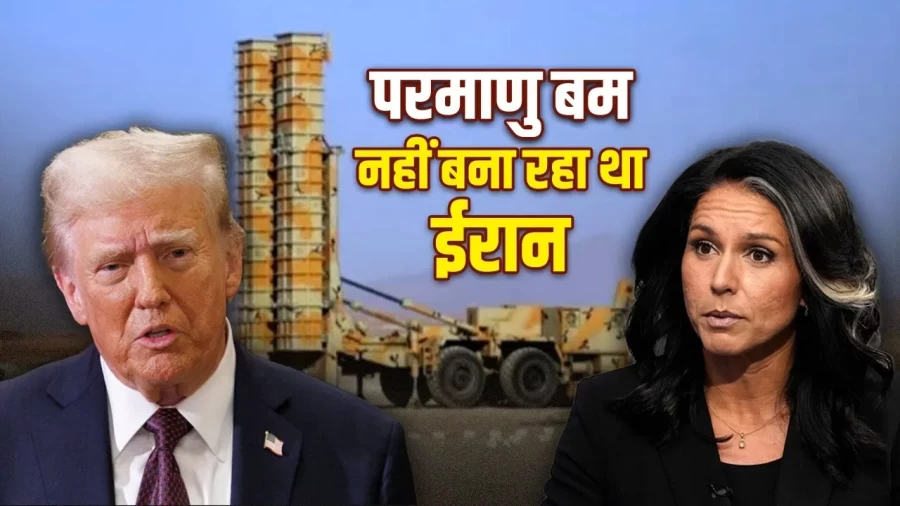
A significant controversy has erupted following revelations that five high-ranking international officials have challenged the justifications provided by US President Donald Trump for the military strikes against Iran. During the conflict, the Trump administration maintained that Iran was actively developing nuclear weapons following the 2025 attacks, posing an existential threat to the Middle East. However, recent testimonies and statements from officials in the US, UK, Oman, and the IAEA suggest that these claims were factually incorrect and that a diplomatic resolution was within reach.
Tulsi Gabbard's Testimony Before Senate Committee
On Wednesday, 18 March, US Intelligence Chief Tulsi Gabbard testified before the Senate Intelligence Committee, providing a starkly different account of Iran's capabilities. Gabbard stated that the military strikes in June 2025 had effectively neutralized Iran's nuclear infrastructure. According to her testimony, there was no evidence of Iran attempting to restart its nuclear weapons program after that period, while this revelation led to intense questioning within the Senate, with many lawmakers demanding to know why this intelligence wasn't prioritized before the subsequent escalation of hostilities.
Omani Foreign Minister's Revelations in The Economist
Badr bin Hamad Al-Busaidi, the Foreign Minister of Oman, who played a pivotal role as a mediator between Washington and Tehran, published a detailed account in 'The Economist'. Al-Busaidi claimed that a comprehensive deal had been reached where Iran agreed to dilute its enriched uranium. He alleged that the US proceeded with the attack despite this breakthrough, suggesting that the decision was heavily influenced by Israeli interests. The minister noted that the US administration appeared to have lost independent control over its Middle East foreign policy objectives.
IAEA Chief Rafael Grossi's Technical Assessment
Rafael Grossi, Director General of the International Atomic Energy Agency (IAEA), has consistently maintained that Iran wasn't engaged in an active nuclear weaponization program at the time of the strikes. According to official IAEA monitoring reports, Iran wasn't in a position to produce a nuclear device in the immediate timeframe suggested by the White House. Grossi’s assessment, based on international inspections, directly contradicts the narrative used to justify the military intervention, highlighting a disconnect between intelligence findings and political rhetoric.
UK NSA Jonathan Powell on Failed Diplomacy
British National Security Adviser Jonathan Powell expressed surprise at the timing of the US-led strikes. Reports from 'The Guardian' indicate that Powell was informed of a near-final agreement where Iran had consented to the removal of its uranium stockpiles. According to Powell, the diplomatic track was showing unprecedented progress. However, just two days after the final round of talks, the US and Israel launched coordinated strikes, effectively terminating the possibility of a negotiated settlement. Powell's account suggests that the military option was chosen over a viable diplomatic alternative.
Resignation of Intelligence Official Joe Kent
Joe Kent, a senior US intelligence official and Director of the Counter-Terrorism Center, resigned from his post in protest against the war with Iran. In his resignation letter, Kent stated that Iran posed no immediate threat to US national security. He alleged that the President acted under external pressure rather than based on objective intelligence. As an appointee of the current administration, Kent's departure and his public criticism have sparked a major political debate in Washington regarding the transparency of the decision-making process leading to the conflict.
