

- India,
- 19-Mar-2026 01:45 PM IST


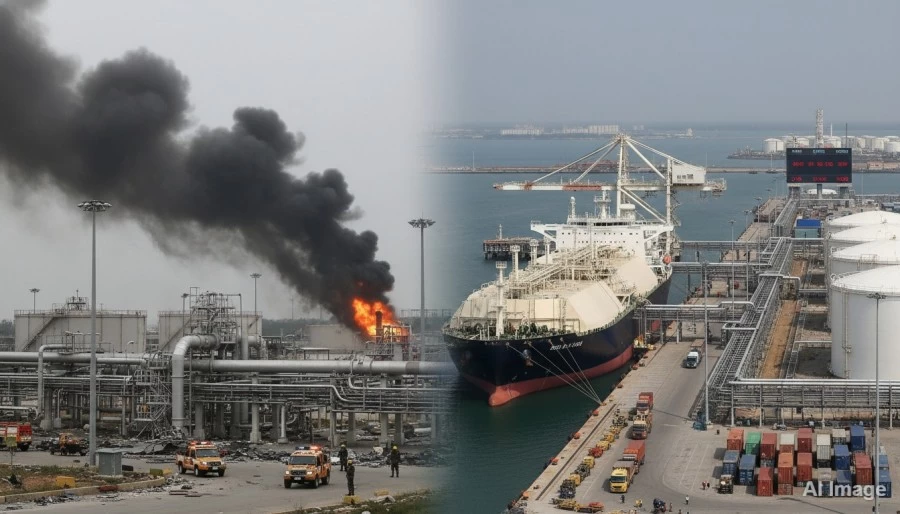
The escalating military conflict in West Asia has reached a critical point with direct strikes on vital energy infrastructure. Following an Israeli attack on Iran's South South Pars gas field, Tehran launched retaliatory strikes against gas and oil installations in Qatar, the United Arab Emirates, and Saudi Arabia. According to official reports, the most significant strike targeted QatarEnergy's Ras Laffan Industrial City in Qatar. As the world's largest LNG export plant, Ras Laffan handles approximately 77 to 80 million tons of LNG annually, accounting for nearly 20% of the global LNG trade. This escalation has placed the primary energy supply routes for Asia and Europe under immediate threat.
The Strategic Significance of Ras Laffan
The strike on Ras Laffan is a major development in the regional conflict due to its central role in the global energy market. This facility manages about one-fifth of the world's LNG exports. Regional data indicates that approximately 25% of global gas reserves are linked to the affected area, and nearly 20% of global oil flow passes through this volatile region. In addition to the Qatari facility, Saudi Arabian authorities confirmed that a gas plant in their Eastern Province was targeted, with ballistic missile fragments falling near a refinery in Riyadh. These coordinated strikes represent a direct challenge to the energy security of importing nations.
India's Gas Supply and Domestic Production Balance
India's natural gas consumption is met through a combination of domestic production and Liquefied Natural Gas (LNG) imports. Currently, about 50% of India's Piped Natural Gas (PNG) supply is sourced domestically from fields operated by companies such as ONGC and Reliance. The government prioritizes domestic gas for the household and transport sectors to ensure price stability and continuous supply. Officials have stated that no immediate disruption is expected for residential consumers or CNG vehicles, as these sectors remain at the top of the allocation hierarchy. However, the reliance on imports for the remaining 50% of the requirement leaves the industrial sector vulnerable to global supply shocks.
Dependency on Qatari LNG Imports
India is among the world's largest buyers of LNG, with imports expected to reach 24-25 million tons in 2025. A substantial portion of this volume, exceeding 50%, is sourced directly from Qatar through long-term contracts. While India also imports LNG from the United States, Australia, Russia, and parts of Africa, Qatar remains the most critical partner due to the scale and duration of existing agreements. The attacks on Qatari export infrastructure, specifically Ras Laffan, pose a direct risk to the scheduled delivery of these volumes, which are essential for India's fertilizer, power, and industrial sectors.
Logistics and the Strait of Hormuz
A critical logistical challenge for India is that 50% to 55% of its LNG imports must pass through the Strait of Hormuz. This narrow waterway is currently under heightened surveillance and control by Iranian forces. While diplomatic channels suggest that Iran has allowed Indian vessels to continue their passage, the overall security risk in the channel has increased, while unlike crude oil, for which India maintains strategic petroleum reserves, there are no strategic reserves for LNG. Gas is primarily stored as working inventory by utility companies, meaning any prolonged blockage or damage to export terminals could rapidly impact the domestic supply chain.
Petronet-QatarEnergy Deal and Diversification
5 million tons of LNG per year, a deal valued at approximately USD 78 billion. This agreement underscores the long-term energy partnership between the two nations. Data from Kpler shows that the United States has also emerged as a significant partner, becoming India's third-largest LNG supplier last year with a 12% share of total imports. Despite efforts to diversify sources, the sheer volume of Qatari supply means that any disruption at Ras Laffan remains a primary concern for Indian energy planners and policymakers monitoring the West Asian crisis.
