

- India,
- 19-Nov-2025 06:46 PM IST


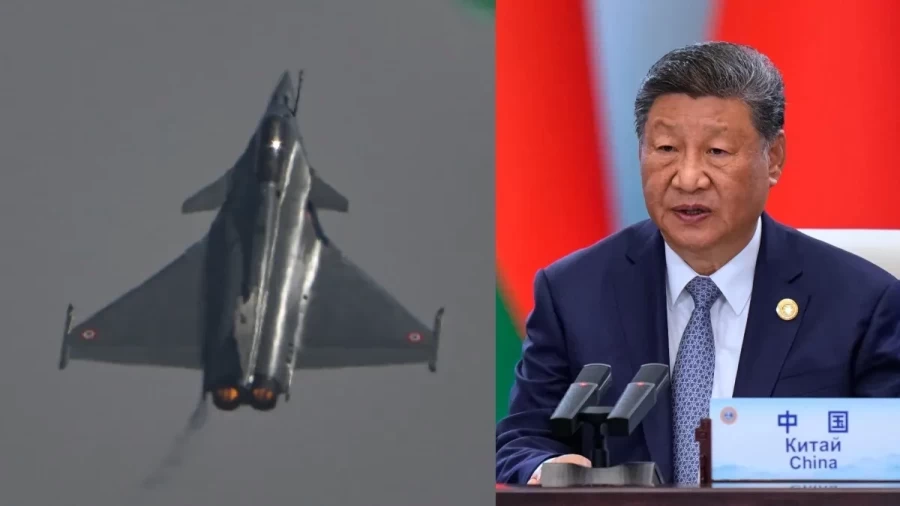
A shocking new report from the US-China Economic and Security Review Commission has unveiled a sophisticated disinformation campaign orchestrated by China against India's advanced Rafale fighter jets. This campaign reportedly took place during India's 'Operation Sindoor' in May, with the primary objective of discrediting the French-manufactured aircraft on the global stage and simultaneously elevating the perceived superiority of China's domestically produced J-35 fighter jet. This revelation from an authoritative American source underscores the increasing sophistication and strategic importance of information warfare in contemporary geopolitical rivalries. In May, India initiated 'Operation Sindoor,' a critical military operation aimed at neutralizing terrorist organizations operating from Pakistani soil, while this proactive measure was a direct response to persistent threats to regional security.
Following India's decisive action, the Pakistani Air Force attempted a retaliatory strike, launching an offensive against Indian positions. However, these attempts were met with strong resistance from the Indian forces and were ultimately thwarted, resulting in a significant failure for Pakistan's military objectives. During the heightened tensions, Pakistan made a sensational but entirely false claim: that it had successfully shot down an Indian Rafale fighter jet. This assertion was quickly debunked by India and international observers, revealing it to be a baseless fabrication. The recent US report now provides crucial context, suggesting that China actively capitalized on this volatile situation to further its own strategic agenda by amplifying such false narratives.
China's Deceptive Digital Warfare
The US-China Economic and Security Review Commission's report to Congress explicitly details China's involvement in a targeted disinformation campaign against the Rafale, while the report states that during the border dispute between India and Pakistan in May 2025 (as specified in the report section), China launched a concerted effort to spread misinformation. The core of this campaign involved the sophisticated use of artificial intelligence (AI). China leveraged AI technology to generate highly convincing, yet entirely fabricated, images. These images purported to show "debris" from aircraft that were allegedly destroyed by Chinese weapons. The intent was clear: to create visual "evidence" of the Rafale's vulnerability and China's military prowess. To ensure widespread dissemination and maximum impact, these AI-generated visuals were then propagated across numerous fake social media accounts. This network of inauthentic profiles was meticulously crafted to appear credible, allowing the disinformation to infiltrate various online communities. And influence public perception, thereby undermining confidence in the Rafale's capabilities and promoting the J-35 as a superior alternative.
A Broader Pattern of Global Influence Operations
The incident involving the Rafale is, according to the American report, not an isolated event but rather indicative of a larger, more pervasive pattern of China's engagement in digital deception and influence operations on a global scale. The report highlights similar activities observed in 2024, where pro-China online actors systematically employed advanced AI tools. These tools were used to create AI-generated news anchors and AI-generated profile photos, which were then deployed across a multitude of fake social media accounts. The strategic aim of these operations was to sow discord and deepen existing societal divisions within the United States, while by focusing on highly contentious and polarizing issues such as drug use, immigration policies, and abortion rights, these actors sought to manipulate public discourse, incite unrest, and undermine social cohesion, demonstrating a sophisticated understanding of psychological warfare in the digital age.
Escalating Cyber Warfare and Geopolitical Pressure
Beyond the realm of disinformation, the US report also meticulously documents China's aggressive and widespread cyber activities, which represent another critical dimension of its digital strategy. In 2024, Taiwan's National Security Bureau issued an alarming report, revealing that its government service networks were subjected to an average of 2. 4 million cyber attacks every single day. The overwhelming majority of these relentless attacks were unequivocally attributed to Chinese cyber forces, highlighting a sustained and intense campaign of digital espionage and disruption against Taiwan. On top of that, the report noted a significant cyber attack launched by China against the government of Palau in 2024, indicating a broader scope of targets. The report also sheds light on China's strategic use of economic use as a tool for geopolitical pressure. It specifically points out that China deliberately timed trade investigations and the imposition of tariffs to coincide with Taiwan's elections in 2024. This calculated move was designed to exert maximum economic and political pressure, attempting to influence electoral outcomes and shape Taiwan's political landscape in a manner favorable to Beijing.
Implications for International Security and Digital Integrity
The comprehensive revelations contained within the US-China Economic and Security Review Commission's report paint a stark picture of an evolving geopolitical landscape where digital warfare and information manipulation are becoming increasingly central to statecraft. China's calculated efforts to discredit advanced military hardware, such as the Rafale, through sophisticated AI-driven disinformation campaigns, coupled with its relentless and widespread cyber operations and strategic influence campaigns, collectively pose profound and multifaceted challenges to regional stability, international security, and the integrity of global information ecosystems. This multi-pronged and highly sophisticated approach to hybrid warfare necessitates not only heightened vigilance but also the development of solid and coordinated countermeasures from all nations committed to maintaining a free, open, and secure digital environment. The report serves as a critical warning, urging a re-evaluation of national security strategies in the face of these advanced digital threats.
