

- India,
- 12-Feb-2026 03:24 PM IST


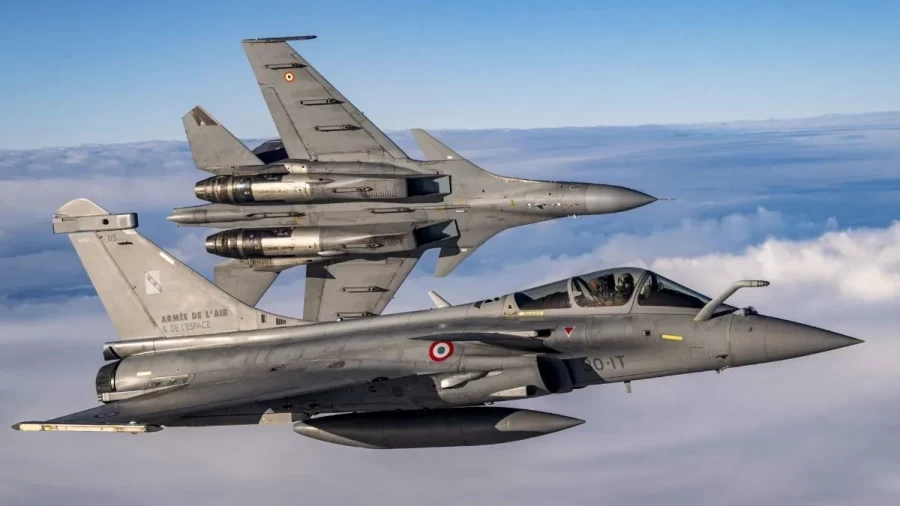
In a significant boost to India's aerial combat capabilities, the Union Government has officially approved the procurement of 114 new Rafale fighter jets for the Indian Air Force (IAF). The decision was finalized during a high-level meeting of the Defence Acquisition Council (DAC) chaired by Defence Minister Rajnath Singh. 25 lakh crore, represents one of the largest defense acquisitions in India's history, aimed at addressing the critical shortage of fighter squadrons.
5 lakh crore for the acquisition of the airframes, while the remaining ₹75,000 crore is earmarked for advanced weapon systems, spare parts, and comprehensive logistics support. Also, the DAC has approved the purchase of 6 P-8I maritime patrol aircraft worth ₹28,000 crore to enhance the Indian Navy's surveillance capabilities in the strategic Indian Ocean Region.
Financial Breakdown and the MRFA Program
The procurement of these 114 jets falls under the Multi-Role Fighter Aircraft (MRFA) program. 25 lakh crore investment is designed to ensure long-term operational readiness through India-specific enhancements and a strong maintenance framework. This acquisition is expected to follow a phased delivery schedule, ensuring that the IAF can replace its aging fleet of legacy aircraft while maintaining a technological edge over regional adversaries.
Lethal Weaponry: Meteor, SCALP, and HAMMER Missiles
The Rafale's combat superiority is largely attributed to its sophisticated arsenal. The aircraft is equipped with the Meteor missile, a world-leading air-to-air missile with a range exceeding 100km, providing Beyond Visual Range (BVR) dominance. For precision strikes against ground targets, the Rafale utilizes the SCALP cruise missile, capable of neutralizing enemy bunkers and infrastructure from 300-500km away. On top of that, the HAMMER (Highly Agile Modular Munition Extended Range) system allows for short-range precision strikes against hardened targets.
Advanced Avionics and Electronic Warfare Systems
Technologically, the Rafale features the RBE2 AESA radar, which can track up to 40 targets simultaneously and engage the most immediate threats. To ensure survivability in contested environments, the jet is integrated with the SPECTRA electronic warfare suite. This system provides 360-degree detection of threats and employs advanced jamming techniques to neutralize enemy radar and missile seekers. The inclusion of Helmet-Mounted Displays (HMD) allows pilots to access critical flight and targeting data without looking down at the cockpit instruments.
Strengthening Naval Aviation and Maritime Security
The government's focus extends beyond the Air Force to the maritime domain. The approval for 6 additional P-8I aircraft is a strategic move to counter increasing naval activities in the Indo-Pacific. This follows the earlier ₹63,000 crore deal for 26 Rafale-Marine (Rafale-M) jets, which are specifically designed for carrier-based operations. These naval variants will be deployed on the INS Vikrant and INS Vikramaditya, providing a unified and potent strike capability across both the Air Force and the Navy.
Expert Analysis on Strategic Impact
According to defense analysts, the addition of 114 Rafale jets will fundamentally alter the regional security dynamics. Experts suggest that the Rafale's proven performance in previous operations has established a clear air dominance for India. Analysts also point out that this deal may include provisions for technology transfer, which could benefit India's domestic aerospace industry under the 'Make in India' initiative. The integration of such high-end technology is seen as a vital step in modernizing the armed forces to meet contemporary security challenges.
To sum it all up, the approval of the 114 Rafale jet deal marks a pivotal moment in India's defense strategy. By combining massive firepower with cutting-edge electronic warfare capabilities, the Indian Air Force is set to achieve a significant leap in its operational effectiveness, ensuring the nation's sovereignty in an increasingly complex geopolitical landscape.
