
- India,
- 15-Aug-2026 08:32 PM IST



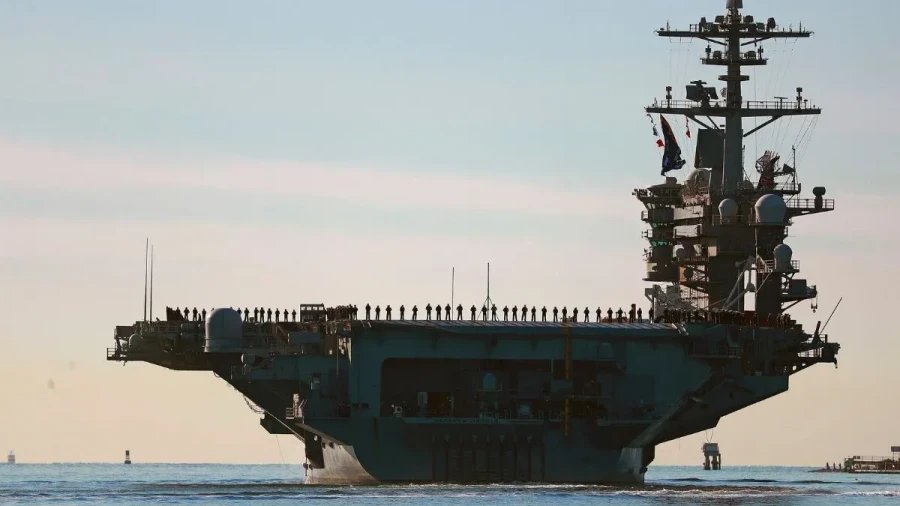
The United States Navy has officially announced that the aircraft carrier USS Abraham Lincoln is scheduled to return home after an extensive and grueling deployment in the Middle East that lasted for more than 250 days. This decision comes at a time when concerns regarding the mental health and declining morale of the sailors and Marines stationed on the vessel have reached a critical point. Acting Secretary of the Navy, Hung Cao, provided details regarding the carrier's return, emphasizing that the safety and well-being of the personnel remain the top priority for the naval leadership despite the operational demands of the region.
Scheduled Rotation and Official Statement
In a formal statement released on Friday, Hung Cao confirmed that the USS Abraham Lincoln has successfully completed its mission objectives during its time in the West Asian theater. He stated that the carrier performed its duties in a glorious manner and is now set to head back to the United States as part of a planned rotation. Cao reiterated that the security of the sailors and Marines is the primary concern of the Navy. He was quoted as saying, "USS Abraham Lincoln has completed its deployment gloriously and will return home soon under a scheduled rotation.
Concerns Over Mental Health and Morale
The announcement of the carrier's return follows a series of reports highlighting the difficulties faced by the crew during this prolonged deployment, while according to reports from CNN, the mental health of the sailors and the issue of low morale have become significant points of discussion. These concerns have caught the attention of members of the US Congress and the families of the sailors, who have raised questions about the impact of such a long stay at sea. The stress of the mission and the extended time away from home have reportedly taken a toll on the personnel on board.
Extended Deployment in the Arabian Sea
The USS Abraham Lincoln was deployed to West Asia to support American operations amidst tensions and conflict involving Iran. It has been stationed in the Arabian Sea for more than 250 days, a period during which the conflict has entered its 6th month. One of the most striking details of this deployment is that the aircraft carrier has not docked at any port for more than 200 days. This continuous presence at sea without the opportunity for the crew to have port leave has been identified as a major factor contributing to the exhaustion and mental strain of the sailors.
Operational Necessity and the Reality of War
Hung Cao explained that the deployment of the USS Abraham Lincoln was extended beyond its original schedule because it was deemed necessary for the ongoing operations at that time. While acknowledging the strategic importance of the carrier's presence, he also admitted the hardships associated with long-term combat deployments. Cao noted that military leaders must find a balance between the requirements of war and the welfare of the troops. He remarked, "USS Abraham Lincoln's deployment was extended because it was needed in operations at that time. However, continuous deployment is difficult. Deployment in combat operations is even more difficult.
Reports of Extreme Distress
The situation on the carrier has been described as increasingly tense. Recent claims have surfaced suggesting that the pressure of the deployment led to extreme incidents, including reports that some US sailors attempted to jump off the USS Abraham Lincoln. These reports have added urgency to the discussions regarding the sailors' well-being and the necessity of bringing the carrier back for a scheduled rotation. The leadership has acknowledged that in long deployments, uncertainty and changes are inevitable, but the human cost must be managed by military commanders.