

- India,
- 23-Feb-2026 09:49 PM IST


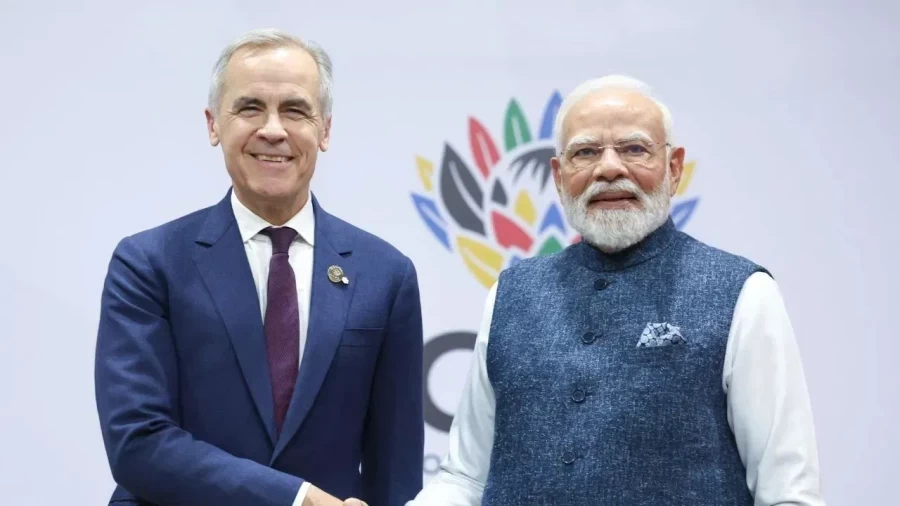
Canadian Prime Minister Mark Carney is scheduled to undertake an official visit to India, Australia, and Japan from February 26 to March 7. According to an official statement from the Prime Minister’s Office, Carney will commence his Indian tour in Mumbai before proceeding to New Delhi for bilateral discussions with Prime Minister Narendra Modi. This marks Carney's first official visit to India, focusing on exploring new opportunities in trade, energy, technology, artificial intelligence (AI), and defense.
The high-level engagement comes at a time when both nations are seeking to elevate their economic partnership. Prime Minister Narendra Modi previously visited Canada in June 2025 for the G7 Summit at Carney's invitation. During the upcoming visit, Carney is expected to meet with prominent business leaders in Mumbai to encourage investment in Canada and facilitate new commercial agreements between the two countries.
Roadmap for $70 Billion Bilateral Trade Target
India and Canada have set an ambitious target to increase bilateral trade to $70 billion by the year 2030.8 billion and $31 billion. To achieve the projected growth, both governments are working toward a Comprehensive Economic Partnership Agreement (CEPA).
During the 2025 G20 Summit, both nations agreed to resume formal negotiations on CEPA. Carney's visit is expected to provide momentum to these talks, addressing trade barriers and enhancing market access, while according to Canadian officials, expanding trade ties with India is a cornerstone of Canada’s Indo-Pacific Strategy, which emphasizes economic diversification and supply chain resilience.
Cooperation in Energy, AI, and Defense Sectors
A significant portion of the bilateral agenda will focus on energy security and clean technology. Canada possesses vast natural resources and critical minerals essential for India’s growing energy demands and green transition goals, while discussions are likely to cover technical cooperation in nuclear energy and renewable sectors. Plus, both nations aim to collaborate on AI and advanced technologies through talent exchange and joint research initiatives.
On the defense and security front, India and Canada are looking to enhance cooperation in maritime security and defense manufacturing. Ensuring stability in the Indo-Pacific region remains a shared priority. The Canadian PMO stated that Canada intends to use its technical expertise to become a reliable security partner for India, fostering a deeper strategic alignment.
Diplomatic Engagements in Australia and Japan
Following his visit to India, Prime Minister Carney will travel to Sydney and Canberra to meet with Australian Prime Minister Anthony Albanese. A highlight of this leg will be Carney’s address to both houses of the Australian Parliament, the first such address by a Canadian Prime Minister in nearly 20 years. The discussions in Australia will center on defense, maritime security, critical minerals, and advanced technologies like AI.
The final leg of the tour will take Carney to Tokyo for a meeting with Japanese Prime Minister Sanae Takaichi. The agenda in Japan includes clean energy, advanced manufacturing, food security, and defense cooperation. Carney emphasized that Canada’s wealth of energy, minerals, and technical expertise is in high demand globally, and the country is actively building international partnerships to strengthen its economy and security.
Enhancing Economic Resilience through Global Partnerships
The Canadian Prime Minister’s Office highlighted that amidst global economic uncertainty, Canada is focused on building a more resilient and self-reliant economy. The government’s strategy involves strengthening domestic industries while expanding trade footprints abroad and attracting significant foreign direct investment. Partnering with a rapidly growing economy like India is viewed as vital for Canada’s long-term economic objectives.
According to officials, the visit isn't only about trade figures but also about reinforcing the cultural and talent-based ties between the two nations. The large Indian diaspora in Canada and the significant flow of students have created a strong social foundation, which the current administration seeks to translate into tangible economic and strategic gains.
