

- India,
- 24-Nov-2025 05:00 PM IST
- (Updated 24-Nov-2025 02:12 PM IST)


The long-standing friction between China and Taiwan has escalated into a new diplomatic confrontation, now involving Japan. China has consistently maintained an aggressive stance towards Taiwan, viewing it as an inseparable part of its territory and repeatedly asserting that it won't shy away from military action to achieve reunification, while against this backdrop, recent remarks by a prominent Japanese political figure concerning Taiwan have provoked a strong reaction from Beijing, Importantly heightening diplomatic tensions between the two major Asian powers.
China's Strong Rebuke to Japan's Statement
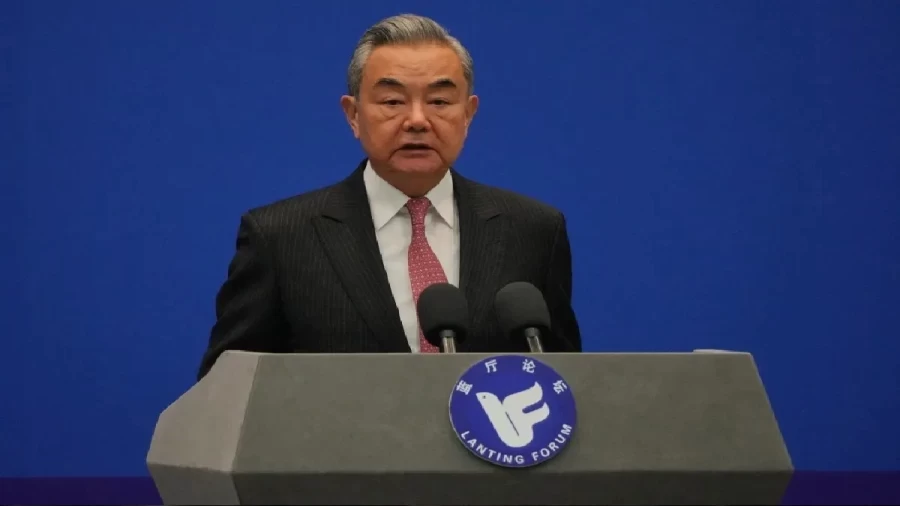
Chinese Foreign Minister Wang Yi has voiced strong objections to the statement made by Japan's new leader, Sanae Takaichi. Wang Yi explicitly stated that Takaichi had "crossed a line" with her comments regarding military intervention in Taiwan. According to a post on the Chinese Foreign Ministry's website, remarks made by Japan's Prime Minister Sanae Takaichi earlier this month were described as "stunning. " Takaichi reportedly suggested that a Chinese naval blockade or any other action against Taiwan could serve as grounds for a retaliatory military response from Japan. China has interpreted this statement as a direct challenge to its sovereignty and territorial integrity.
China Demands a 'Firm Response'
In his statement, Wang Yi emphasized that current Japanese leaders, by publicly discussing military intervention in the Taiwan issue, have sent "wrong signals. " He asserted that they've uttered words they shouldn't have and, in doing so, have "crossed a line" they shouldn't have approached. China views Taiwan as an internal affair, and any external interference is deemed unacceptable, while beijing considers Japan's comments a violation of international laws and diplomatic norms, posing a threat to regional stability. Chinese Foreign Minister Wang Yi further stated that China must "firmly respond" to Japan's actions, while tensions between the two nations have been escalating in the weeks following Takaichi's statement. Beijing has also taken the matter to an international forum. China has sent a formal letter to United Nations Secretary-General António Guterres, criticizing Takaichi for violating international laws and diplomatic rules, while this move underscores the seriousness with which China views the issue and its unwillingness to take Japan's actions lightly.
President Xi Jinping's Recent Stance on Taiwan
This development comes shortly after Chinese President Xi Jinping made a significant statement regarding Taiwan. During a ceremony held at Beijing's Great Hall of the People to celebrate the 76th anniversary of the founding of the People's Republic of China, Xi Jinping declared that China would firmly oppose separatist activities and external interference concerning Taiwan's independence. He reiterated China's unwavering commitment to resolutely safeguard national sovereignty and territorial integrity. This statement, made prior to the Japanese leader's comments, highlights China's consistent and firm position on Taiwan.
The Historical Division of China and Taiwan
China and Taiwan separated in 1949 during a civil war. The Communist Party came to power in mainland China, while the defeated Nationalist Party forces retreated to Taiwan, where they established their own government, while since then, China has regarded Taiwan as a breakaway province that must be reunited with the mainland, even if by force. The Chinese military regularly dispatches fighter jets and warships into Taiwan's airspace and waters, and in recent years, it has conducted large-scale military exercises in the region, serving as a means to assert its claim of sovereignty over Taiwan. Japan's recent comments have further complicated this already sensitive and volatile issue.
