

- India,
- 23-Dec-2025 05:55 PM IST


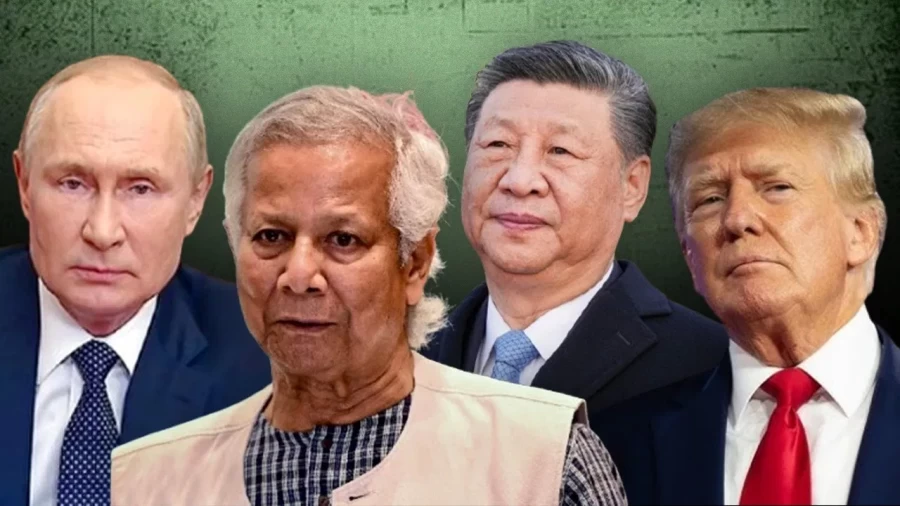
Bangladesh is currently experiencing a volatile political climate marked by pre-election violence, drawing significant attention from global superpowers. The reactions from China, the United States, and Russia offer crucial insights into their perspectives on Bangladesh's interim government and its future trajectory. While both China and the US have maintained a neutral stance on the ongoing turmoil, Russia. Has taken a more critical approach, urging the Yunus government to mend its relations with India. These international responses highlight the complex interplay of global powers in. Bangladesh's internal affairs, shaping the narrative around its upcoming parliamentary elections.
China's Measured and Neutral Stance
In response to the unrest in Bangladesh, China has issued a carefully worded and neutral statement, while a spokesperson for China's Ministry of Foreign Affairs described the situation as 'regrettable' and expressed Beijing's hope for safe, stable, and smooth parliamentary elections in Bangladesh. China believes that through elections, various sectors in Bangladesh will appropriately advance important political agendas. Beijing has urged all parties to abandon violence and uphold national unity and stability. This statement is particularly noteworthy given that the interim government of Bangladesh, led by Mohammad Yunus, has been in continuous contact with China since the ouster of Sheikh Hasina. Chief Advisor Mohammad Yunus met with Chinese President Xi Jinping earlier this year in May. During that visit, Yunus had reportedly offered Bangladesh's support to China on the 'Chicken Neck' issue, a statement that drew a strong reaction from India. China's current statement makes no mention of Yunus or his allegations, clearly indicating its intention to avoid directly endorsing any party during this sensitive period, instead prioritizing a stable Bangladesh.
The United States' Evolving Position and Neutrality
When Sheikh Hasina was ousted in August 2024, questions arose regarding the United States' role. Leaders of the Awami League openly blamed the US for the coup, and Sheikh Hasina herself, on multiple occasions, accused the US of facilitating Yunus's ascent to power, while according to Hasina, Yunus was appointed Chief Advisor at the behest of the United States. However, with the current political upheaval in Bangladesh, the US has adopted a neutral position. America is neither issuing statements in support of Yunus nor against Sheikh Hasina, while recently, on Monday (December 22), Mohammad Yunus held discussions with US Special Envoy Sergio Gor. During this meeting, Yunus leveled serious accusations against Sheikh Hasina, claiming that Awami League members were instigating violence to destabilize the environment. However, Gor refrained from commenting on these allegations, merely emphasizing the importance of conducting elections peacefully, while this response underscores the US's current policy of neutrality, seeking to promote stability without taking sides in the domestic political conflict.
Russia's Direct Critique and Historical Reminder
Russia has been notably critical of the Yunus government amidst the unrest in Bangladesh, delivering a clear message. Speaking to journalists in Dhaka, Russian Ambassador Alexander Khozin stated that it would be beneficial for Bangladesh to mend its relations with India soon. The Russian Ambassador also invoked the historical context of 1971, recalling India's pivotal role in the creation of Bangladesh and Russia's support to both India and Bangladesh at that time, while khozin explicitly warned that going against India wouldn't serve Bangladesh's welfare. He advised the Yunus government to learn from history and prioritize de-escalating. Tensions with India to foster a conducive environment before the upcoming elections. Russia's strong statement serves as a significant warning to Bangladesh's interim government, prompting it to seriously consider its foreign policy and regional relationships, particularly with a crucial neighbor like India.
Electoral Atmosphere and International Pressure in Bangladesh
The atmosphere leading up to the parliamentary elections in Bangladesh remains tense and marred by violence. The appeals from all three superpowers for an immediate end to the violence signal the international community's desire for stability in Bangladesh. While China and the US's neutral stance encourages all parties to seek peaceful resolutions, Russia's direct intervention and advice to improve relations with India present a complex challenge for Bangladesh's interim government, while the Yunus administration must not only maintain internal peace and order but also carefully navigate its foreign policy to balance relations with regional and global powers. The interim government, led by Mohammad Yunus, faces numerous challenges. On one hand, it must control domestic violence and ensure fair elections, while on the other, it needs to balance international relations. China's neutrality despite Yunus's hopes for support, the US's step back from its perceived previous role, and Russia's direct intervention regarding relations with India all contribute to a complex diplomatic puzzle for the Yunus government. De-escalating tensions with India and maintaining regional stability would be in Bangladesh's long-term interest, as indicated by the Russian Ambassador. By addressing these challenges, Bangladesh can move towards a stable and democratic future.
