

- India,
- 19-Nov-2025 07:42 AM IST


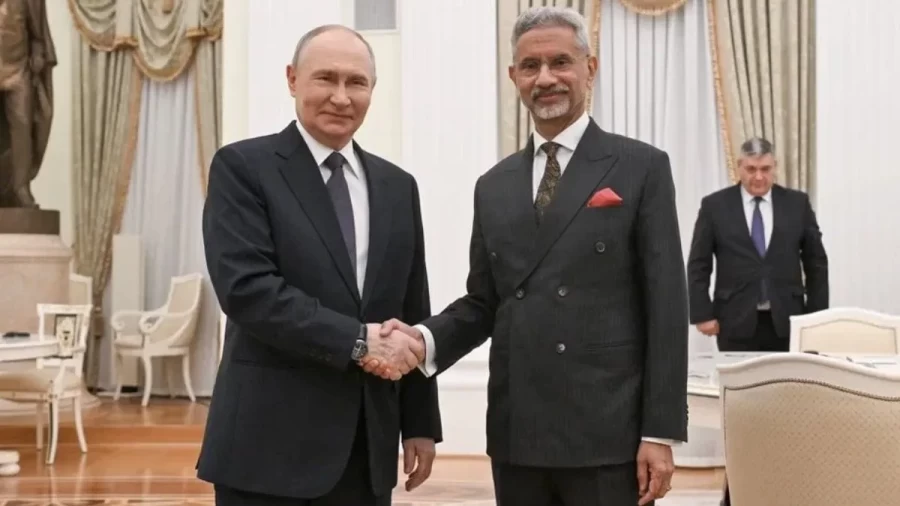
India's External Affairs Minister (EAM) S. Jaishankar recently concluded a significant visit to Moscow, where he held a high-level meeting with Russian President Vladimir Putin. This diplomatic engagement underscores the enduring strategic partnership between India and Russia,. Characterized by regular high-level interactions and a shared commitment to strengthening bilateral ties. During the meeting, EAM Jaishankar conveyed Prime Minister Narendra Modi's warm greetings and best. Wishes to President Putin, reflecting the strong personal rapport between the leaders of both nations.
High-Level Diplomatic Engagement
The meeting between EAM Jaishankar and President Putin was particularly significant as it took place in the run-up to the eagerly anticipated India-Russia annual summit. Jaishankar briefed President Putin on the preparations for the upcoming summit, providing insights into the agenda and potential outcomes. Beyond bilateral matters, the discussions also encompassed a wide array of regional. And global events, allowing both leaders to exchange perspectives on pressing geopolitical issues. Following the meeting, EAM Jaishankar took to social media platform 'X' to express his. Honor, stating, "Honoured to call on President Vladimir Putin of Russia in Moscow today. Conveyed the greetings of PM @narendramodi. Briefed him on our bilateral cooperation and the preparations for the upcoming India-Russia Annual Summit. Also exchanged views on regional and global developments. Value his thoughts and guidance for further strengthening our relationship. " This statement highlights the mutual respect and the comprehensive nature of their dialogue.
Pre-Summit Discussions
The India-Russia annual summit is a pivotal event in the bilateral calendar, serving as a platform for major decisions across various sectors, while the discussions between Jaishankar and Putin indicate that both sides are actively working towards ensuring a productive summit. Such pre-summit engagements are crucial for finalizing agendas, deliberating on potential agreements, and resolving any outstanding issues, thereby ensuring smooth and impactful outcomes during the summit. This lays the groundwork for future cooperation in areas such as trade, defense, energy security, and cultural exchanges, reinforcing the multifaceted nature of their strategic partnership.
SCO Council of Heads of Government Meeting
In addition to his bilateral meeting with President Putin, EAM Jaishankar also met with President Putin alongside other heads of government delegations from the Shanghai Cooperation Organization (SCO). This multilateral engagement underscores the importance of collective cooperation within the SCO framework. The 24th meeting of the SCO Council of Heads of Government was held in Moscow on November 17 and 18, focusing on enhancing economic, cultural, and humanitarian cooperation among member states. Jaishankar's presence at both bilateral and multilateral forums in Moscow highlights India's active role in regional and global diplomacy.
India's Firm Stance on Terrorism
During his address at the SCO Council of Heads of Government meeting, EAM Jaishankar unequivocally reiterated India's firm and unwavering stance against terrorism. He emphasized that terrorism, in all its forms and manifestations, has no justification whatsoever and can't be condoned or whitewashed. This powerful statement firmly positions India's 'zero tolerance' policy on terrorism on the global stage, reflecting the nation's steadfast commitment to combating this pervasive threat to national and international security. India has consistently advocated for a unified global approach to counter terrorism.
Recalling SCO's Core Mandate
Jaishankar reminded the SCO member states of the organization's foundational principles. He stressed that the SCO was established with the primary objective of combating the "three evils" of terrorism, separatism, and extremism. He cautioned that these threats have only grown more severe over the years, necessitating enhanced collective efforts from the organization to tackle these challenges effectively, while this reminder serves to refocus the SCO on its core purpose and to galvanize its members towards more solid strategies for addressing regional security threats.
Global Call for Action
The External Affairs Minister issued a strong call for a unified global response to terrorism. He asserted, "The whole world must adopt a 'zero tolerance' policy against all forms of terrorism, while " This appeal urges the international community to adopt a concerted and coordinated approach against all forms and manifestations of terrorism, including dismantling its financing, support networks, and safe havens. India has consistently maintained that terrorism is a global menace that requires a global solution, transcending national boundaries and political considerations. In his address, Jaishankar also underscored India's inherent right to protect its national interests. He unequivocally stated that India has every right to protect its citizens and will do so at any cost. This declaration highlights India's sovereignty and its resolute commitment to ensuring the safety and security of its people, particularly in the context of cross-border terrorism. It signals that India won't hesitate to take all necessary measures to safeguard its security from any threats.
Appeal for SCO Reforms
Jaishankar appealed to the SCO to adhere to its founding principles while also emphasizing the need for reforms within the organization. This suggestion aims to adapt the SCO to the evolving geopolitical landscape and enhance its effectiveness. Reforms could potentially involve streamlining decision-making processes, strengthening mechanisms for counter-terrorism cooperation, and broadening the scope of its activities to better serve the interests of its member states in a dynamic global environment.
SCO Meeting Details and Membership
The 24th meeting of the SCO Council of Heads of Government concluded in Moscow on November 17 and 18. The SCO is a crucial regional organization comprising India, Russia, China, Pakistan, Kazakhstan, Kyrgyzstan, Tajikistan, Uzbekistan, Iran, and Belarus as member states. It plays a significant role in promoting security, economic, and political cooperation across the Eurasian region. EAM Jaishankar's visit provided a vital opportunity to reinforce bilateral ties and articulate India's positions on multilateral platforms.
