

- India,
- 27-Feb-2026 12:38 PM IST


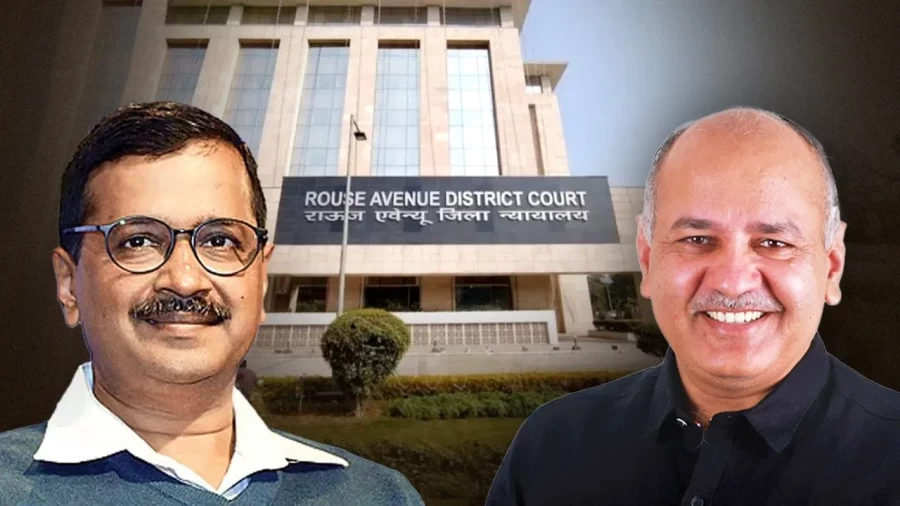
In a significant legal development, the Rouse Avenue Court in Delhi has acquitted all 23 accused, including former Chief Minister Arvind Kejriwal and former Deputy Chief Minister Manish Sisodia, in the corruption case registered by the Central Bureau of Investigation (CBI) related to the now-scrapped Delhi Excise Policy 2021-22. Special Judge Jitendra Singh delivered the judgment, stating that the prosecution failed to establish the charges of criminal conspiracy and corruption against the individuals named in the chargesheet. The verdict marks a major turn in the long-standing legal battle surrounding the national capital's liquor trade regulations.
Judicial Observations on CBI Investigation
While delivering the judgment, Special Judge Jitendra Singh made several critical observations regarding the CBI's probe. The court noted that the investigative agency's case was largely built on conjectures and assumptions rather than concrete evidence, while according to the court, there was insufficient material to prove that a conspiracy was hatched to manipulate the excise policy for personal or political gains. The judge pointed out significant flaws in the chargesheet and remarked that the facts weren't presented with the required legal rigor. The court emphasized that in criminal jurisprudence, allegations must be backed by substantial proof, which was found lacking in this instance, while the judgment highlighted that the CBI couldn't demonstrate how the policy decisions directly translated into the alleged illegal acts by the accused.
Background of the Alleged Excise Scam
The controversy dates back to July 2022, when Delhi Lieutenant Governor VK Saxena recommended a CBI probe based on a report by the Chief Secretary. The CBI registered an FIR on July 20, 2022, alleging that the Delhi Excise Policy for 2021-22 was modified to facilitate monopolization and cartelization in the liquor trade. The agency claimed that the policy resulted in a loss of approximately ₹2,026 crore to the state exchequer. It was further alleged that licenses were issued to blacklisted companies and that the 'South Group' was given undue favors in exchange for kickbacks, while manish Sisodia, who held the excise portfolio at the time, was arrested in February 2023, while Arvind Kejriwal was arrested later in connection with the same investigation.
Details of the 23 Acquitted Individuals
The acquittal extends to all 23 individuals and entities named by the CBI in its multiple chargesheets. The list includes prominent political figures such as Arvind Kejriwal, Manish Sisodia, and BRS leader K. Kavitha. Other key individuals acquitted are Vijay Nair (former AAP communications in-charge), Abhishek Boinpally, Arun Ramachandra Pillai, Mutha Gautham, Sameer Mahendru, Amandeep Singh Dhall, Arjun Pandey, Buchi Babu Gorantla, Rajesh Joshi, Damodar Prasad Sharma, Prince Kumar, Arvind Kumar Singh, Chanpreet Singh Rayat, Durgesh Pathak, Amit Arora, Vinod Chauhan, Ashish Chand Mathur, and Sarath Chandra Reddy, while officials Kuldeep Singh and Narendra Singh were also cleared of all charges. The court ordered the immediate discharge of their bail bonds and the release of any seized personal property related to this specific case.
Legal Implications and Future Course of Action
The Aam Aadmi Party (AAP) has welcomed the court's decision, describing it as a validation of their leaders' integrity. Arvind Kejriwal stated that the verdict proves the allegations were politically motivated. However, the legal proceedings aren't entirely over, while the CBI has indicated its intention to challenge the acquittal in the Delhi High Court. Plus, the Enforcement Directorate (ED) is pursuing a separate money laundering case related to the same excise policy. While the CBI case focused on corruption and conspiracy, the ED case deals with the alleged flow of proceeds of crime, while legal experts suggest that since the CBI's predicate offense has resulted in an acquittal, it may Importantly impact the sustainability of the ED's ongoing prosecution, although the two cases are technically independent under the Prevention of Money Laundering Act (PMLA).
