

- India,
- 12-Feb-2026 11:18 AM IST


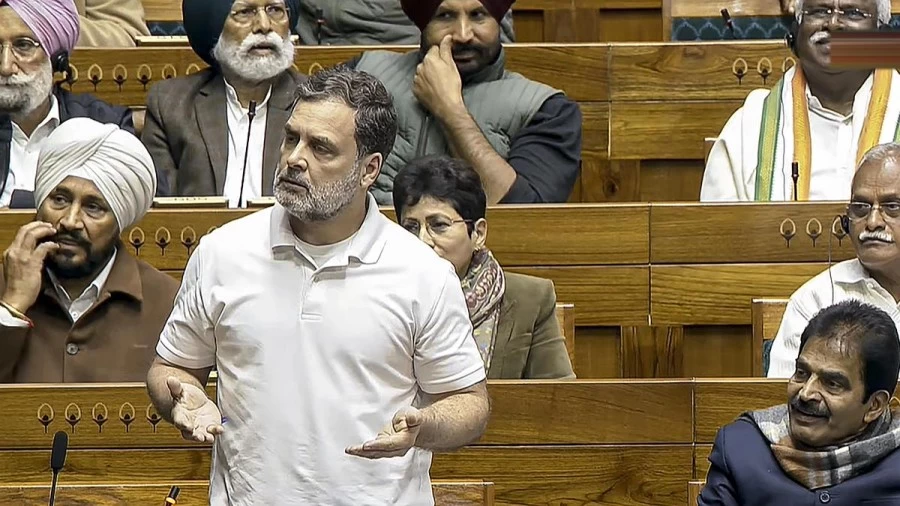
NEW DELHI: The political standoff in the Lok Sabha has intensified as the Union Government explores the possibility of moving a privilege motion against the Leader of the Opposition, Rahul Gandhi. This development follows controversial remarks made by the Congress leader regarding a purported trade agreement between India and the United States during the ongoing budget discussions, while on Thursday, the proceedings of the Lower House were severely disrupted as opposition members entered the well with placards and posters, leading to a suspension of the Question Hour. The House, which convened at 11:00AM, was adjourned within 7minutes until 12:00PM by the presiding officer, KP Tenneti, due to continuous sloganeering and protests.
Core Controversy and Allegations by Rahul Gandhi
The controversy stems from statements made by Rahul Gandhi on Wednesday, where he alleged that the government had surrendered national interests through a trade deal with the US. He claimed that the government had effectively sold out and that future decisions regarding India's oil procurement would be dictated by Washington rather than the Indian Prime Minister, while these assertions were met with strong resistance from the treasury benches. Parliamentary Affairs Minister Kiren Rijiju stated that the allegations were entirely baseless and aimed at misleading the House. The Minister indicated that such conduct warrants a privilege motion to maintain the sanctity and factual integrity of parliamentary discourse.
The Framework of Parliamentary Privilege and Article 105
Under Article 105 of the Indian Constitution, Members of Parliament (MPs) are granted specific privileges and immunities to ensure they can perform their duties without fear or external interference. These include freedom of speech within the House and immunity from court proceedings regarding any statement made during sessions. However, these privileges are subject to the rules of the House. A breach of privilege occurs when a member deliberately provides false information or acts in a manner that lowers the dignity of the institution. The procedure involves a member giving notice to the Speaker, who then determines the validity of the claim. If the Speaker finds merit, the matter is referred to the Committee of Privileges for a detailed investigation and subsequent report.
Procedural Steps and Potential Sanctions
Once the Committee of Privileges investigates the matter, it submits its findings to the House. If a member is found guilty of a breach of privilege or contempt of the House, several disciplinary actions can be taken. These range from a formal reprimand or warning to suspension from the service of the House for a specific duration. In extreme cases, the House has the authority to order the detention of the individual, though such instances are exceptionally rare in contemporary practice. While Minister Rijiju has not specified the exact timeline for moving the motion, the government's intent signals a firm stance against what it terms as misinformation regarding international agreements and national sovereignty.
Analysis of Parliamentary Conduct and Current Standoff
According to parliamentary analysts, the responsibility for the accuracy of statements made on the floor lies with the member making them. Experts suggest that while political rhetoric is common, allegations involving national sovereignty and international relations are viewed with higher scrutiny, while the current friction reflects a broader divide between the government and the opposition over economic policies and foreign trade. The opposition maintains that it's exercising its right to question the executive, while the government argues that the sanctity of the House is being compromised by unsubstantiated claims. The progression of this privilege motion will depend on the Speaker's assessment of the evidence provided by the government regarding the alleged misleading nature of the statements.
