

- India,
- 10-Feb-2026 10:50 AM IST


The controversy surrounding the unauthorized leak of former Indian Army Chief General Manoj Mukund Naravane's memoir, titled 'Four Stars of Destiny', has escalated into a legal battle. The Delhi Police Special Cell has registered a First Information Report (FIR) following a clarification from the publisher, Penguin Random House India (PRHI). The publisher has formally stated that the book has not yet been published or released for public consumption, making any current circulation illegal under copyright laws.
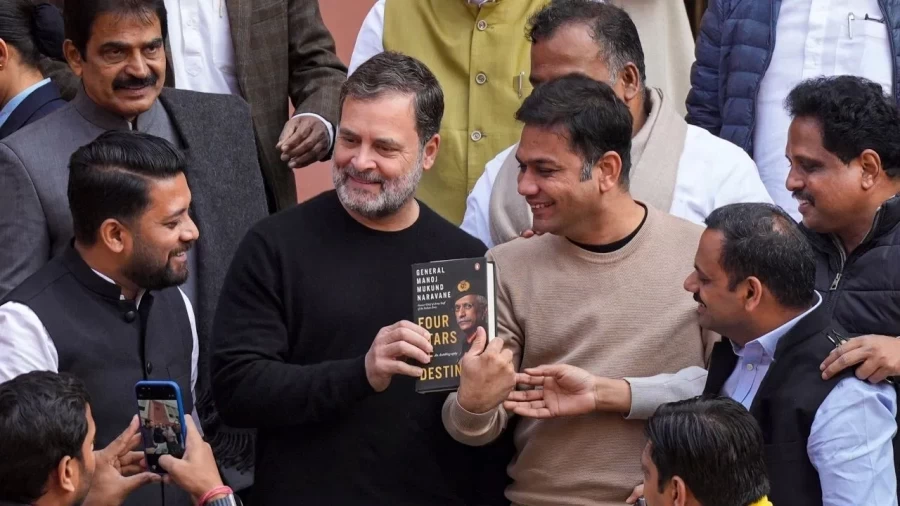
The issue gained significant traction during the recent Budget Session of Parliament when Rahul Gandhi, the Leader of the Opposition in the Lok Sabha, attempted to cite excerpts from the unpublished memoir. This political reference triggered widespread curiosity and led to the circulation of unauthorized digital copies. PRHI has since moved to protect its exclusive publishing rights, emphasizing that no version of the book has been authorized for distribution or sale.
Publisher's Official Statement and Copyright Warning
In a detailed statement, Penguin Random House India clarified that it holds the sole and exclusive rights to publish, distribute, and sell General Naravane's memoir. The publishing house categorically denied releasing any copies, whether in print or digital format, to the public, while they highlighted that any version currently in circulation—be it a full manuscript, a PDF, or an online copy—is a direct violation of PRHI's intellectual property rights.
The publisher has issued a stern warning against the illegal dissemination of the book's content. According to PRHI, the unauthorized sharing of the memoir on social media platforms and messaging apps must cease immediately. The company has indicated that it will pursue rigorous legal action against individuals or entities found responsible for the leak or further distribution of the copyrighted material.
Political Context and Parliamentary Developments
The memoir became a focal point of political debate after Rahul Gandhi was seen with a copy of the book within the Parliament complex. Gandhi intended to read portions of the memoir during the discussion on the Motion of Thanks to the President's Address on February 2. However, he was prevented from doing so because the book had not been officially published, and its contents couldn't be authenticated on the floor of the House.
The attempt to use an unpublished military memoir in a parliamentary debate raised questions about how the manuscript reached political circles. Under parliamentary rules, members are generally discouraged from quoting documents that aren't in the public domain or whose authenticity is under question. The leak is viewed with concern not just as a commercial issue but also as a matter involving the memoirs of a former top military official.
Delhi Police Investigation and Special Cell Action
According to the Delhi Police, the Special Cell is currently investigating the circumstances under which the unpublished manuscript was leaked. The FIR was registered to probe the breach of confidentiality and the violation of the Copyright Act. Investigators are looking into the digital trail to identify the source of the leak, focusing on whether the breach occurred at the publishing, printing, or distribution stage.
Police sources suggest that technical teams are analyzing the metadata of the circulated PDF files to trace their origin. Penguin Random House India is reportedly cooperating fully with the authorities to ensure that the unauthorized distribution is halted. Legal experts note that such leaks involving high-profile memoirs are rare and pose a significant challenge to the traditional publishing timeline and security protocols.
Analytical Perspective and Future Implications
According to industry analysts, the leak of a high-profile memoir like General Naravane's underscores the vulnerabilities in the digital publishing chain, while analysts suggest that the legal intervention by the Delhi Police is a necessary step to safeguard intellectual property in an era where digital piracy is rampant. From a journalistic perspective, the incident highlights the intersection of military history, political discourse, and legal frameworks governing copyright.
So, to wrap up, the memoir 'Four Stars of Destiny' remains officially unpublished, and its unauthorized circulation is now the subject of a criminal investigation, while the outcome of the Delhi Police probe will likely determine the accountability for the leak. Until an official release date is announced by Penguin Random House India, any copy of the book currently available is considered an illegal version, and its possession or distribution may carry legal consequences.
