

- India,
- 05-Feb-2026 05:59 PM IST


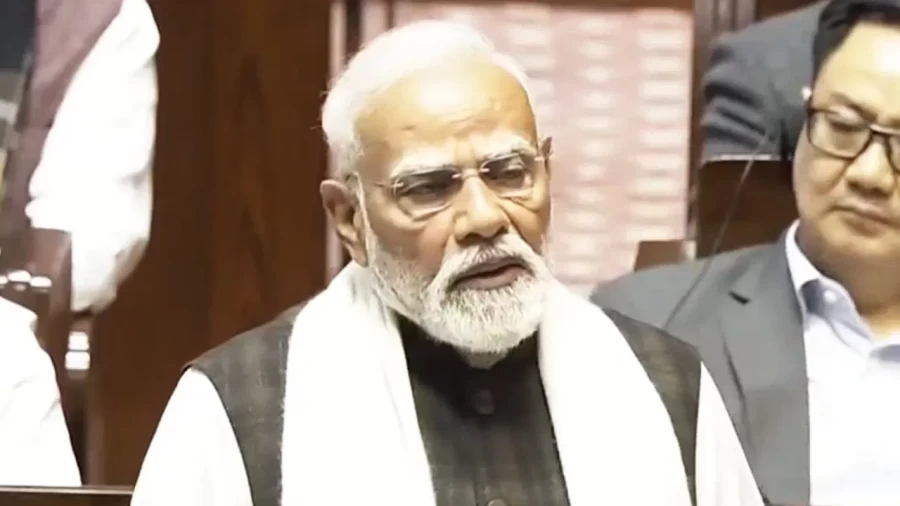
Prime Minister Narendra Modi addressed the Rajya Sabha on Thursday during the discussion on the Motion of Thanks to the President's Address. In a comprehensive speech, the Prime Minister outlined India's trajectory toward becoming a developed nation, emphasizing that the second quarter of the 21st century would be decisive for the country's growth. He asserted that India has reached a pivotal stage where momentum must be maintained to achieve long-term national goals, highlighting the country's high growth and low inflation as pillars of economic strength.
Global Trade Partnerships and the 'Mother of All Deals'
The Prime Minister underscored India's rising stature as a trusted global partner. ' According to the Prime Minister, these future-ready trade agreements with entities like the European Union and the United States are being recognized globally for their potential to enhance international stability. He noted that the world's inclination toward India is a result of consistent policy reforms and the country's emerging role as a leader of the Global South.
Banking Sector Transformation and NPA Management
Focusing on the financial sector, PM Modi criticized the pre-2014 'phone banking' era, alleging that political interference led to indiscriminate lending and pushed the banking system toward a crisis. He detailed the reforms undertaken by his government, including the strategic merger of weak public sector banks and the implementation of transparent lending norms. The Prime Minister stated that the mountain of Non-Performing Assets (NPAs) has been Importantly reduced, restoring the health of the banking system. Plus, he highlighted that under the Mudra Yojana, over ₹30 lakh crore has been disbursed to young entrepreneurs, fostering a culture of self-reliance.
Performance of PSUs and MSME Strengthening
The Prime Minister addressed the performance of Public Sector Undertakings (PSUs), stating that the previous mindset of viewing them as failing entities has been replaced with a focus on efficiency and profitability. He cited the record profits of LIC, SBI, and HAL as evidence of successful reforms. PM Modi also emphasized the role of the MSME network in strengthening the national economy, noting that a solid small-scale industry increases global confidence in India's manufacturing capabilities. He criticized the opposition for spreading misinformation regarding the stability of these key financial and industrial institutions.
Agricultural Support and the Shift to NITI Aayog
Regarding the agricultural sector, the Prime Minister highlighted the government's commitment to small farmers who own less than two hectares of land. He stated that through the PM-Kisan Samman Nidhi, approximately ₹4 lakh crore has been directly transferred to the bank accounts of 10 crore farmers. PM Modi also contrasted the current governance model with the past, citing an anecdote from Indira Gandhi's tenure to illustrate the limitations of the erstwhile Planning Commission. He explained that the transition to NITI Aayog has enabled more flexible and technology-driven implementation of policies, such as the 'Pragati' platform, ensuring that development reaches remote areas like Bastar.
Analyst Perspectives and Political Context
Market analysts observe that the Prime Minister's focus on structural reforms and trade diversification reflects a strategy to insulate the Indian economy from global volatility. The speech occurred amidst an opposition walkout, which the Prime Minister characterized as an evasion of accountability. Earlier, the Lok Sabha Speaker had described the disruptions in the lower house as a 'black spot' on parliamentary proceedings. Experts suggest that the government's emphasis on 'Future Ready' policies is intended to capitalize on India's demographic dividend and its growing influence in the new world order.
To sum it all up, Prime Minister Modi reiterated that India is currently on a 'Reform Express,' driven by the talent of its youth and a vision for 2047. He maintained that the government's efforts to correct past administrative errors have paved the way for a more resilient and globally integrated economy.
