

- India,
- 18-Dec-2025 09:00 AM IST


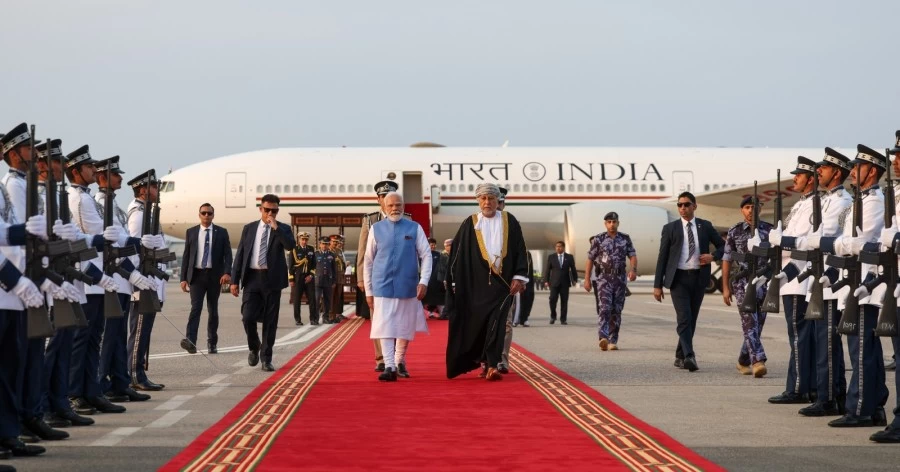
Prime Minister Narendra Modi's visit to Muscat culminated in a significant milestone today as India and Oman formally signed a Free Trade Agreement (FTA). The Prime Minister held extensive bilateral discussions with Sultan Haitham bin Tariq, reinforcing the deep-rooted strategic partnership between the two nations. This agreement is poised to unlock new avenues for economic cooperation, benefiting a wide array of Indian industries and further cementing India's presence in the Gulf region.
Key Agenda: Free Trade Agreement
The newly signed Free Trade Agreement is a pivotal development in India-Oman economic relations, promising substantial advantages for various Indian sectors. Industries such as textiles, footwear, automobiles, gems and jewelry, renewable energy, and auto components are expected to receive a direct boost. The agreement aims to reduce tariffs and non-tariff barriers, facilitating smoother trade flows and increasing market access for Indian products in Oman. Discussions for this comprehensive agreement had commenced in November 2023, reflecting a concerted effort from both sides to enhance their trade partnership. The successful conclusion of these talks underscores a shared vision for economic prosperity and integration.
Deepening Economic Ties
Prime Minister Modi arrived in Oman's capital, Muscat, on Wednesday evening, where he received a warm reception. He was greeted at the airport by Oman's Deputy Prime Minister for Defense Affairs, Sayyid Shihab bin Tariq Al Said. The two leaders engaged in formal discussions shortly after the Prime Minister's arrival, setting a positive tone for the visit. Deputy Prime Minister Al Said also hosted a dinner in honor of PM Modi, symbolizing the strong diplomatic ties and hospitality. Upon reaching his hotel, Prime Minister Modi took the opportunity to meet with members of the vibrant Indian diaspora, acknowledging their contributions to both nations. The welcome ceremony also featured captivating performances by artists of.
Indian origin, showcasing the rich cultural exchange between India and Oman. India and Oman share solid and growing economic and commercial ties, with India playing a crucial role in Oman's trade landscape. India stands as the fourth-largest buyer of Omani crude oil, having. Purchased approximately 4000 crore rupees worth of crude oil in 2023 alone. Beyond oil, India is also the third-largest market for Oman's non-oil products, which include plastics, rubber-based products, chemicals, and metals.
The bilateral trade volume between the two countries has seen significant fluctuations, reaching $12. 38 billion in fiscal year 2022-23, and standing at $8. 947 billion in 2023-24. India's exports to Oman encompass a diverse range of goods such as rice, machinery, ships, aircraft parts, aluminum products, various food items, fruits, vegetables, spices, tea, coffee, and meat, while conversely, Oman exports crude oil, fuel, urea, chemicals, plastics, cement, and aluminum to India, highlighting a complementary trade relationship.
Strategic Partnership: Logistics Access
A cornerstone of the India-Oman strategic partnership is the unique logistics access. Agreement, making Oman the only Gulf country with such a pact with India. This landmark agreement was signed in 2018 during Prime Minister Narendra Modi's previous visit to Oman, while under this accord, the Indian Navy and Air Force are granted permission to use Oman's strategic ports and military bases. A particularly vital aspect of this agreement is India's logistical access to the Duqm Port. Situated on a critical maritime route in the Arabian Sea and the Indian Ocean, Duqm Port offers immense strategic advantages. Following the agreement, the Indian Navy can benefit from facilities at Duqm. For refueling, repairs, and supplies for its vessels and military aircraft. This arrangement is instrumental in strengthening regional security, enhancing the monitoring of crucial sea lanes, and bolstering India's strategic presence in the broader Indian Ocean Region, while it also solidifies Oman's position as a reliable strategic partner for India in the Gulf.
Oman's Unique Neutrality
Oman is widely recognized as the most neutral country in the Middle East, a characteristic that defines its foreign policy. Its diplomatic approach is marked by a consistent refusal to openly side with any party in regional disputes, instead favoring dialogue and peaceful resolution. This neutrality is particularly significant in a region often fraught with major conflicts, such as those between Saudi Arabia and Iran, the US and Iran, and the ongoing crisis in Yemen, while oman has consistently chosen the path of negotiation and mediation. It's one of the few nations that maintains strong relations with both the United States and Iran. Notably, Oman played a crucial mediating role in the back-channel discussions leading to the 2015 Iran Nuclear Deal (JCPOA). On top of that, in various regional tensions, including the Yemen crisis, Oman has quietly pursued peace efforts behind the scenes. Despite being a member of the GCC (Gulf Cooperation Council), Oman has deliberately distanced itself from several Saudi-led military operations, particularly refraining from direct military involvement in the Yemen war, unlike many other Gulf states.
A Legacy of Monarchy
Oman stands as one of the world's oldest monarchies, with a centuries-old Sultanate system. The country is governed by a Sultan, and power has been transferred generationally within the ruling family. The roots of Oman's monarchy are traced back to the 18th century when the Al Said dynasty assumed power, while this dynasty has maintained continuous rule since 1744, making it one of the longest-reigning monarchies globally. The current Sultan of Oman is Haitham bin Tariq, who ascended to the throne in 2020, succeeding the long-serving Sultan Qaboos bin Said. Politically, Oman operates as an absolute monarchy, where the Sultan holds ultimate decision-making authority. This stable and continuous system of governance has been a key factor in ensuring political stability within Oman and the broader region.
Ancient Bonds: 5000 Years of Connection
The relationship between India and Oman transcends modern diplomacy, with its origins stretching back an astonishing 5000 years to the era of the Indus Valley Civilization, while historians suggest that the region known today as Oman was referred to as 'Magan' in ancient times. This ancient 'Magan' region served as a significant hub for maritime trade with the Indus Valley Civilization around 3000 BCE. Archaeological evidence strongly supports the existence of extensive sea trade between India and Oman during that period, involving commodities such as copper, stone, pottery, and other goods, while oman was a primary source of copper, which was traded to India and Mesopotamia, while India exported textiles and other valuable items to Oman. This vibrant maritime trade, conducted via the Arabian Sea, played a crucial role in fostering not only commercial but also cultural and social interactions, laying a profound historical foundation for the enduring friendship between the two nations.
