

- India,
- 08-Mar-2026 02:29 PM IST


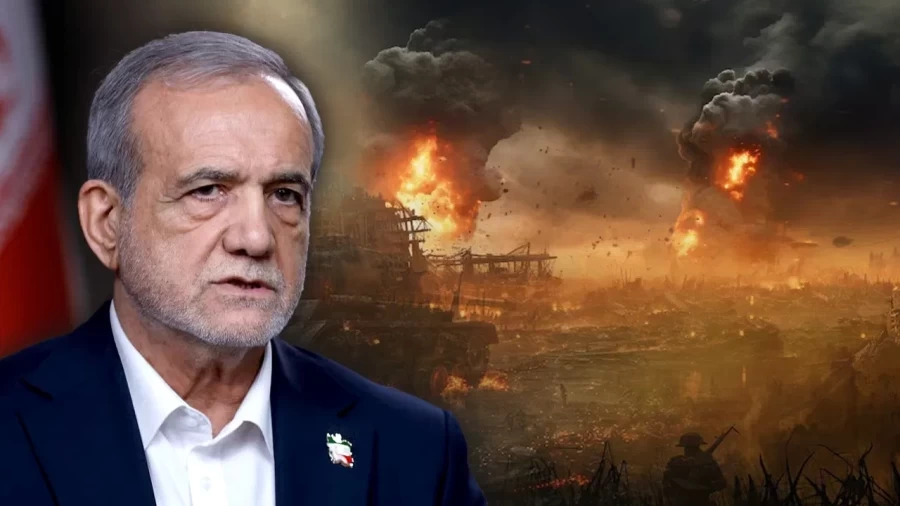
The geopolitical landscape in the Middle East has reached a critical juncture as Iran continues its military operations against neighboring Gulf states, despite a public apology from its President, Masoud Pezeshkian. On the eighth day of the ongoing conflict, drones and missiles launched from Iranian territory were intercepted by the defense systems of Saudi Arabia, Kuwait, and the United Arab Emirates (UAE). This escalation comes at a time when the Iranian leadership had signaled a desire to de-escalate tensions with its immediate neighbors.
Presidential Apology and Strategic Conditions
In a televised address on Iranian state media, President Masoud Pezeshkian issued a formal apology to neighboring countries affected by Iranian strikes. He clarified that Tehran's primary objective wasn't to target sovereign neighbors but to strike locations housing American military assets. Pezeshkian stated that the Interim Leadership Council had reached a consensus to halt strikes on neighboring nations provided their airspace or territory isn't used as a launchpad for attacks against Iran. However, the President maintained a firm stance, asserting that Tehran wouldn't surrender its strategic interests under external pressure.
Escalation Following Israeli Strikes on Oil Infrastructure
The conflict intensified Notably following a series of Israeli airstrikes targeting strategic locations within Iran. Among the most severe was an attack on a major oil depot in Tehran, which caused substantial damage. In direct retaliation, officials from the Islamic Revolutionary Guard Corps (IRGC) announced that they had targeted the Haifa oil refinery in Israel. While Iran maintains that its responses are calibrated against Israeli infrastructure, the trajectory of these projectiles has repeatedly crossed into the defensive zones of Gulf nations, prompting immediate military responses from regional powers.
Donald Trump Claims Diplomatic Victory
Former US President Donald Trump has weighed in on the situation, claiming credit for what he describes as Iran's weakening position. In a series of statements on social media, Trump asserted that Iran is currently facing unprecedented defeat. He characterized the apology from the Iranian President as a sign of surrender, attributing this shift to the sustained military and diplomatic pressure exerted by the US and Israel. Trump claimed that Iran, which once sought to dominate the Middle East, has now been reduced to a defensive posture, marking a significant shift in regional power dynamics.
Regional Defense and Interception Reports
Military authorities in Saudi Arabia, Kuwait, and the UAE have reported multiple successful interceptions of Iranian-origin drones and missiles over the past 48 hours. These defense operations highlight the persistent threat felt by Gulf nations despite diplomatic overtures from Tehran. According to security officials, the continued launches suggest a potential disconnect between Iran's political leadership and its paramilitary wings, such as the IRGC. The high state of alert across the Persian Gulf remains in effect as regional actors monitor the flight paths of incoming projectiles.
Current Security Status and Strategic Implications
The direct confrontation between Iran and Israel has created a volatile environment for the entire Middle East. While President Pezeshkian’s apology was seen as an attempt to isolate the conflict with Israel from broader regional relations, the ongoing military activity suggests otherwise, while international observers are closely monitoring the situation as Israel threatens further strikes on Iranian soil. The contradiction between Tehran's diplomatic rhetoric and its military actions continues to fuel uncertainty regarding the long-term stability of the region's energy corridors and sovereign borders.
