
- India,
- 26-Oct-2026 05:35 PM IST



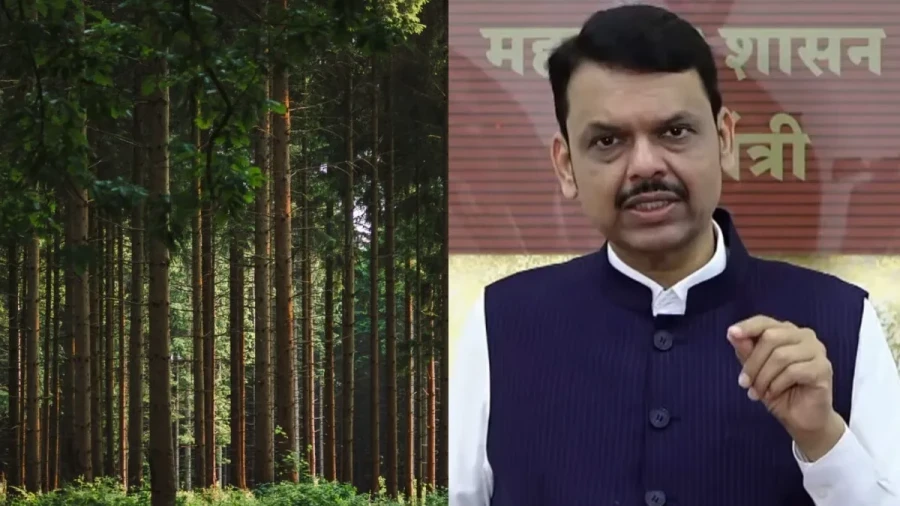
A massive political controversy has erupted in the Raigad district of Maharashtra over a major power project, sparking intense debates across the state. The primary reason behind this fierce dispute is the planned felling of over thirty-two thousand trees, prompting opposition parties to launch a united front against the state government. In response to the escalating uproar, Chief Minister Devendra Fadnavis has stepped forward to present the government's official stance, dismissing all allegations leveled by the opposition and emphasizing that the project is completely eco-friendly and vital for securing clean energy resources for the future. The proposed project is slated to come up in the forested area near Karjat in the Raigad district, positioned strategically between Pune and Raigad. The project site is located approximately twenty kilometers away from the revered Bhimashankar Jyotirlinga and about sixteen kilometers away from the dense Bhimashankar forest. For the implementation of this ambitious initiative by Torrent Power, two hundred and fifty-three acres of forest department land have been officially allocated, with the primary objective of generating three thousand megawatts of electricity.
Felling of Trees and United Opposition Protests
The allocation of two hundred and fifty-three acres of land for Torrent Company's three-thousand-megawatt power project involves clearing thousands of trees to pave the way for infrastructure development, while when public information revealed that more than thirty-two thousand trees would face the axe for this venture, political circles immediately witnessed a sharp outburst of opposition. Prominent opposition factions, including the Congress party, Uddhav Thackeray's faction of the Shiv Sena, Sharad Pawar's Nationalist Congress Party, and Raj Thackeray's Maharashtra Navnirman Sena, have strongly registered their vehement opposition to this move. Opposition leaders argue collectively that while they aren't fundamentally against the concept of development, destroying lush green forests and sacrificing thousands of trees in the guise of developmental progress is entirely unacceptable. The Congress party has formally demanded that if the construction of this power project is genuinely indispensable, the government must relocate it to an alternative site where the damage inflicted upon local forests and native trees is kept to an absolute minimum. On top of that, the Maharashtra Navnirman Sena has issued stern warnings of launching aggressive street-level agitations to counter the project.
MNS Chief Raj Thackeray's Proposed Visit and Shiv Sena Stance
Senior Maharashtra Navnirman Sena leader Sandeep Deshpande has also voiced strong disapproval against decisions that cause irreversible harm to the environment, while earnestly appealing to the general public to raise their voices collectively on this critical issue. MNS chief Raj Thackeray is scheduled to visit the project site personally on the twenty-eighth of October to inspect the ground realities. During this high-profile visit, he will interact directly with local villagers and address a public gathering to rally local support. Meanwhile, Uddhav Thackeray's Shiv Sena has also lambasted the state government over the clearance granted to this contentious project. The unified question posed by all opposition parties is that when both the nation and the global community are incessantly preaching the vital importance of environmental preservation, afforestation, and planting more trees, how can the government grant official permission for the mass destruction of tens of thousands of mature trees, while opposition leaders have strongly asserted that the government must conduct a comprehensive review regarding the actual necessity of the project and its adverse environmental impacts, keeping the genuine welfare of local residents and ecological concerns at the forefront.
Chief Minister Devendra Fadnavis Clarifies and Defends the Project
Countering the relentless barrage of criticism and allegations from the opposition camp, Maharashtra Chief Minister Devendra Fadnavis has clarified the state's position and strongly accused opposition leaders of intentionally spreading misinformation and false narratives among the general public. The Chief Minister firmly maintained that this project isn't designed to inflict any harm upon the delicate ecology, but rather to aggressively promote clean energy and sustainably meet the escalating energy demands of the state. According to official government data and assertions, this project will generate a massive three thousand megawatts of electricity, which will play an instrumental role in providing uninterrupted power supply to burgeoning industries and ordinary citizens alike, while simultaneously generating substantial employment opportunities. Chief Minister Fadnavis highlighted that if an equivalent amount of electricity were to be produced through conventional coal-based thermal power generation, the resulting environmental pollution would reach dangerously alarming levels, while the core rationale presented by the government is that utilizing a pumped hydro storage project successfully bridges energy deficits while Importantly contributing to pollution reduction.
Three Major Benefits of the Project Outlined by the Chief Minister
Chief Minister Devendra Fadnavis elaborated upon the far-reaching and critical benefits of the project by highlighting three key points during his address, while he first emphasized that this three thousand megawatts of electricity, which is being acquired purely in the form of clean energy, would otherwise have to be substituted with thermal power generated from coal if this project is abandoned. Contemplating the sheer magnitude of pollution generated by three thousand megawatts of thermal power, he noted that neutralizing that volume of pollution would require planting twenty-seven crore fully grown trees. Fully developed twenty-seven crore trees would need to be planted if we were to counteract that specific level of environmental pollution. In essence, the exact volume of pollution neutralized by twenty-seven crore trees is precisely the amount of clean energy we're producing through this sustainable project.
Continuing his comprehensive explanation, the Chief Minister pointed out a second crucial factor concerning harmful emissions, stating that generating three thousand megawatts through thermal power produces greenhouse gas emissions equivalent to running forty lakh vehicles simultaneously on public roads. This project effectively mitigates and eliminates that massive emission footprint. The third and final point highlighted by the Chief Minister pertained to water consumption; if the identical quantum of electricity were procured from traditional thermal power plants, it would consume an astronomical nineteen billion cubic feet of water. This staggering volume of water is sufficient to satisfy the annual water requirements of approximately four lakh people, while this precious water resource would have to be continuously drawn and consumed annually for power generation, which will now be entirely conserved through the implementation of this innovative hydro storage project.
Promise to Plant Three Times More Trees on Triple Land Area
Concluding his detailed remarks, Chief Minister Devendra Fadnavis reiterated that, viewed comprehensively, this venture is an exceptionally eco-friendly and strategically crucial project for the state of Maharashtra. The proposed site is located sixteen kilometers away from the Bhimashankar forest and twenty kilometers away from the revered Bhimashankar temple. Plus, the entire financial investment is being injected directly within Maharashtra, employment is being generated locally within the state, and the first right over the generated energy rests unequivocally with the people of Maharashtra. Because of this, this project is indisputably indispensable for the future progress of Maharashtra. In contemporary times, industrial growth is expanding at an unprecedented scale across the state, necessitating massive energy reserves to sustain their operations smoothly. To fulfill this demand, we require absolute clean energy that doesn't emit pollutants. Nonetheless, the opposition is deliberately orchestrating a misleading narrative to obstruct this crucial undertaking.
The Chief Minister further announced that the Torrent Company will be mandated to provide three times the land area utilized for the project and plant three times the number of trees in compensation. According to official government claims, there is a structured plan in place to plant approximately ninety thousand new saplings, while however, despite these assurances regarding compensatory afforestation and the preservation of existing wilderness, skepticism and intense public debates persist. The political atmosphere in Maharashtra remains deeply charged over this high-stakes Raigad project. While the state administration champions the initiative as an absolute prerequisite for clean energy and sustainable future development, opposition parties remain fiercely steadfast in their protest against the mass felling of over thirty-two thousand trees. Following the scheduled visit of Raj Thackeray on the twenty-eighth of October, political momentum surrounding this contentious issue is anticipated to escalate further. Currently, the entire political spectrum and the citizens of the state are keenly observing what definitive steps the state government will take to strike a harmonious and sustainable balance between developmental progress and environmental conservation.