
- India,
- 23-Oct-2026 05:38 PM IST



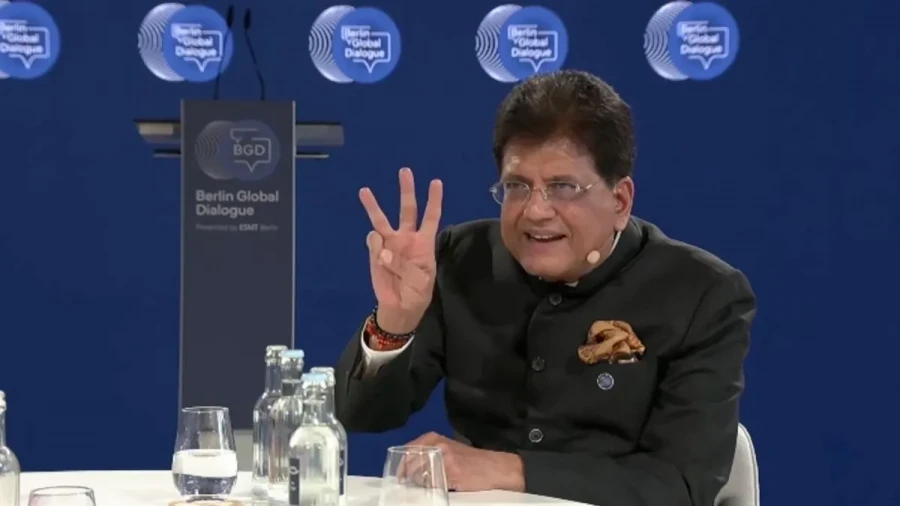
Union Minister for Commerce and Industry Piyush Goyal launched a scathing attack on developed nations during the Berlin Global Dialogue held in Germany, exposing their failure on the crucial climate fund front. The wealthy nations, which hold a major responsibility for global pollution, are now shamelessly backing out of their longstanding promises to assist developing nations. Highlighting this grave injustice at a prominent international platform, the Union Minister gave a befitting response to the developed world, raising the fundamental question of who will ultimately bear the responsibility for this unfolding global crisis.
Who is primarily responsible for the grave problem of climate change, and who is going to pay the heavy price to combat its disastrous consequences, while india once again cornered the developed nations on this critical question before the global community. During this high-level dialogue event in the German capital of Berlin, Piyush Goyal pulled no punches against wealthy countries, stating that the solemn promises made to provide financial assistance to developing nations for tackling climate change have not been fulfilled to date. He raised sharp questions, asking why developed countries, which have a major historical role in causing pollution, are now shying away from shouldering their responsibilities when the actual time for action has arrived.
Piyush Goyal forcefully raised the sensitive issue of the climate fund during a roundtable discussion at the Berlin Global Dialogue. He reminded the gathering that during the Paris Climate Conference held in the year 2015, developed countries across the globe had made a firm commitment to help developing and least developed nations tide over this crisis. Under this framework, a target was set to mobilize one hundred billion dollars, or 100 billion dollars, in annual climate assistance to be provided to needy nations. According to Goyal, a full 11 years have passed since this major promise was made, yet developing nations have not received any real benefit from it, not even a single penny. He explicitly stated that all these commitments have remained confined merely to paper with no ground reality. He also raised sharp questions regarding the European Union and its Carbon Border Adjustment Mechanism, known as CBAM, expressing deep concern over its impacts.
Massive Gap In Population And Carbon Emissions
During his address and discussions, Piyush Goyal meticulously highlighted the vast differences between India and Europe regarding total population and per capita carbon emissions. Citing clear statistics, he pointed out that India alone accounts for about 17 percent of the global population, yet its contribution to total global carbon emissions remains Notably below 3 percent. He also emphasized that the level of per capita carbon emissions in various European countries is vastly higher compared to India, making them the primary contributors, while according to Goyal, developed nations reaped massive benefits from decades of relentless industrial development, but now when the real challenge of combating climate change faces the world, they're stepping back from providing essential economic and advanced technological assistance to developing nations.
4 billion people, while simultaneously ensuring the absolute security of the nation. Despite these immense internal challenges and hurdles, India has been working extremely rapidly and effectively in the domain of clean energy and green power. He once again strongly emphasized that to tackle climate change successfully, developed nations must step forward and fulfill their historical responsibilities with absolute sincerity. His clear assertion was that developing countries must receive adequate financial and infrastructural support to rapidly reduce their carbon emissions and adopt clean energy pathways.
Bilateral Discussions And Trade With Knauf Group
During his crucial visit to Berlin, Union Commerce and Industry Minister Piyush Goyal didn't restrict his engagements to global forums alone; he also held high-level meetings with prominent international business leaders, while continuing this diplomatic and economic outreach, he held a significant meeting with Murat Akyildiz, Global General Partner at Knauf Group. During this special interaction, extensive discussions were held regarding the expansion of the company's manufacturing footprint within India. On top of that, both sides held meaningful deliberations on ways to foster the production of sustainable construction materials in India and enhance mutual cooperation for the development of modern national infrastructure. This visit thus proved highly significant on multiple fronts, advancing India's economic interests and its persistent demand for global climate justice.